Konkuk University, Seoul · October 5–7, 2016

Natural Science Farming Symposium 2016

A day of talks in Seoul, then two days on the farms. 23 talks, three languages. Master Cho's students from ten countries showed what natural farming did on their fields, from Afghan potatoes to Hawaiian macadamias. Every talk is translated, checked line by line, and boiled down to what was tested and what happened.

Read what it all adds up to →

Also on the record: Hilo 2015

Topics microbes soil economics pigs poultry rice history corn food scale disease feed health minerals protectors reproduction Clear

9 talks on “economics”

Chris Trump ·United States (Hawaiʻi) ·14 min

800 Acres of Macadamia on KNF for $21 an Acre a Year

Chris Trump, who farms 800 acres of macadamia nuts in Hawaiʻi with his family, reports six years of feeding the whole orchard with natural farming only. He says the full program, labor included, costs $21 per acre per year, and that 98% of diseased trees recovered. He also explains why he moved from huge solid Microbes (IMO4) piles to a sprayed liquid Microbes (liquid IMO) program after a storm hit a 50-ton pile.

Found Whole nutrition program costs $21 per acre per year

disease economics macadamia microbes orchard scale

Joe McGinn ·United States (Hawaiʻi) ·25 min

100 Pigs, No Bought Feed: Oʻahu's Natural Farming Network

Joe McGinn tells how a natural farming support network grew on Oʻahu in the five years after he trained with Dr. Hoon Park and Master Cho in 2011: shared classes, hands-on input making, a 2013 Hawaiʻi symposium, and whole families on the farm. His own farm keeps about 100 pigs, two dozen chickens and six goats on no bought feed, using brewery spent grain treated with natural farming inputs. He also names the hard parts: few trainees keep farming, there is not yet enough product for market, and classes don't pay for themselves.

Found About 100 pigs, two dozen chickens and half a dozen goats on no bought feed

community economics feed history microbes pigs

Juju C. S. Wang ·Taiwan ·14 min

Lotus Trusts and Sparrow Rice: Natural Farming as a Movement

Juju Wang, a professor at National Tsing Hua University, argued that natural farming in Taiwan should be run as a social movement and spread through 'social design': projects that make taking part easy and fun. He showed examples, including a two-acre lotus farm kept by 287 trustees who pay about US$100 a year, rice brands built around sparrows and the endangered leopard cat, school gardens, two university farmers' markets, and vegetable bouquets at graduation. He gave no figures on how much these projects changed farm incomes or land use.

Found Lotus farm trust: 287 trustees pay NT$3,000 (about US$100) a year

economics education markets rice social movement wildlife

Teruhiko Sawamura ·Japan ·23 min Spoken in Japanese

Kumamoto Grower: Wild-Grass Compost Cut Tomato Wilt

Teruhiko Sawamura grows organic greenhouse tomatoes in Shiranui, Kumamoto, using natural farming he learned from Master Cho. He builds soil with riverbank reeds and grasses aged three years into low-nitrogen compost, plus home-made bokashi made on a clay floor, and sprays a home-made plant extract with brown rice vinegar and seawater. He reports much less bacterial wilt, organic tomatoes shipped in the scarce autumn season from ten years of his own saved seed, and support from the Kumamoto governor after the 2016 earthquake. It is a farm report with photos; no trial data were shown.

Found Bacterial wilt of tomato dropped a great deal

cleanser disease economics food minerals rice

Son Sung-kyu ·South Korea ·10 min

Mindanao Rice Farmers Took Up Cho's Method, Now Export Rice

A Korean pastor who served in the Philippines from 1991 to 2013 contrasts chemical and natural farming on two slides of paired words, then shows a pig pen and a duck-and-chicken coop. He says farmers used to chemicals are the hardest to change, even after some 60 conferences. He ends with a Mindanao NGO report: he brought Master Cho in for a three-day seminar, the group spent a year testing natural farming on rice, and he says the farmers now export brown rice.

Found Farmers already used to chemical farming were hard to convert, even after almost 60 conferences

economics history pigs poultry rice soil

Cho Kyung-hoon ·South Korea ·17 min Spoken in Korean

One Korean County Took Natural Farming Rice From 23 to 200 ha

A county extension officer from Gokseong tells how his office moved from organic farming that failed to natural farming under Master Cho, starting in 2009. Natural farming rice in the county grew from 23 ha in 2009 to 200 ha in 2015–2016, with 250 ha expected next. The rest is a photo tour of crops and livestock with field stories, spoken figures and few controlled comparisons.

Found Natural farming rice grew from 23 ha in 2009 to 200 ha in 2015 and 2016

economics health horticulture pigs poultry rice

Chang-pyo Lee ·South Korea ·26 min

Neorganic Rice: Same Yield, Higher Price, Up to 3x Profit

Chang-pyo Lee of World Vision Korea reports on 'Neorganic' farming (natural farming plus no-till, mulch and compost) in World Vision projects in Vietnam, Sri Lanka and Ethiopia. In Vietnam, rice yielded the same as conventional at lower input cost, and a higher selling price gave two to three times the net profit; chicken and herbs also earned more, while lettuce, broccoli and pigs fed no protein earned less. Ethiopian seed potatoes yielded more at all three cooperatives, and Sri Lankan families gained food access and diet diversity, though their yields were not significantly different from non-participants.

Found Vietnam rice: same yield, 11,000 vs 6,500 VND/kg, 2.3–3.3 times the net profit

economics microbes pigs potato poultry rice

Jegatheesary Gunasingam ·Sri Lanka ·20 min

Sri Lanka: Classes Alone Failed, Small Groups Worked

A World Vision Sri Lanka staff member reports on a 2013–2015 project, funded by World Vision Korea and KOICA, that brought natural farming (which she calls 'neo-organic') to 600 farm families in Vaharai, a war-affected coastal division. After a year of training only a handful of farmers had taken it up; small groups, close follow-up and training the government agriculture instructors turned it around. The final evaluation shows wide use of homemade fertilizers and pesticides, more home gardens and water access, and weekly chemical-free vegetable markets, but no yields, costs or incomes.

Found After one year of training, only a few farmers had adopted; both transcripts heard 'only two'

economics health microbes soil training vegetables

Field trip Lee Eun-ha (host), with Master Cho Han-kyu (interpreted by Dr. Hoon Park) ·South Korea ·44 min Spoken in Korean

Hens Eat Fermented Cow Dung on a Pastor's Muju Farm

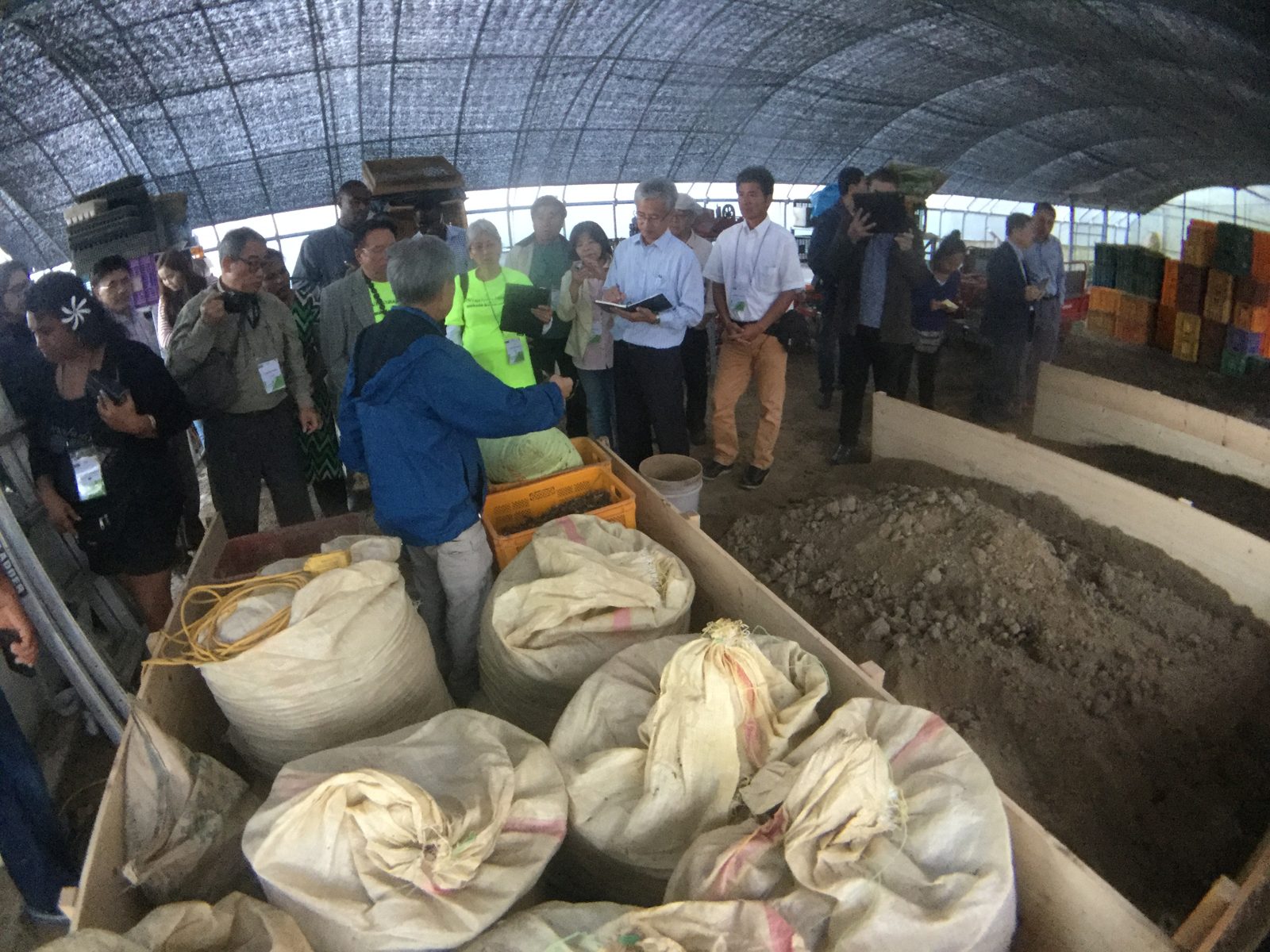
On the evening of October 6, 2016, the group visited a small hen farm next to a country church, run by Lee Eun-ha, the former missionary to the Philippines who spoke on the first day. Master Cho calls it the first place in the world to feed fermented cow dung to hens, inside a closed loop where the farm makes its own feed and fertilizer. The hosts showed chopped green corn stalk fermented for feed, a BMW water tank, IMO4 mixed with a tiller, a feed mixer and fermenting trough, hens on a bare-earth IMO4 floor with no smell, a chili field with soft soil, and a makgeolli insect trap. Laying was about 60% while feed ratios were still being tested.

Found Laying rate about 60%, aiming for 65 to 70%

cow dung economics feed food microbes poultry