Farmers are the masters again.
Three Japanese teachers Cho never met alive. One Korean farmer who put their ideas together and swapped every chemical for something you can make at home. Sixty years later, a room in Hilo on the second Tuesday of every month. This is the family tree.
Before any person
Three teachers, met through their books
Korea
- Janong institute, Goesan
- Master Lee of Muju
- Goseong & Gokseong counties
Family
- Cho Ju-young (CGNF)
- Cho Young-sang (Ultra Low Cost Agriculture)
- MADAJ, open source
The world
- Japan · China · Mongolia
- Philippines · Thailand
- India · Vietnam · Congo
Hawaiʻi
- Dr. Hoon Park · Kim Chang
- CTAHR · CGNF-Hawaiʻi
- Hilo meeting · Pure KNF
Cho didn’t want one heir. “Successor is the institute, and people who join the institute are all successors.” We are one branch of many.
The roots
In 1965 a young Korean farmer went to Japan looking for teachers. The three he wanted were already dead. So he read their books, visited their homes, and learned from the families they left.
“The learning sessions with these teachers became the motherly womb, where today’s Natural Farming was born.”
— Cho Han-Kyu, Natural Farming (2008), p. 7
Oinoue Yasushi
Plants need different food at different ages. His Nutritive Cycle Theory (1936) is the backbone of KNF’s growth-stage schedule. He also bred the Kyoho grape. Cho read his book “more than several dozen times.”
Read more →Yamagishi Miyozo
Design for what the creature needs, not what’s easy for the farmer. His poultry method shaped KNF animal housing. From 1961 young Cho farmed in a Yamagishi-style rural movement back home in Hwaseong.
Read more →Shibada Genshi
Pull the life out of plants with sugar, and ferment it. That’s the grandfather of FPJ. Cho visited his house in October 1965; his widow showed him the cedar barrels.
Read more →And the teachers that weren’t people
Cho always put these first. In 2018 he told a Hawaiʻi class his greatest teacher was God.
Master Cho Han-Kyu
Born in 1935 in Hwaseong, near Suwon. Farm boy. The Korean War took his school years; he joined the 4-H Club at fourteen and finished agricultural high school in his late twenties.
He trained as a county vet and quit. Every sick animal he treated taught him the same thing: don’t fix the disease, prevent it. He spent the next sixty years working out what prevention takes.
His teachers still used chemical fertilizer. Cho didn’t. He replaced every input with one a farmer could make from sugar, rice, fish, bones, weeds and forest soil. That was the new thing. The government didn’t like it.
“In 1967 already, I organized a group of farmers that studied ways for higher yield without using these chemicals. At that time, I was treated as an anti-government criminal.”
— Cho Han-Kyu, Natural Farming (Janong, 2003), p. 3
He kept going. A farming school in Goesan. Books in Korean, Japanese, Chinese, Thai and English. Demonstration farms from Mongolia to Congo. About thirty countries by the end. He tasted the soil wherever he went.
“Inputs are self-made; farmers are once again the masters of farming. Farming should be a tool for living open to anybody including those who have no money.”
— Cho Han-Kyu, Natural Farming (Janong, 2003), p. 3
Korea
Cho started with a study group of farmers in 1967. Of the five who began, he said, he was the last one left. What they built is still farming.
Janong
Cho’s institute. Natural Farming Life School in Goesan, Chungbuk (1994); about 30,000 farmers trained there by 2002. Renamed Cho Han-kyu Global Village Natural Farming Research Institute in 2008.
Master Lee of Muju
Pastor, former missionary, Cho’s “number one disciple.” His no-smell, no-wash piggery in Muju County was the teaching farm for the 2017 international trainings. Since passed.
Goseong County
Under county head Lee Hak-ryeol (2002–2014) it put its rice into Cho-method “Life-Environment Farming.” 160 ha by 2009: costs down 60%, yields up to 20%.
Gokseong County
Home of a Natural Farming Learning Center and host of the 2017 international trainings. Sister city of Hawaiʻi County since 2013.
The world
Cho gave the method away. People told him to sell IMO starter instead. He said it was a gift from the Creator, so it belonged to everyone. Here is where it went.
Japan
Koyama co-wrote Cho’s first English book (1997). Himeno ran the Japanese Natural Farming Association and translated for Cho. Korea–Japan Natural Farming Exchange Association since 1993.
Philippines
Herbana Farms, Laguna. Called the father of Philippine natural farming. Studied with Cho, wrote the widely shared IMO booklet, and taught on the Big Island around 2009.
Thailand
Maejo University, Chiang Mai. Wrote the Thai natural farming textbook. The no-smell piggery Dr. Park saw in Chiang Mai in 2004 led him to Cho.
India
Cho visited Pulicherla, Andhra Pradesh in 2005. Reddy was his first Indian student; her training center opened in 2007.
China
Demonstration farms from 1999 and a research center in Jilin. Cho received Friendship Awards from Jilin Province and Zhengzhou.
Mongolia, Vietnam, Malaysia, Congo
Demonstration farms across Asia, a desert project with nomadic herders in Mongolia (2001), and work with Kinshasa University in Congo.
“Your farm is the university and your crops are your professor and farmers are the students.”
— Master Cho, advanced fruit seminar, Korea 2017 (as interpreted)
How it came to Hawaiʻi
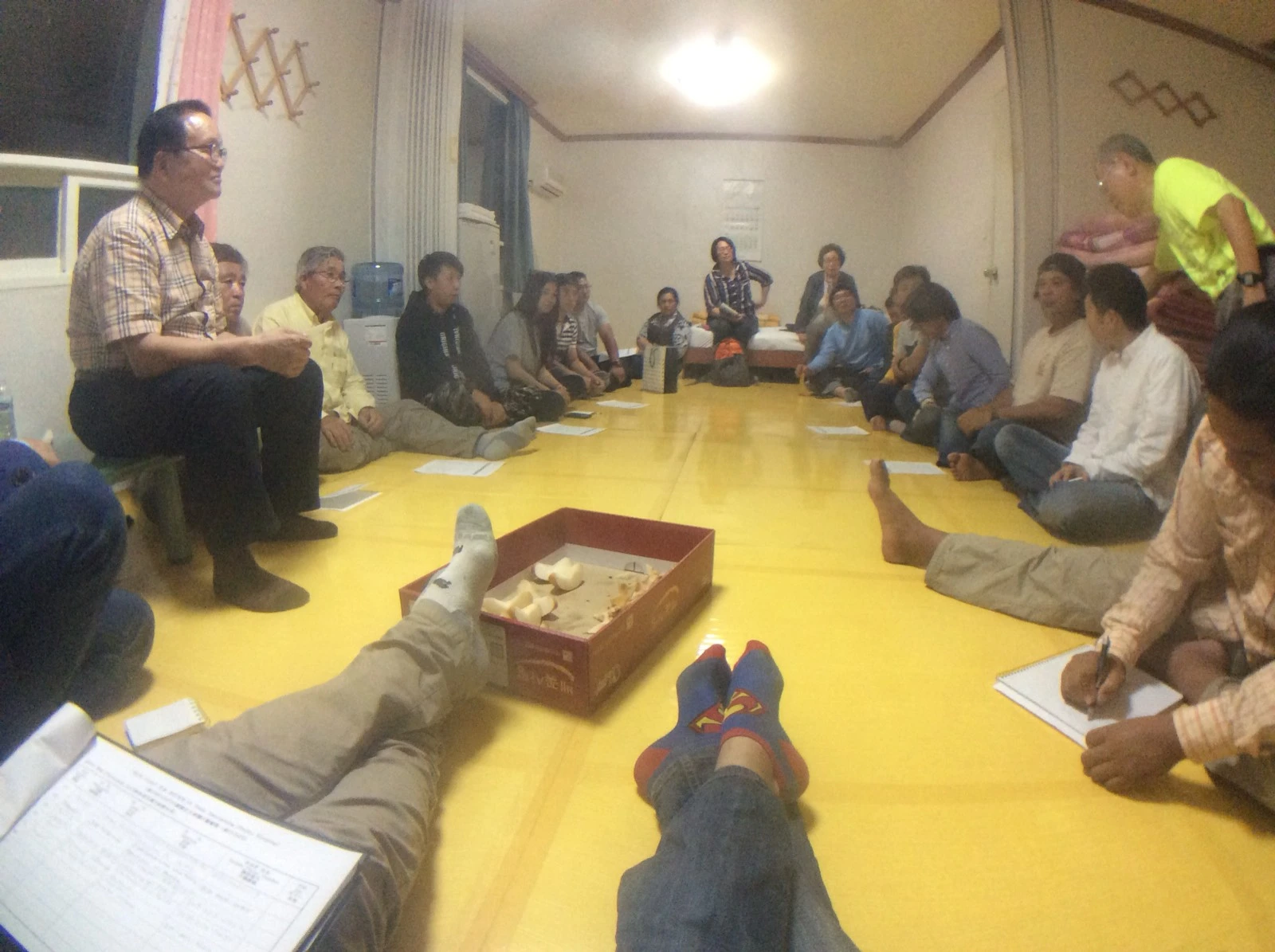
A Hilo pediatrician on a mission trip smelled a pig farm that didn’t smell. He asked why. Someone handed him a book by Cho Han-Kyu. In February 2005 he sat on the floor of a cold Korean schoolroom with 120 people and listened from 7:30 in the morning to 11 at night. Then he invited Cho to Hawaiʻi.
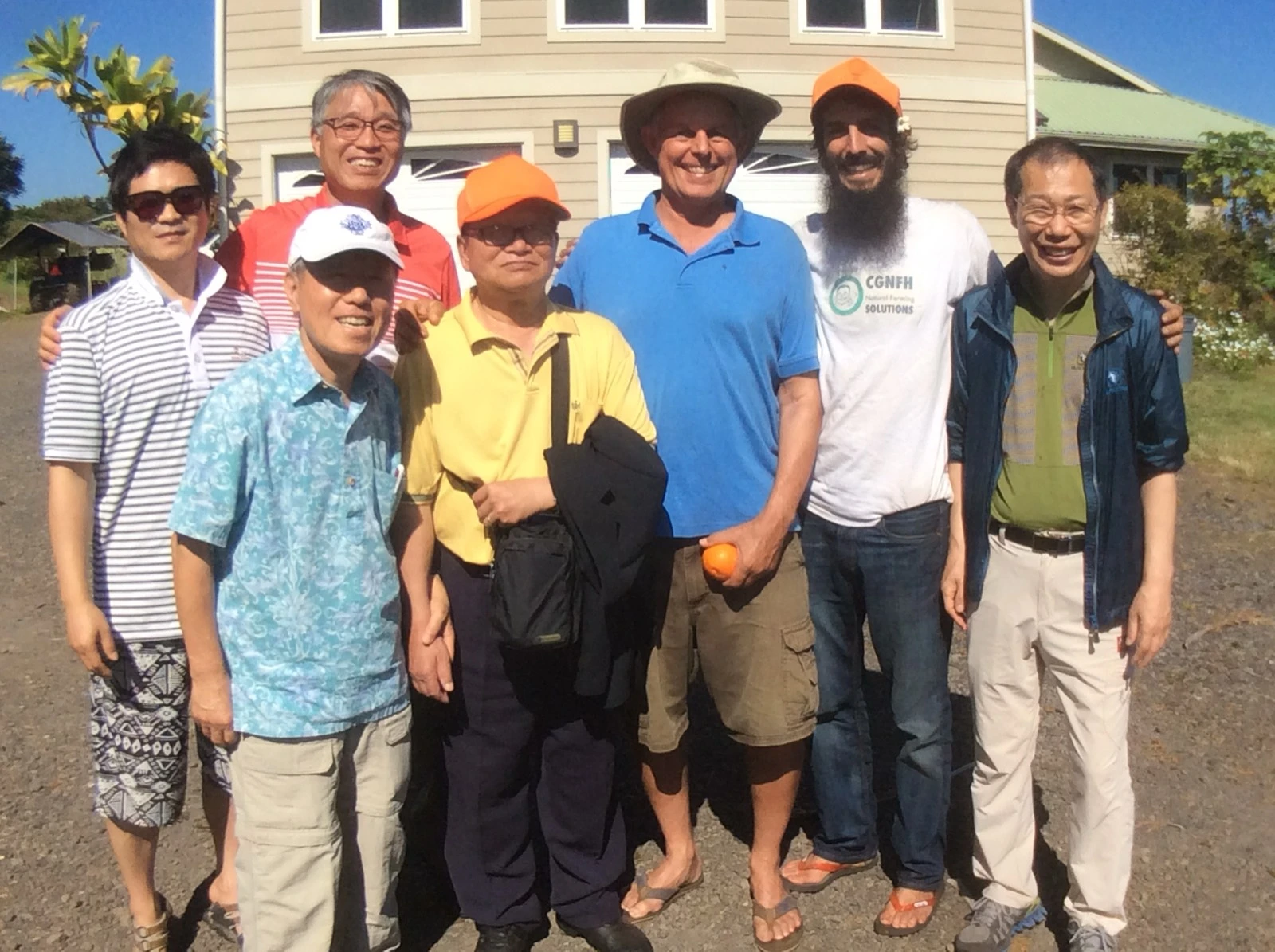
- 2005 Dr. Hoon Park brings Master Cho to Hawaiʻi, his first visit to the United States. About a dozen people come, among them CTAHR’s Mike DuPonte and Dwight Sato. Park translates himself.
- 2006 DuPonte and Sato go to Korea and see the no-smell piggeries for themselves.
- 2008 A week-long seminar at University of the Nations in Kona, students sleeping in the dorms. CTAHR publishes “How to Cultivate Indigenous Microorganisms” (Park & DuPonte). Cho Global Natural Farming USA registers in Hawaiʻi. The Hilo monthly meeting begins.
- 2009 Late October: the first group of Hawaiʻi farmers goes to Korea, hosted by the Gokseong Agricultural Technology Center, with Cho visiting every farm and Park translating. A sign at the learning center: “Welcome, Hawaii natural farmers.” Gil Carandang teaches on the Big Island.
- 2010 Cho teaches big seminars on Oʻahu, in Kohala, and a five-day workshop at UH Hilo. Hundreds turned away.
- 2011 July, Makapala, Kohala. Cho’s five-day course licenses about sixty people to teach, Hawaiʻi’s first teachers. He asks Mayor Billy Kenoi for a learning center in North Kohala; the County funds it, and Pālili o Kohala follows.
- 2013–14 Hawaiʻi County and Gokseong become sister cities. Six CTAHR papers on the core solutions, written by CGNF-Hawaiʻi farmers with UH extension.
- 2015 November: the first County of Hawaiʻi delegation to Gokseong — Council member Dennis Onishi, David Fuertes, Dr. Park, DuPonte, Kim Chang, Chris, David Wong, Drake and others. The gift: a pōhaku kuʻi ʻai, a poi pounder, “to the people of our sister city.”
- 2016–18 Cho’s last teaching years in Hawaiʻi: 2016, Papaikou in 2017 (“about six times visiting in Hawaii”), and Hilo in 2018 (“make 2018 the year Hawaii becomes food self-sufficient”). Hawaiʻi farmers train with him in Gokseong and Muju in 2017.
- 2019 The Pure KNF Foundation is founded as a nonprofit.
- 2021 Weekly Office Hours begin. Now the longest-running KNF teaching program in English.
- 2024 Office Hours works through Ultra Low Cost Agriculture, taught open source as MADAJ: the disgustingly cheap way in, with Master Cho’s methods as the destination.
- 2025 Master Cho dies on 14 January. The second-Tuesday meeting in Hilo keeps going.
“I have to credit my mentor Dr. Hoon Park. If not for Dr. Park, I don’t think any of us would be here right now.”
— Joe McGinn, Cho advanced seminar, 2017
The people who carried it
Cho didn’t speak English. Everything that reached us went through a few patient people who did, and a few farmers who tried it first. This list isn’t finished.
Family
“These are the origins of [Ultra Low Cost Agriculture], in Master Cho’s book. It’s all one. It’s all Korean natural farming.”
— Drake Weinert, Office Hours, 7 Jan 2024
The bridge to Hawaiʻi
Hawaiʻi’s first teachers
Scholars & allies
Master Cho Han-Kyu
“You are the leaders of natural farming. When you go back, be the leaders of your own region. Natural farming is not a finished product. It is always evolving.”
— Master Cho to the international cohort, Korea 2017 (as interpreted)
“You’re here because of him. It’s not unexpected, but it’s like, now it’s our turn.”
— Drake Weinert, Office Hours, 19 Jan 2025
Timeline
Dates we can point to. Where sources disagree, we say so.
- 1892–1952 Oinoue Yasushi. Nutritive Cycle Theory published 1936.Japanese Wikipedia; Kotobank
- 1935 Cho Han-Kyu born 14 February in Hwaseong, Suwon area, Korea.Natural Farming (Janong, 2003) author bio; Cho family memorial video
- 1950 Korean War. Cho, fourteen, joins the 4-H Club.Natural Farming (2008) prologue
- 1961 Joins a Yamagishi-style rural movement in Hwaseong.Cho family memorial video
- 1965 Trains in Japan. Meets his three teachers through their books and families. Visits Shibata’s house in October. Over his life, 60+ trips.Natural Farming (2008) pp. 5–8
- 1967 Founds a farmers’ study group for high yield without chemicals. Treated as an “anti-government criminal.”Natural Farming (Janong, 2003) p. 3
- 1994 Natural Farming Life School opens in Goesan. Natural farming recognized as a legal entity.Cho family memorial; CGNF slides
- 1997 First English book, with Atsushi Koyama.Google Books
- 1999–2002 Demonstration farms in China, Thailand, the Philippines, Malaysia, Vietnam, Mongolia and Congo.Natural Farming (Janong, 2003) author bio
- 2004 Korea’s Stone Pagoda Order of Industrial Service Merit.Korean Wikipedia; Financial News 2009
- 2005 First visit to the United States: Hawaiʻi.Dr. Hoon Park, NF Hawaii meeting 2017
- 2011 First advanced teacher training in the U.S. (Makapala, Kohala).Natural Farming Hawaiʻi; seminar transcripts
- 2017–18 Last international trainings (Gokseong, Muju) and Hawaiʻi seminars.2017–18 seminar recordings
- 2025 Dies 14 January. Spread to about 30 countries in his lifetime.Cho family memorial video; Korean Wikipedia
What KNF isn’t
“Natural farming” is a crowded name. These are neighbors, not ancestors.
Fukuoka’s natural farming
“Do-nothing” farming: no inputs, no tilling. KNF is the opposite — you make a lot of inputs, timed to the plant. Same English words, different thing.
Okada’s Nature Farming & EM
Effective Microorganisms is a bought, standardized mix. KNF microbes are caught locally, from your own forest.
Mountain microorganisms (MM)
A similar Central American practice. No documented link to Cho.
Master Cho in the archive
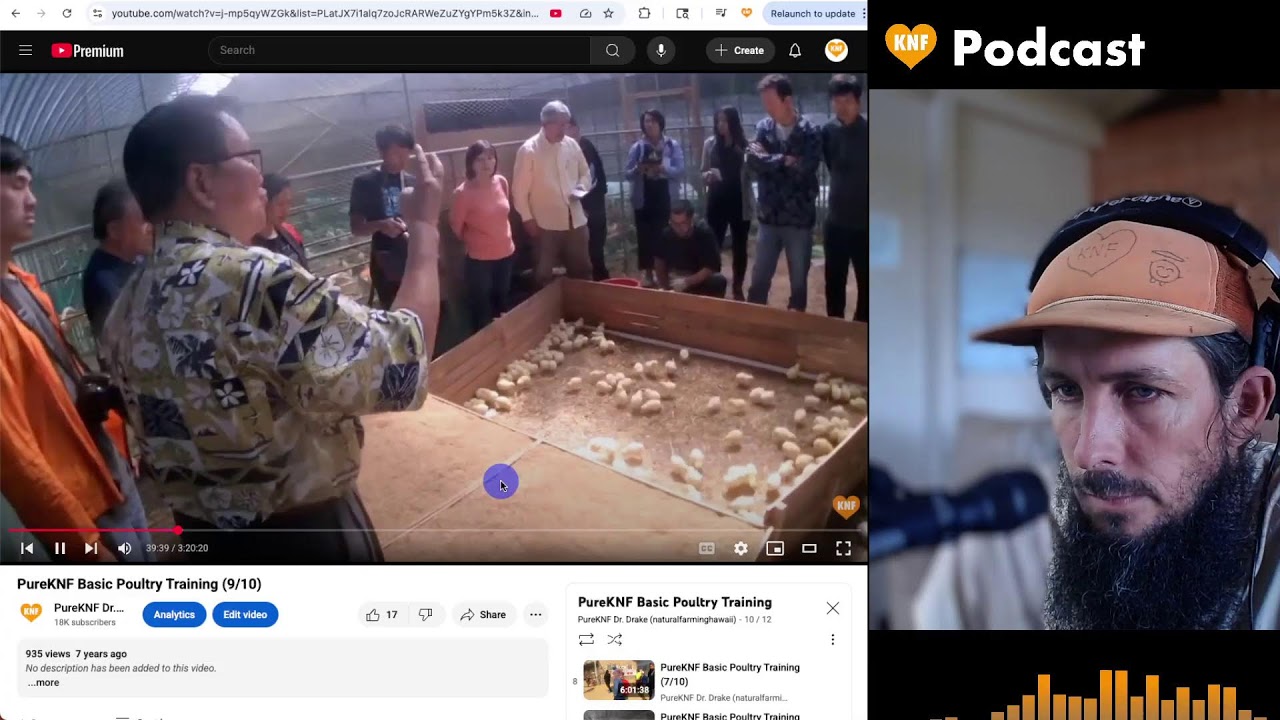
Office Hours episodes where we go back to his seminars.
Search every Office Hours episode →
Were you there?
If you learned from Master Cho, Dr. Park, Kim Chang or any of the people here, we want your story, your photos, and your corrections. This history is still being written down.
Sources
- Cho Han-Kyu, Natural Farming (Janong Natural Farming Institute, 2003), and Natural Farming (CGNF, 2008/2010).
- Master Cho seminar recordings: Hawaiʻi c. 2010, 2016, Papaikou 2017, Korea 2017, Hawaiʻi 2018.
- Dr. Hoon Park at Natural Farming Hawaiʻi meetings, 2017. KNF Office Hours, 2021–2025.
- Cho family memorial video (Cho Young-sang's channel, 20 Jan 2025); Korean Wikipedia, 조한규; Financial News, 1 Jan 2009.
- UH CTAHR publications BIO-9 (2008), LM-23 (2012), SA-7 through SA-12 (2013–14).
- Mayor Harry Kim, letter to Gokseong County (2017).