The short version
- On the same field, natural farming came out ahead. Konkuk's students grew tomato, eggplant and maize three ways: natural, organic and chemical. Natural farming gave the biggest harvest every time, 17 to 32 percent over chemical. On peanuts, farm-made Microbes (IMO4) out-yielded a commercial microbe product (EM) by about half again.
- Every one of those trials was a single season on small plots. Most never wrote down which natural farming solutions went on, or at what strength. That makes them a strong first result, not proof.
- Both dose trials went past Master Cho's usual strengths, and both did best at the strongest dose tried. That was Reproduction (calcium) on potatoes and Fuel (FAA) on rice. Nobody has found the ceiling yet.
- Where farmers made more money, it came from a better price and lower costs, not a bigger harvest. The one project that lost money fed its pigs no protein.
- It spread where someone made it easy. That meant small groups, a county workshop that made the solutions for farmers, and a network that made them together. Classes alone did not do it.
- The field trip showed it on the ground. A county that makes the solutions for its farmers, a missionary's odorless henhouse, and student plots still fruiting in October after the chemical rows had stopped.
- Master Cho's own message was not a technique. "Natural farming is not a technique, it is love." 86 of the 109 points we checked against his books and seminars agree with him. Seven go against him, and those seven are worth a trial.
How much weight each talk can bear
The 24 recordings are not equal. Some are replicated field trials with tables of numbers. Some are a farmer telling what happened on their land. Some are speeches. We sorted them so nobody leans on a story as if it were a trial.
| Kind of evidence | Talks | What you can take from it |
|---|---|---|
| Replicated field trials with tables and significance letters | Tomato, Eggplant, Maize, Peanut, Potato calcium, Rice and Fuel, Rice pest sprays | A direction, with sizes. One season and one site each (Paju; the pest trial also used a farm in Yeoju). |
| Lab and microbe work | Soil disease and microbe counts | Solid on lab biocontrol. Preliminary on natural farming soils, in the speaker's own words. |
| Project monitoring with comparison groups | Vietnam, Sri Lanka, Ethiopia, Sri Lanka | Real farms and real money. One plot per method, or surveys with no stated method. |
| Farm and program reports | Macadamia, Oʻahu network, Kumamoto tomatoes, Poultry feed, Soybean, Gokseong county, Native corn | What works on a working farm, and how big it can get. No controls. |
| Talks, Q&A and ceremony | Master Cho, Website, Taiwan, Mindanao, Pigs and health, Q&A, Closing | Ideas, history and reasons. Read them for why, not for how much. |
Side by side on the Paju farm
From March 2016, Konkuk's master's students, most of them new to natural farming, grew crops at the university farm in Paju, an hour and a half's drive from campus. Four of them compared systems on the same ground.
| Crop | Natural | Organic | Chemical | What else |
|---|---|---|---|---|
| Tomato, marketable kg per plant | 3.80 | 3.42 | 3.12 | First harvest about a week sooner (60.6 vs 67.6 days). Fruit set 82.6% vs 73.0%. |
| Eggplant, marketable kg per plant | 4.08 | 3.56 | 3.1 | Kept longer: 13.6 days to 10% spoilage vs 9.8. Far fewer insects. |
| Maize, dry grain t/ha | 4.8 | 4.3 | 4.1 | A one-week drought after germination wilted 20 of 84 chemical seedlings, against 4 natural and 3 organic. |
| Peanut, kg/ha | 2,816 with solid IMO4 · 2,668 liquid IMO4 · 1,905 commercial EM · 1,675 water only | Far more root nodules, and about 30 times the control's soil microbe count. | ||
| Soybean | Bloomed July 19 vs July 22 (chemical). No yield taken. | Hand weeding against herbicide. | ||
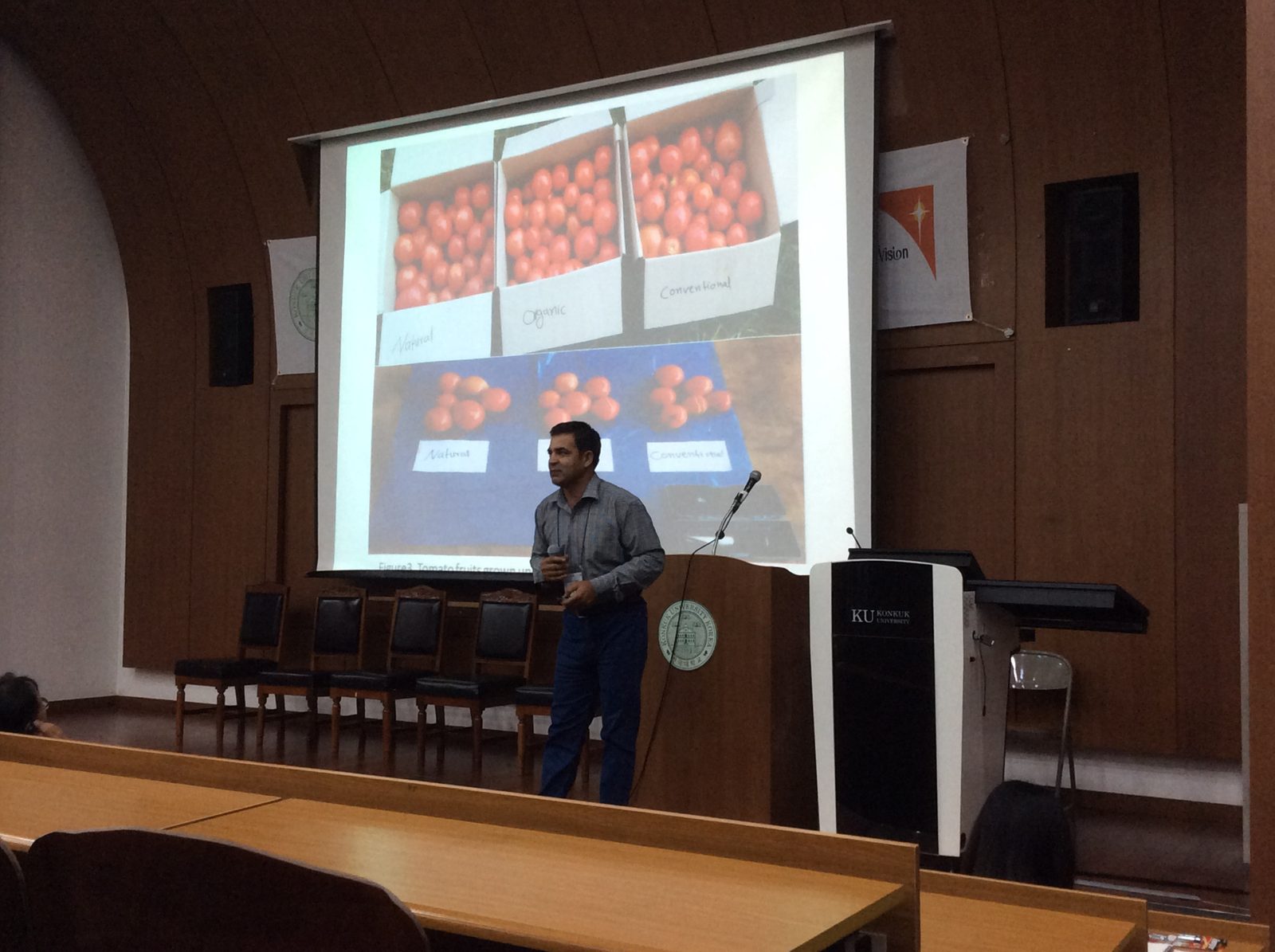
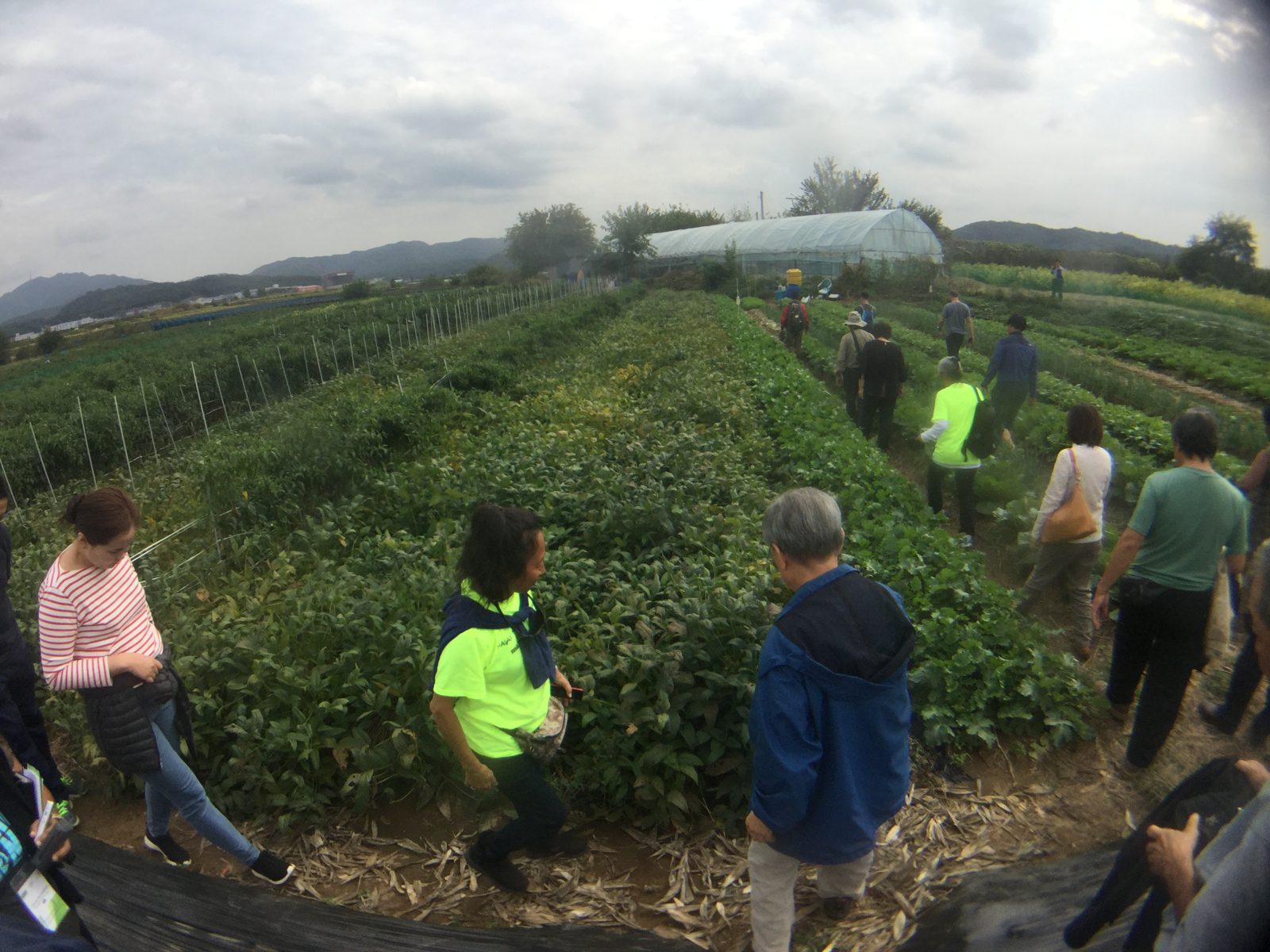
What it adds up to. In all three three-way trials, natural farming gave the biggest harvest: 22% over chemical for tomato, 32% for eggplant, 17% for maize. On peanuts, the two IMO treatments beat both EM and water. The trials also agree on the side effects: fewer insects (tomato, eggplant, maize), better taste scores and keeping quality, and bigger roots. The pattern points the way Master Cho said it would: less nitrogen, fewer pests, more fruit.
Why to hold it loosely.
- One season, one site, small plots (about 20 m² each for tomato and eggplant). Nobody repeated anything.
- The natural plots were fed "by what the plant needed". The tomato and eggplant talks never name the solutions or the rates, so nobody can repeat them exactly.
- The organic and chemical rates aren't given either, so we can't tell whether the chemical plots were farmed well or badly.
- The maize photos seem to show plastic mulch on the organic and chemical rows and straw on the natural rows. That is a second difference besides the inputs.
- Taste, insect and blossom-end-rot scores come without their scales or panel sizes.
The direction is consistent and the gaps are fixable. Repeating these trials, with every input written down, is the cheapest strong evidence natural farming could get.
Strength, timing and route: tests inside natural farming
Three students kept every plot natural and changed one thing. These trials say the most about how to farm.
Reproduction (calcium) on potatoes: the soil beat the leaves
Baryalai Malekzada gave water-soluble calcium ten ways: on the soil, on the leaves, or both, at three strengths.
| Calcium | Yield, t/ha |
|---|---|
| None | 25.03 |
| On the leaves only, weakest two strengths | 27.9 to 28.6 (no different from none) |
| On the soil, strongest (150 ppm, about 1:113) | 40.7 |
| Soil and leaves, strongest | 39.3 |
The soil route gave about 63% more potatoes and the heaviest tubers (112 g vs 77 g). In the Q&A someone asked why he went six to nine times stronger than the usual 1:1000. He said conventional potato studies showed 1:1000 wasn't enough. Master Cho's book has calcium sprayed on the leaves at about 1:1000 once fruit swells. This trial went further on both strength and route, and the soil did the work. One season, four replications. The claim that microbes freed up soil phosphorus is weak: the plots also got calcium phosphate.
Fuel (FAA) on rice: more tillers and roots, unproven grain
Julius Sugue sprayed Fuel at 1:2000, 1:1000 and 1:500 on top of a full natural farming program. At 1:500, rice had 29.1 tillers per hill vs 17.0 with no Fuel, and 180 cc of roots vs 65. It also had the most panicles, 23.6 vs 18.4. But grains per panicle and grain weight did not differ, and no yield per area was taken. Cho's standard is 1:1000. The stronger rate grew a bigger plant; whether it filled more bags is still open.
Timing on corn: up to ten ears on one stalk
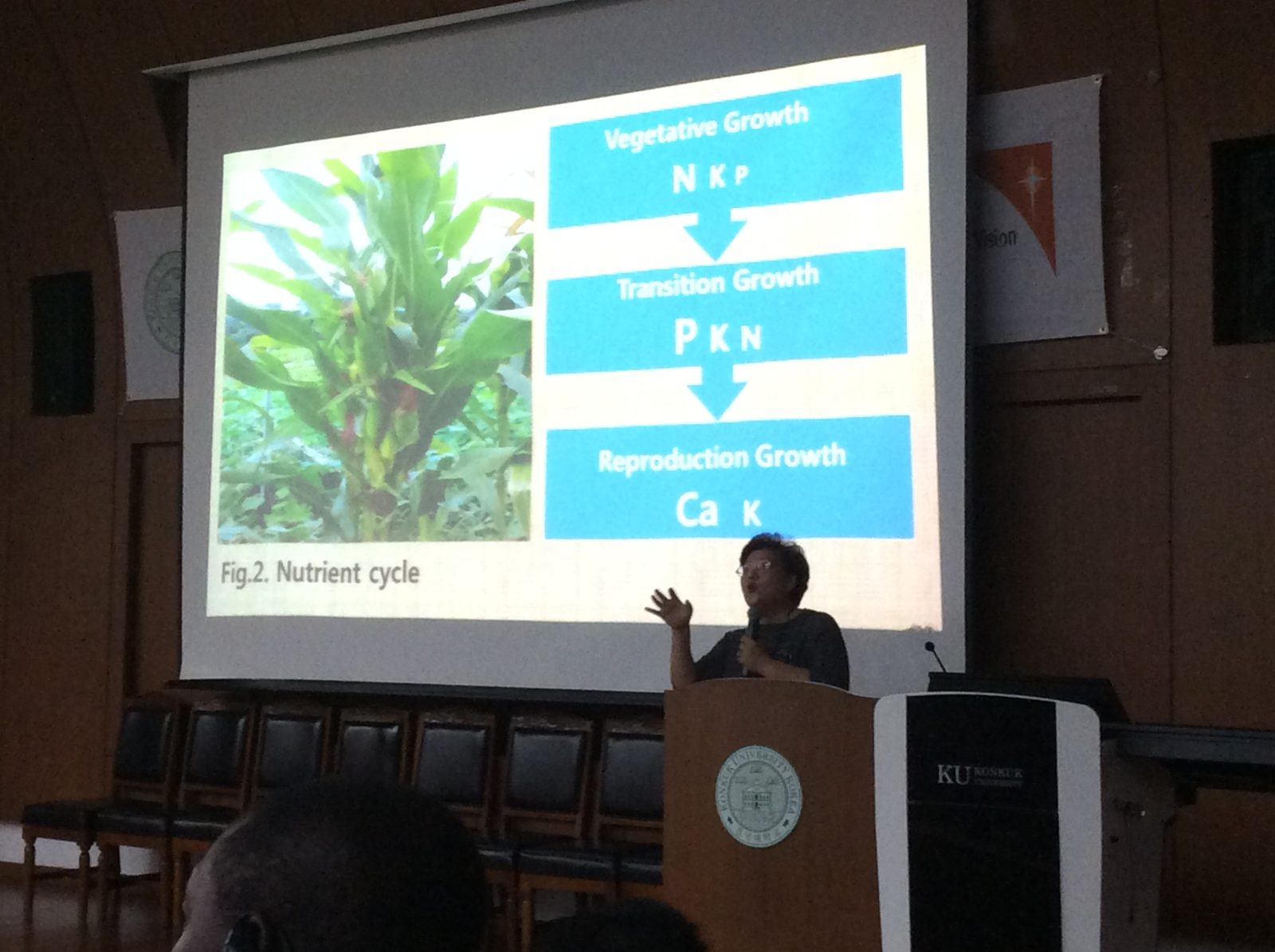
Farmer Kim Eun-ja fed a Korean native corn by growth stage. She used homemade IMO5 batches, one each for nitrogen, phosphorus and potassium. Extra phosphorus went on at the changeover, and nitrogen was cut at tasseling. She had been told this corn sets one ear, two at most. Her video counts one stalk to ten ears, most of them filled. That's one plant, no control and no yields, but it is the clearest picture at the symposium of the nutritive cycle in action. One detail differs from Cho: she put corn's changeover at about six leaves. In his 2017 seminar he says four.
Plant sprays against rice pests
Andrew Lemnsah boiled water pepper, chili, tobacco, lemon peel and neem into sprays. On a chemical farm in Yeoju, water pepper held green grasshoppers and stink bugs about as low as the chemical cypermethrin. It did not hold stem borers, which the chemical did. On the natural farming paddy, every extract cut pest counts while dragonflies stayed. Cho's own line is that it matters more to grow plants pests don't attack. The trial measured killing, not plant health. No grain yield was reported.
What these share. The two dose trials both found their best result at the strongest dose they tried, above Cho's standard. That doesn't mean stronger is better. It means nobody has found where it stops helping, or what it costs. That is the most useful open question in the archive.
Microbes: strong in the field, unclear under the microscope
- In the field, farm-made Microbes clearly mattered. Solid IMO4 out-yielded commercial EM on peanuts (2,816 vs 1,905 kg/ha), with far more nodules and about 30 times the control's soil microbe count (peanut trial). One caution: the IMO4 itself carried a lot of phosphorus (3,075 mg/kg), so microbes and nutrients can't be pulled apart.
- Under the microscope, the picture is murky. Prof. Se-chul Chun counted microbes in the farm's soils and in each step of IMO. Counts fell about tenfold from IMO1 to IMO4 (IMO counts). In his first soil test the natural farming plot had fewer bacteria than the control, and two runs disagreed. He said he couldn't draw a conclusion yet.
- Master Cho told the room what IMO4 is for, and it isn't numbers. Mix IMO3 with soil from the field it will feed, "so the microbes meet cousins and uncles, not rivals" (Master Cho). The tenfold drop at IMO4 may be the price of that, or it may not matter. Nobody has measured what happens after IMO4 goes on the field.
- Lab biocontrol was the cleanest result of the day. A soil bacterium cut pepper root rot from 81% to 22%, and to 6% when it was fed a sugar the disease couldn't use (pepper root rot). That isn't a natural farming solution. But it is the same idea Cho teaches: feed the friendly microbes, and disease loses its foothold.
Scale and money
| Where | What happened |
|---|---|
| Gokseong County, Korea | Natural farming rice grew from 23 ha in 2009 to 200 ha by 2015, with 250 ha planned. The county office makes the solutions for farmers and rents out transplanters. |
| Hawaiʻi macadamia | 800 acres fed for $21 an acre a year, labor included, over six years. The grower's own figures; no yields shown. |
| Vietnam rice | Same yield (6,000 kg/ha). Natural rice sold for 11,000 vs 6,500 dong a kilo, with inputs 6–9% cheaper. That gave 2.3 to 3.3 times the profit. |
| Ethiopia seed potato | More potatoes at all three cooperatives (e.g. 29.0 vs 24.1 t/ha). But those plots also got 16 t/ha of compost and one blight spray. |
| Vietnam chickens and pigs | Chickens made three times the profit. The pigs lost money: they got no protein and sold light. Master Cho says pigs on grain need protein, such as Fuel at 3–5% of the feed. |
| Oʻahu family farm | About 100 pigs, two dozen chickens and six goats on no bought feed, built on brewery spent grain. |

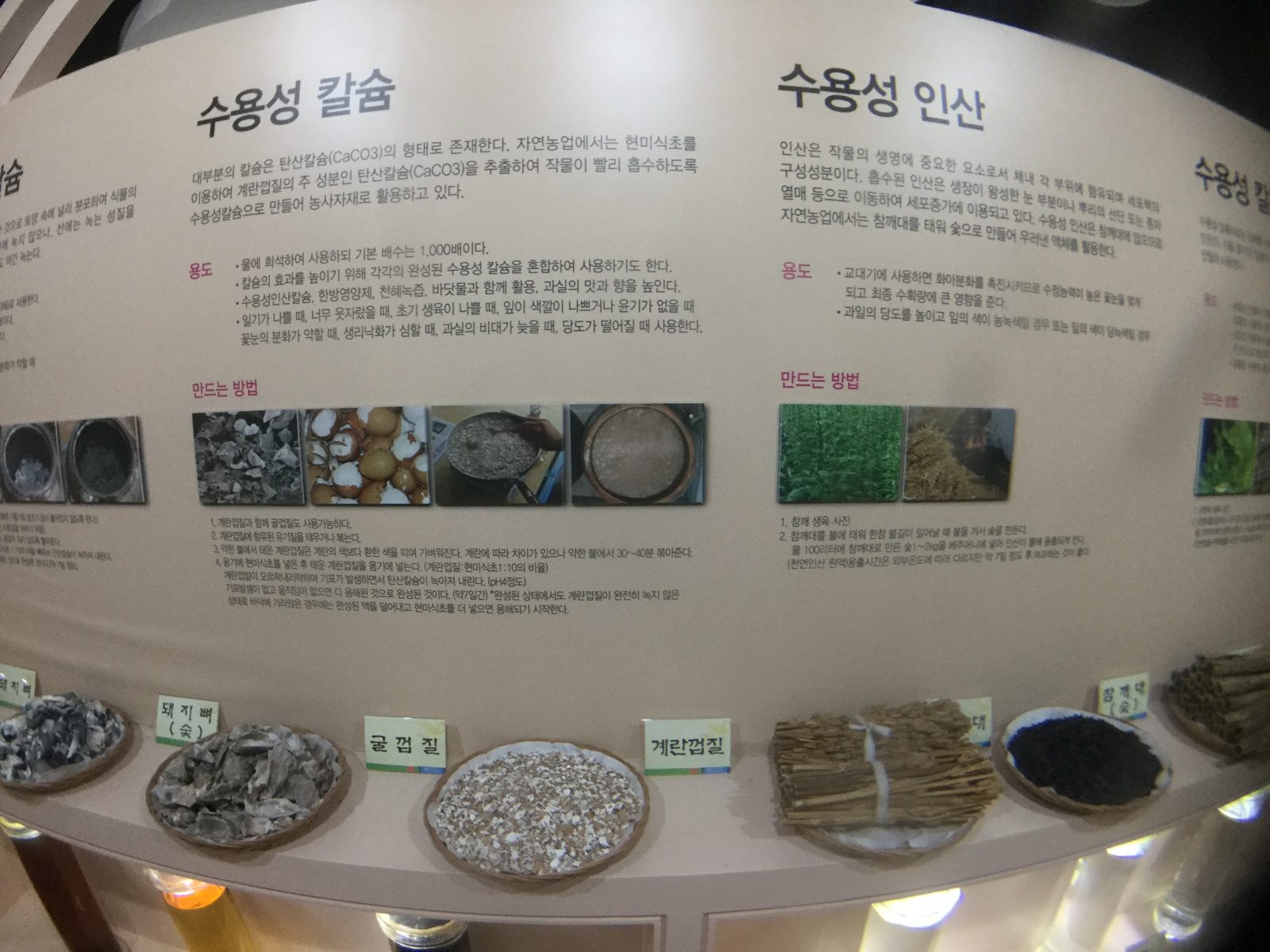
The pattern: the money came from a better price and lower input costs, not a bigger harvest. The hidden cost is labor, in making feed and solutions. Where labor was counted (Vietnam livestock), it ate most of the savings. The premium may not hold once everyone grows natural rice.
How it spreads
- Classes alone failed. In postwar Sri Lanka, a year of training brought only a handful of farmers to it. Ten-farmer groups, key farmers and close follow-up brought most of the 600 families along (Sri Lanka).
- Farmers raised on chemicals are the hardest to move. In Mindanao, almost 60 week-long conferences left many unchanged (Mindanao).
- Make it easy and they come. Gokseong's office makes the solutions and rents the machines (Gokseong). Oʻahu moved classes to hands-on making with whole families. Of the 500 or so people trained on the Big Island, by the speaker's estimate, many did not keep going (Oʻahu).
- Make it something people want to belong to. In Taiwan, 287 people each pay about $100 a year to keep a lotus farm. Others buy rice that shares its field with sparrows or leopard cats (Taiwan).
- People are already looking. A one-person website drew 56,000 visitors through search alone, mostly looking for the odorless pig pen (website).
On the farms: the field trip
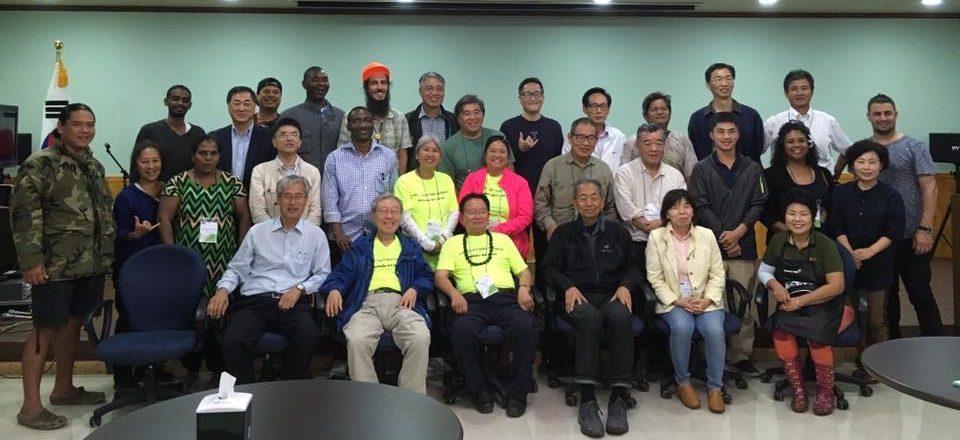
After the talks, the group spent two days on the road. Five stops put farms and faces to what was said in the hall. Like the talks, every stop was transcribed twice, checked line by line and photographed. The recordings will go into the members' archive.
Gokseong: a county that runs it
Talk 17 said Gokseong County makes the solutions for its farmers. The group saw it: an extension center teaching natural farming since 2009, and a mineral-water tank where water drops onto five kinds of stone with a bag of Microbes (IMO4) (Gokseong center). Nearby, a large quail egg farm was building barns for pigs, hens and cows with the county. Its plan is to feed all three from the farm's own waste, about 8 tons of quail manure a day (quail farm). The pens' deep floor is half soil, half sawdust, with salt at 2%. Master Cho's own book gives 10 parts sawdust to 1 of soil and 0.3% sea salt, so that's one to watch.
Muju: the missionary's hens
Lee Eun-ha, whose poultry talk (talk 6) had no numbers, invited everyone to his farm "tomorrow". We matched him by face, by his own invitation, and by equipment from his slides. His hens stood on a bare earth floor treated with IMO4 and gave off no smell. Fermented cow dung went into their feed, which Master Cho called a first. And the number his talk lacked: laying at about 60%, aiming for 65–70% as he kept adjusting the feed (Muju farm).
Master Cho's evening lecture: one IMO4, three IMO5s
After dinner Master Cho taught for an hour and a half, with Dr. Hoon Park interpreting. His point: Microbes (IMO5) aren't one recipe. Start from IMO4 and add what the plant's stage needs: fish for growth, burnt bone in brown rice vinegar for the changeover, eggshell calcium for fruit. He timed calcium phosphate for corn a week before its changeover. Then he named the week's lesson: the corn stalk with ten ears, shown at the symposium, counts for more than report data (the lecture).
Paju: the trial plots in October
On the last day the group walked the plots behind the student talks. In mid-October, Ahmad Jawid Zamany's natural tomato, eggplant and pepper rows were still flowering and fruiting, while the organic and chemical rows had nearly stopped. Buyers in an unlabeled test picked the natural tomatoes (Paju field). Kim Eun-ja showed her first natural year on ground farmed with chemicals for decades. She showed her three IMO5s, nitrogen, phosphorus (rice bran and bone meal) and potassium, and said plainly that she topped up the potassium with bought chemical potash because ash wasn't enough. That differs from Master Cho. It is also exactly the kind of detail a trial needs written down (her recipe).
What the farms add. They show the talks weren't theory: the county program, the odorless henhouse and the October plots were there to walk through. But a field visit is not a measurement. Laying rates, manure tonnage and "no continuous-cropping disorder" are the hosts' own words, and every stop page lists them under "Hold it loosely".
Animals and health
Three talks argued that animals do better without drugs. A Hawaiʻi farm has raised pigs since 2012 with no antibiotics or vaccines and came through two nearby outbreaks (pig farm). A missionary fed chickens grain fermented with soil microbes, and the neighbors called him crazy (poultry). Master Cho's books say the same. But none of these talks had controlled data: no herd sizes, growth rates or disease records. The health graphs shown are correlations. This is the biggest gap between what the movement believes and what was shown.
Next to Master Cho's teaching
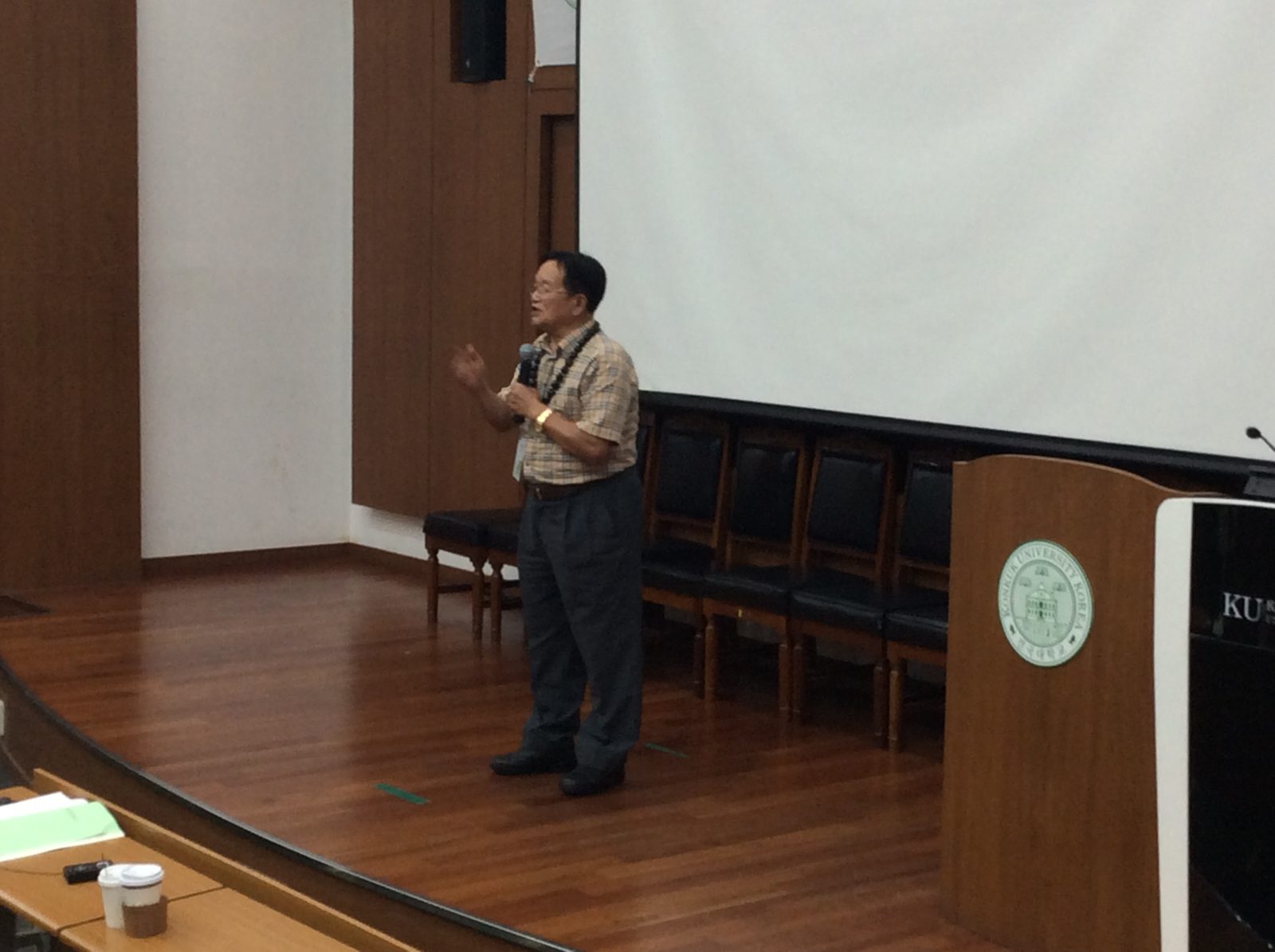
Every talk's main points were checked against Master Cho's books and recorded seminars in the Pure KNF library: 109 points in all.
- 86 agree
- 12 go further than he did
- 7 differ
- 4 can't be settled
Where the talks differ from him:
- Reproduction (calcium) six to nine times stronger than his 1:1000, poured on the soil (Q&A, potato)
- Corn's changeover at six leaves, where he says four (corn)
- About ten rice seedlings per hill, where he plants two or three (rice; the transplanter was set that way)
- Killing pests with sprays, where he would rather grow plants they don't attack (pest sprays)
- Selling direct at farmers' markets; in 2017 he advised Taiwan to sell through partners (Taiwan)
- Calling it "neo-organic"; he draws a hard line between natural farming and organic (Sri Lanka)
- The date his Mindanao work began (Mindanao)
Where they go further:
- Fuel at 1:500 (rice)
- Separate nitrogen, phosphorus and potassium IMO5s (corn)
- IMO4 as a cure for Phytophthora (macadamia)
- 300-plus grains per rice panicle (Gokseong)
- Bokashi made on a soil floor (Kumamoto)
- The first microbe counts through IMO1 to IMO4 (Chun)
- A story of a spring made with bananas in Africa, which we found nowhere else (Master Cho)
Corrections to the record
Checking the recordings line by line changed some things people have repeated for years.
- The corn plant with 13 ears. The farmer's talk shows and says up to ten. The 13 seems to come from a photo Master Cho described in 2017.
- Master Cho's talk is not a history lecture, whatever its upload title says. It is 22 minutes on natural farming as love, told through stories from Kona, China and Africa (Master Cho).
- Names. Several speakers now have their names as written on their own slides: Baryalai Malekzada, Yoo Nam-gyu, Teruhiko Sawamura, Lemnsah Andrew Banboye, Chang-pyo Lee (not "Chan-kyu"), Cho Kyung-hoon of the Gokseong center.
- The odorless pig page was the most-read page on NaturalFarmingHawaii.net, at about 6% of page views, not "about half" as said aloud.
- Machine errors that would have flipped findings: a peanut yield of 2,816 kg/ha heard as "2016"; "calcium" heard as "cancer"; "I grew 25 crops" turned into "I removed 25 crops"; "phosphoric acid" (인산) heard as "greeting" (인사). In all, 284 meaning-changing corrections are listed on the talk pages, and 198 lines we could not confirm are marked.
What to test next
These are the questions this archive raises and can't answer. Each one is a season's work for a careful grower.
- Repeat the side-by-side. Tomato or maize, natural against chemical, two seasons or more, with every solution, strength and date written down, plus the chemical program.
- Find calcium's ceiling on root crops. Reproduction on the soil at 1:1000, 1:300, 1:113 and stronger, against leaf sprays at 1:1000. Measure yield and cost.
- Take Fuel on rice through to the bag. 1:1000 against 1:500 and 1:250, measured as grain per area, not tillers.
- Settle corn's changeover. Phosphorus at four leaves against six. Count ears on every plant, not the best one.
- Split microbes from nutrients. IMO4 against a sterilized IMO4 with the same nutrients, on a legume.
- Feed pigs properly and count. Natural farming feed with a protein source (Fuel at 3–5%), with weights, against bought feed.
- Count microbes the field way. Field-made IMO, replicated, followed into the soil over a season.
You can run any of these and log it in Research. That is what the Research section is for.
Where these numbers come from
Everything here comes from the 24 checked talk records and the 5 checked field-trip stops. Each talk was transcribed twice, the two versions were reconciled line by line, the slides were read off the video, and each point was checked against Master Cho's books and seminars. Nothing was added from outside sources except that comparison with Master Cho. Every link above opens the talk at the minute it was said. Scans of the printed slide handouts will be added when they're digitized, and the numbers marked "about" will be checked against them.