Hens Eat Fermented Cow Dung on a Pastor's Muju Farm
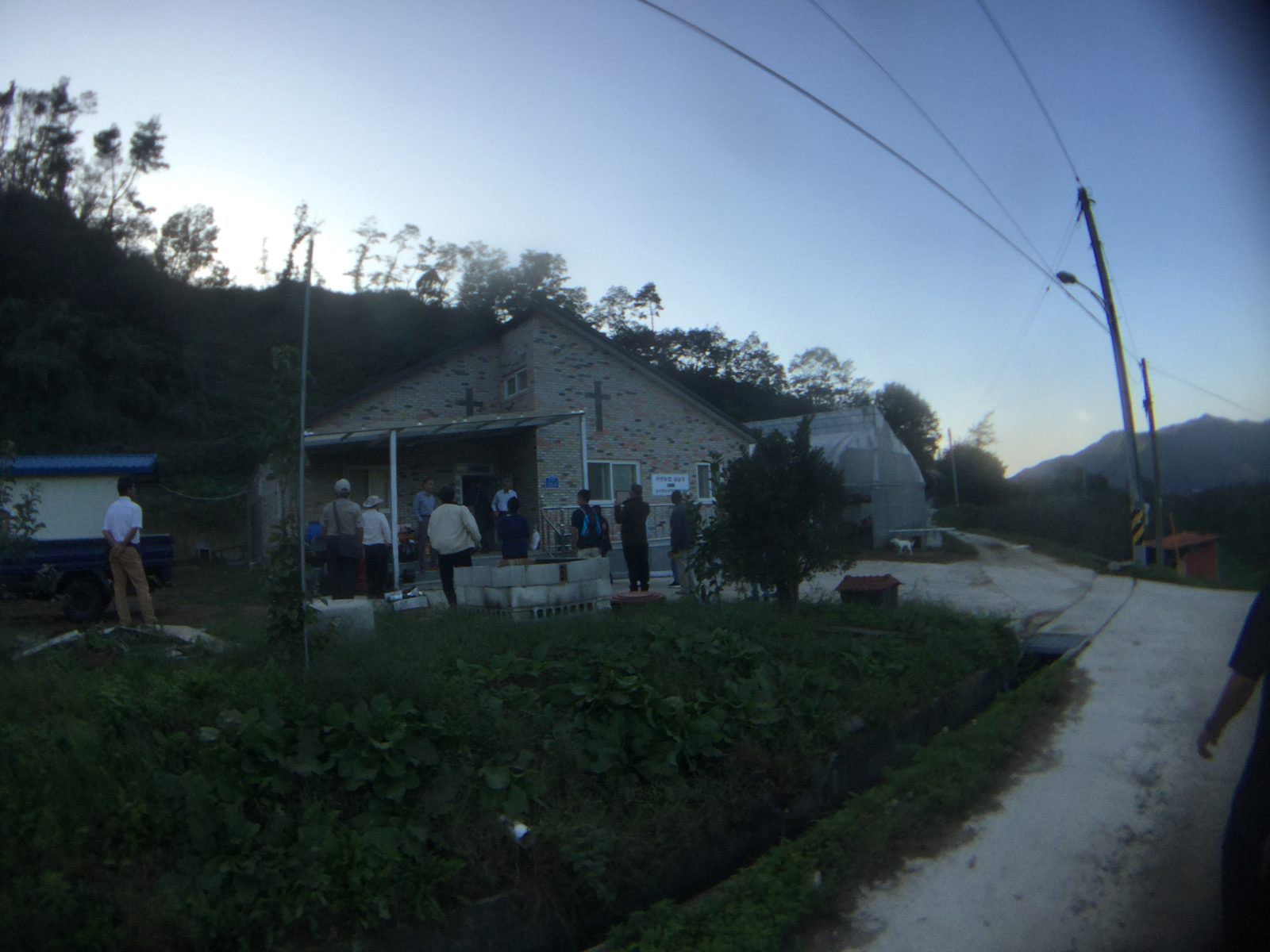
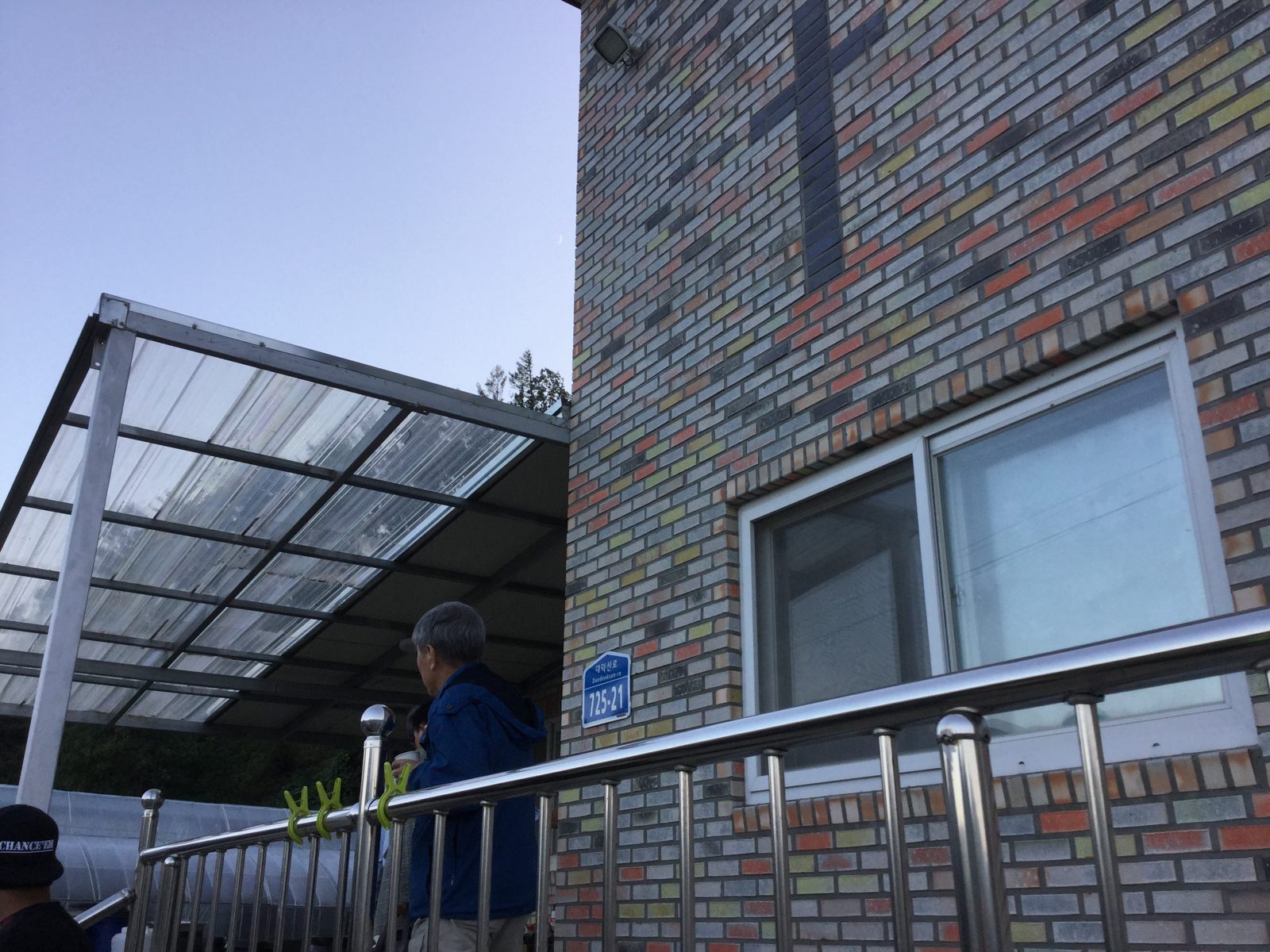
Lee Eun-ha (host), with Master Cho Han-kyu (interpreted by Dr. Hoon Park), Lee Eun-ha's farm beside a small brick church, Daedeoksan-ro, Mupung-myeon, Muju County, North Jeolla · South Korea
Spoken in Korean. Translated to English and checked line by line.
Video of this visit will be added to the members' archive. The transcript times below match that recording.
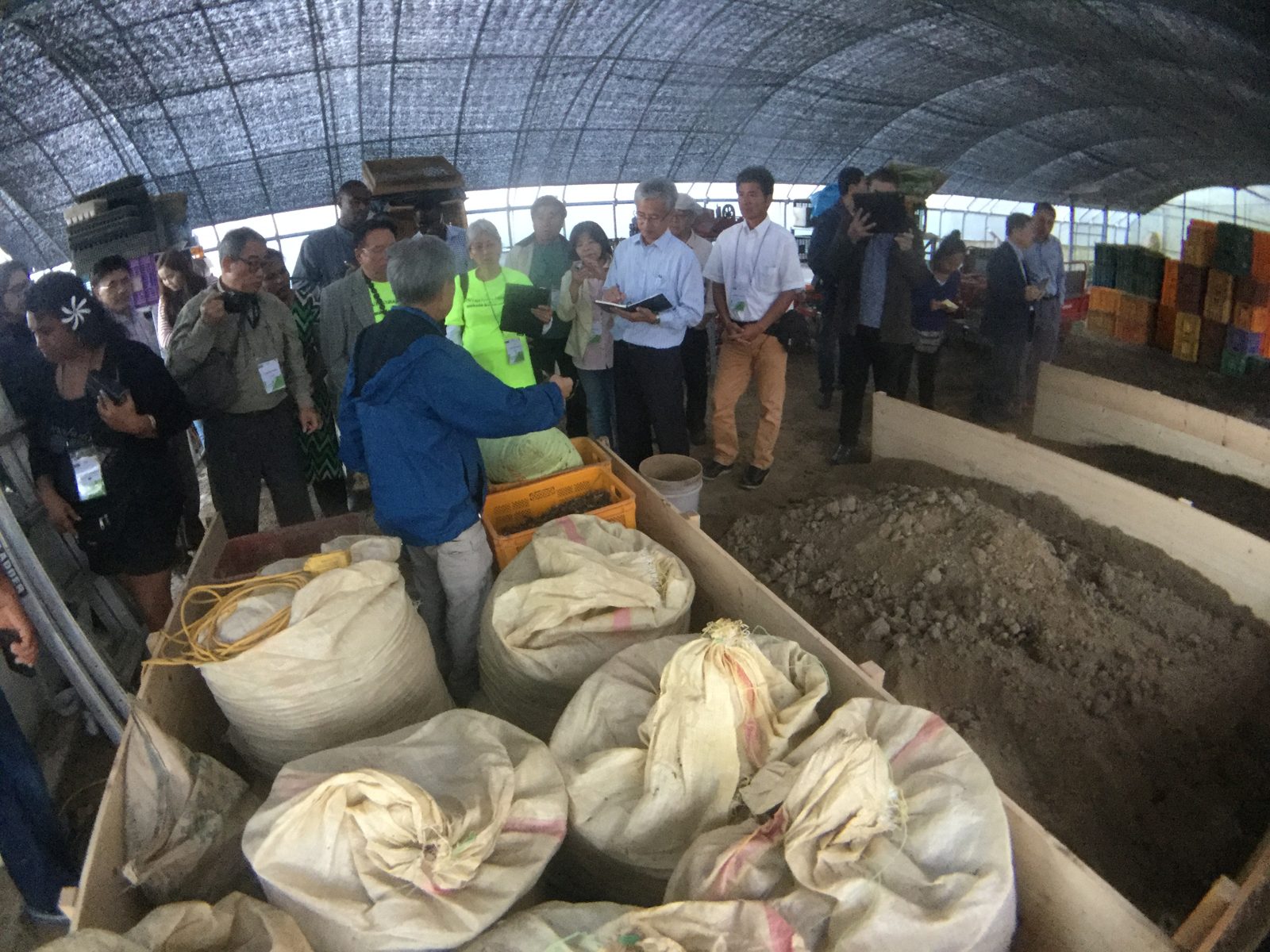
On the evening of October 6, 2016, the group visited a small hen farm next to a country church, run by Lee Eun-ha, the former missionary to the Philippines who spoke on the first day. Master Cho calls it the first place in the world to feed fermented cow dung to hens, inside a closed loop where the farm makes its own feed and fertilizer. The hosts showed chopped green corn stalk fermented for feed, a BMW water tank, IMO4 mixed with a tiller, a feed mixer and fermenting trough, hens on a bare-earth IMO4 floor with no smell, a chili field with soft soil, and a makgeolli insect trap. Laying was about 60% while feed ratios were still being tested.
What they found
How does a small farm make its own hen feed and fertilizer the natural farming way, including fermented cow dung as feed? The group came, in Master Cho's words, to see the method, not the size.
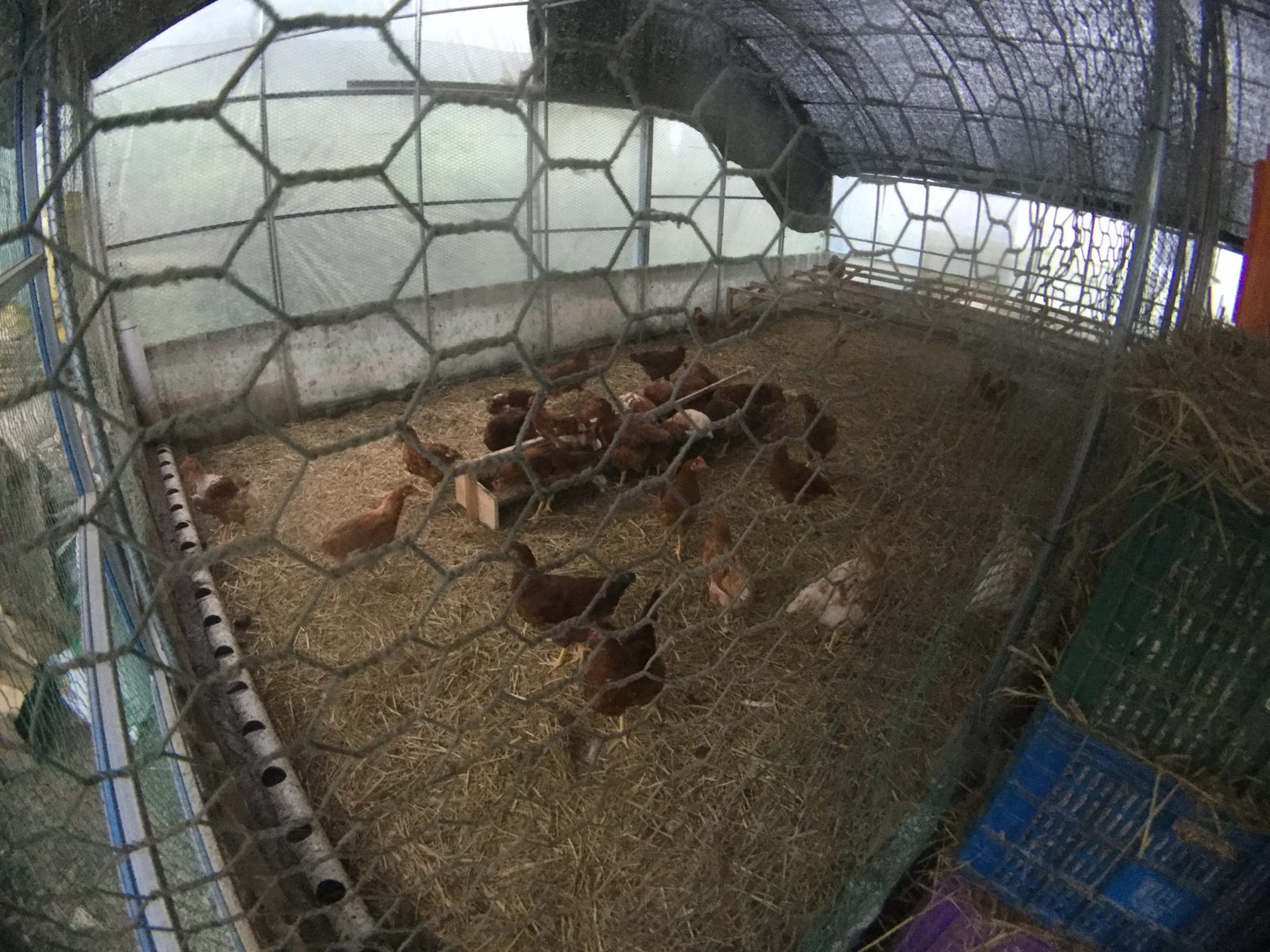
A small farm beside a brick church at Daedeoksan-ro 725-21 (address plate in photo IMG_2552), which places it in Mupung-myeon, Muju County, North Jeolla. Run by Lee Eun-ha, who spoke at the symposium the day before and invited people to his home 'tomorrow'. Laying hens in greenhouse-type houses on a bare-earth IMO4 floor; younger birds in a separate pen; chili peppers on black mulch in the field; shade houses holding the BMW tank, IMO4 beds, a stone sorter, a shell grinder, a feed mixer and a long wooden fermenting trough. Visit about 17:15 to 18:30 on October 6, 2016. Flock size, how long the farm has run, and land area: not stated.
- Fermented corn stalk feed — Green corn stalks (not dried; 'the green one has higher vitamin') chopped by a machine, packed and fermented about 20 days in hot weather, up to two months in cold. Asked what else goes in, the host said lactic acid bacteria and number 4 (IMO4). Amounts not stated. Rice straw is chopped on the same machine.
- Fermented cow dung as hen feed — Cow dung fermented with IMO4 into what the hosts call number 5 (IMO5), then mixed into the feed. Master Cho's stated goal: about 30% cow dung to 70% other material, not yet confirmed as best. Horse dung is said to be better because a horse has one stomach, so its dung carries more nitrogen.
- Feed blend — Fermented corn stalk + Protectors (LAB) + Microbes (IMO4) + IMO5 from cow dung + corn and other feed, mixed in a bladed mixer (stones and metal sorted out first, or the blades break). The ratio is under trial, raised and lowered as Master Cho instructs.
- Fermenting trough — The mixed feed goes into a long wooden trough, packed and covered with rice hulls so the moisture doesn't evaporate; it ferments 3 to 4 days and hens are fed after about 3 days. One end mixes, the other ferments. The rice hulls are also fed; in spring, feed to rice hull is 1:1.
- LAB grown on rice — A dense, sour LAB culture grown on rice, shown in a shed; used in the feed.
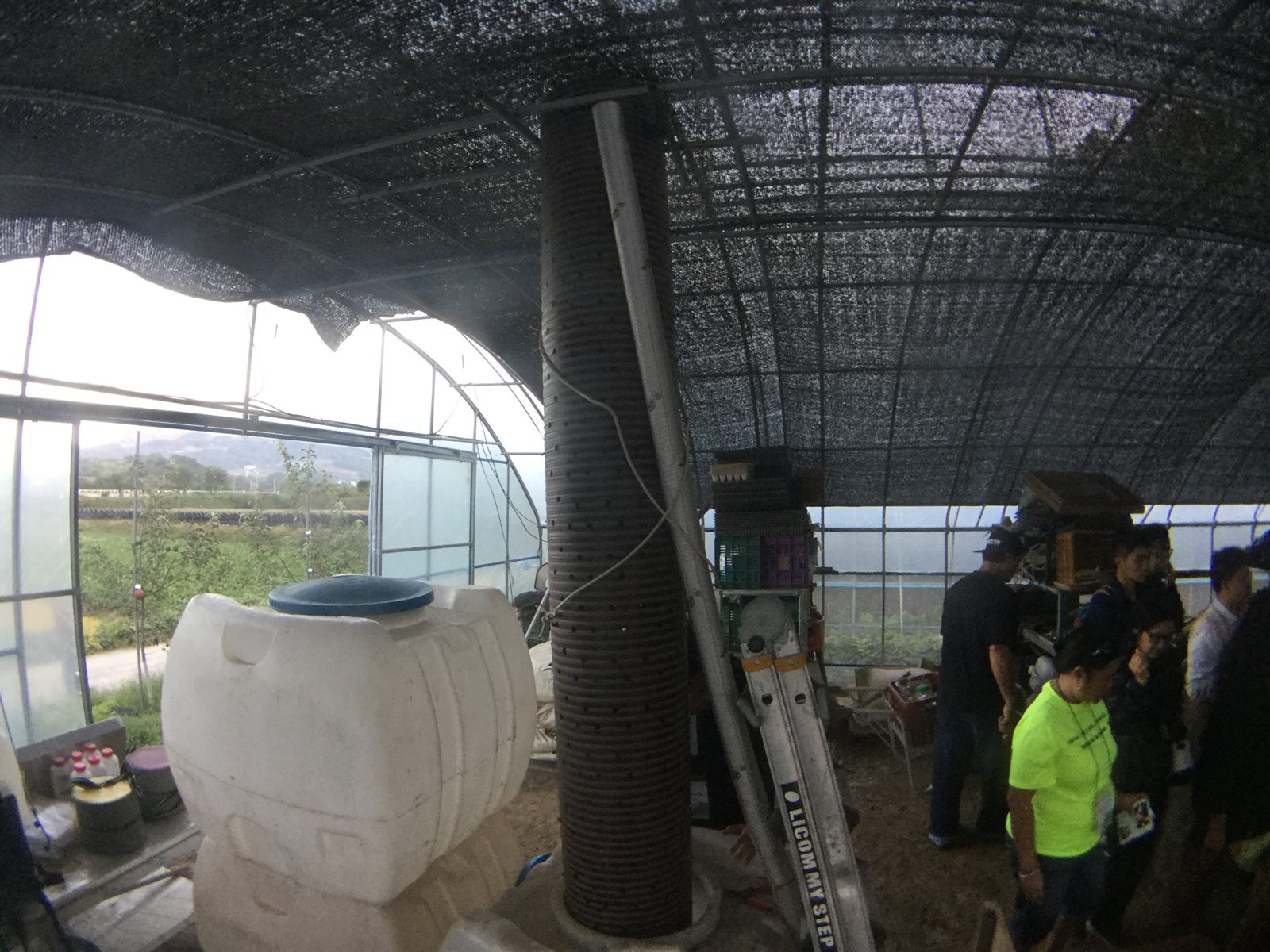
- BMW water — Water drops through a perforated pipe onto stones at the bottom of a tank to pick up oxygen; IMO4 is in the tank. B = bacteria (IMO4), M = minerals from the stone, W = water plus air.
- IMO1 material in cold weather — Leaf mold: fallen bamboo and oak leaves that have turned to soil, kept as material to make IMO1 when it is too cold.
- IMO4 mixing — IMO3 to IMO4 made in small batches in wooden-framed beds, mixed with a walk-behind rototiller. IMO4 made that morning was hot; a five-day-old batch was still steaming.
- Shell and bone grinder — Grinds oyster shells, shrimp shells, bones and dried food scraps to powder. Price given as 3.2 million won (interpreted as about $3,200).
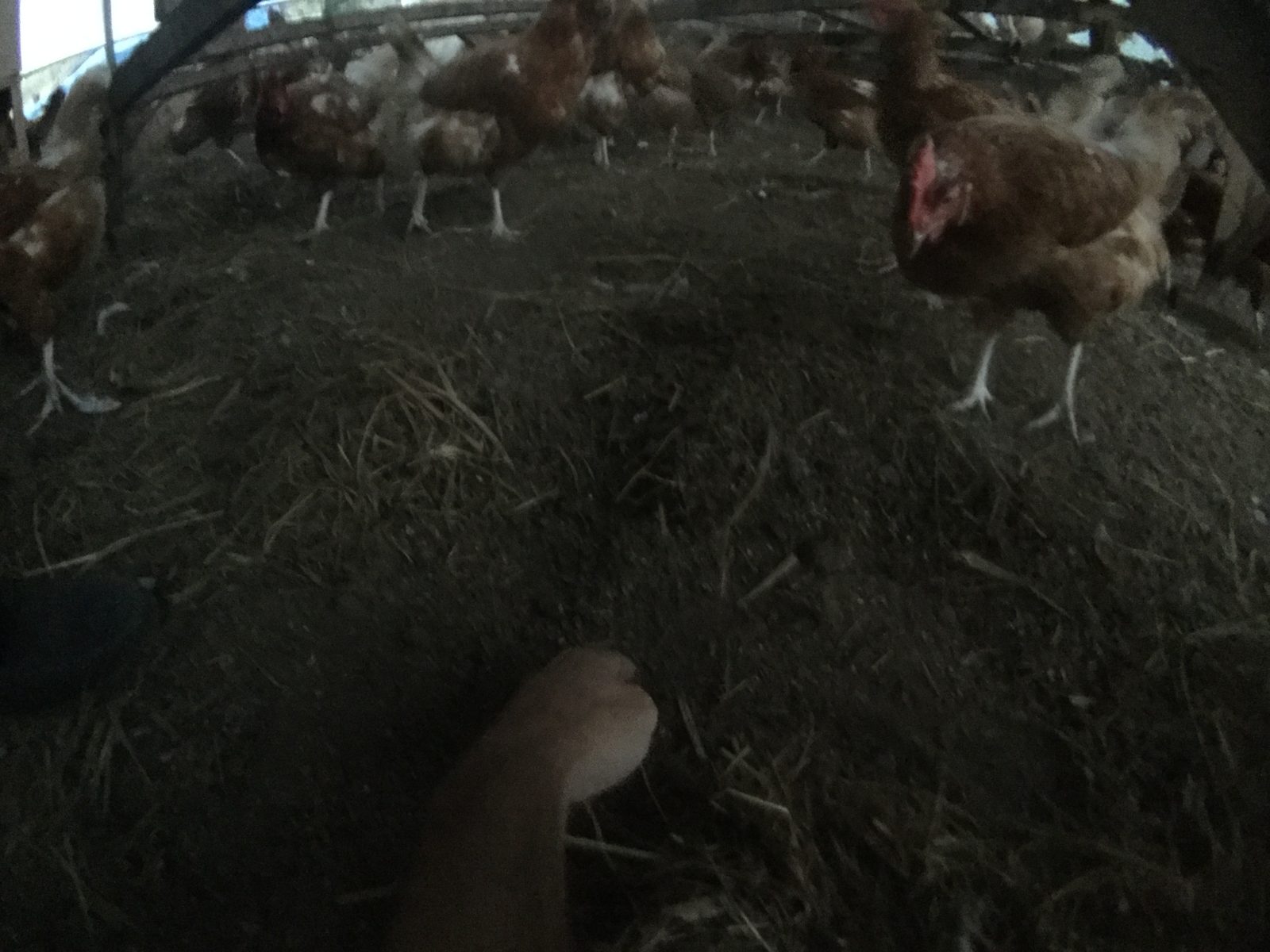
- Henhouse floor — A layer of IMO4 on bare earth, with no vinyl sheet or concrete. Dung is said to ferment in place and disappear. Floor scrapings are fermented again as IMO5 before going to the field.
- Calcium for hens — Three things together: [number 4], oyster and clam shells, and red clay, with some salt. Amounts not stated.
- Housing — Built as a greenhouse because a permit for a livestock barn was not granted; the host says rain gets in and winter is hard, and Master Cho's standard design would be better.
- Makgeolli insect trap — Makgeolli and acacia Food (FPJ) at about 200:1, no water, in hanging bottles; adjusted by region. The makgeolli smell and FPJ sweetness draw butterflies and moths, which drown.
-
Laying rate about 60%, aiming for 65 to 70%
Rate goes up and down because feed ratios are being changed in trials; 'this is not the final result.' Master Cho is said to aim for 65–70%. No flock size or period given.
▶ 30:11 As spoken
-
Henhouse floor has no smell and the dung disappears
Visitors handled and smelled the floor: 'no smell', 'it's soil', 'no vinyl, no concrete', 'dry'. Dung dropped at night is said to be gone by being fermented in place. Offered as proof that a vinyl liner is not needed to protect groundwater; no water test shown.
▶ 33:37 As spoken
-
Eggs improved after cow dung went into the feed
Master Cho: feeding cow dung made the eggs 'very good'; interpreted as 'very high quality'. No measure given.
▶ 1:24 As spoken
-
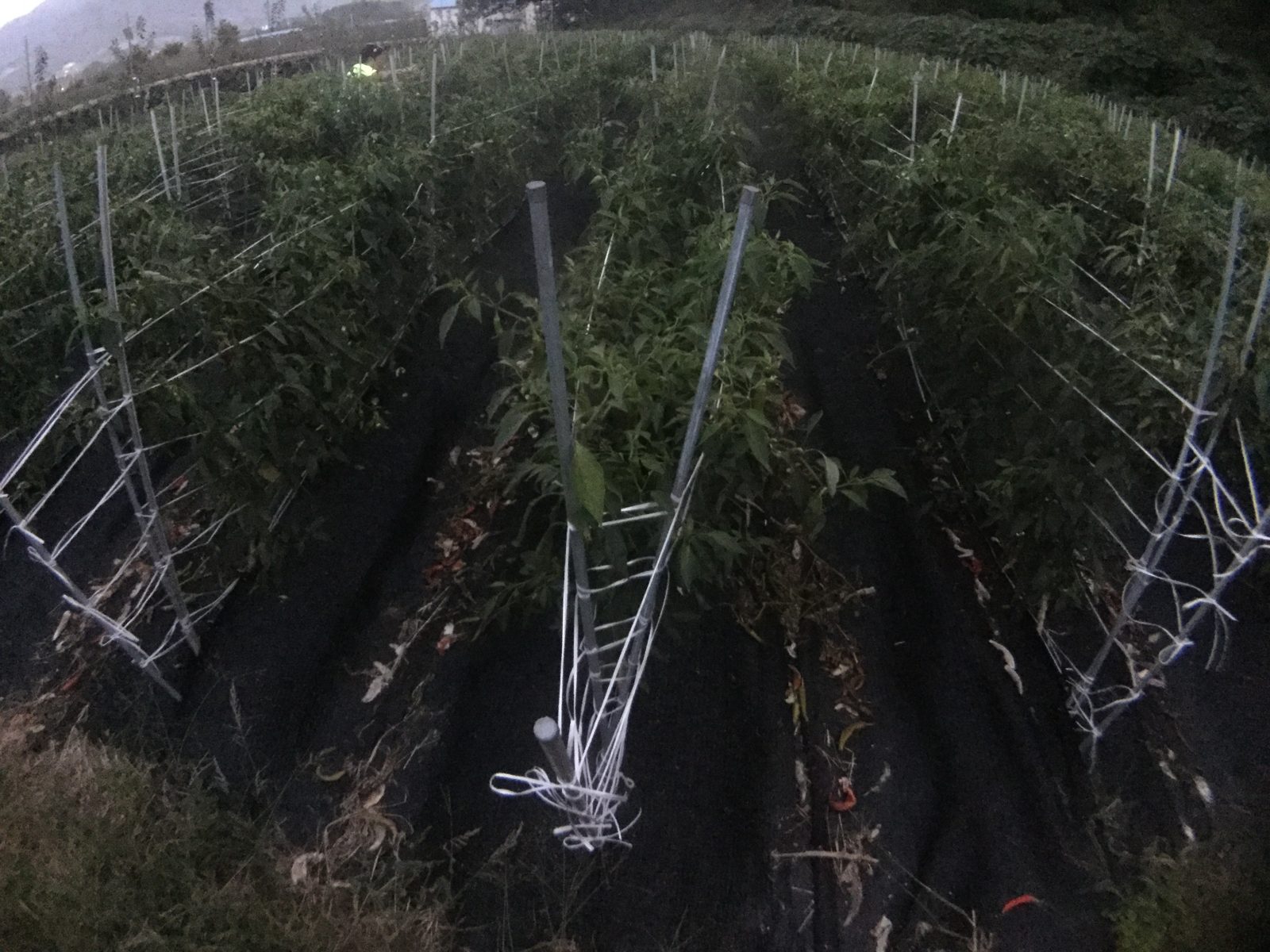
Chili field soil softened: probe went in 40 this year
Hand-shown depth last year vs '40' this year (unit not spoken, likely cm), 'more than two times'. Claim: after three years the soft layer is one meter deep.
▶ 39:20 As spoken
-
Chili plants recovered from anthracnose after days of heavy rain
Anthracnose came after several days of rain a few weeks earlier; the host says other places were worse and these plants recovered once the rain stopped, crediting the soil. Not measured.
▶ 40:20 As spoken
-
IMO4 still steaming on day five
A batch made that morning was hot; a five-day-old pile was still steaming. Number 5 (IMO5) was not hot.
▶ 18:11 As spoken
- A short evening walk-through; nothing was measured on the spot and no records were shown.
- The 60% laying rate and the 30:70 cow-dung goal are spoken figures from feed trials still under way; flock size, period and feed amounts were not given.
- Much of the Korean was only partly captured; long stretches were heard only through the English interpretation, which sometimes simplifies or garbles (for example 'rice' for rice hull, 'number 5 / number 6' for BMW).
- Who said which Korean line is inferred from video and context; several speakers overlap.
- The soil-depth and disease claims compare this farm with itself last year or with unnamed neighbors; no controls.
- Light faded near the end; the last chili-field and trap segment is dark and partly inaudible.
- Look for feed and fertilizer inside the farm: crop residue, dung and food scraps can go back to the animals after fermenting with Microbes (IMO).
- Pack corn stalk green and moist for fermented feed; dried stalk loses the vitamins the host values.
- Sort out stones and metal before materials reach a mixer or grinder.
- A bare-earth floor topped with IMO4 lets the soil life work on the droppings; plastic or concrete under it keeps them out.
- Ferment hen-house scrapings again (IMO5) before they go on the field.
- A bottle of makgeolli with a little FPJ can serve as a cheap moth and butterfly trap; adjust the mix to your area.
Next to Master Cho's teaching
-
Agrees
Fermented cow dung as hen feed In 2017 Cho's team described this same practice ('the only place in the whole world cow dung is feed to the chicken and the pigs') and said it had moved from 30% to 50% of the ration. In 2016 it was still at the 30% target.
2017/Advanced Cho/swine/IMG_1943 @ 0:42:07 (translated)
-
Agrees
Bare-earth henhouse floor, no smell Cho's book says the floor must touch the soil, with straw and microorganisms working on the droppings. The farm uses an IMO4 layer on bare earth.
Cho, Janong Natural Farming (2010 draft), p. 71
-
Goes further
Rice hulls in hen feed Cho's book has rice husks reaching 20–25% of feed by six months. The farm feeds rice hull 1:1 with feed in spring, more than the book's figure.
Cho, Janong Natural Farming (2010 draft), p. 73
-
Differs
Makgeolli insect trap Cho's book dilutes both FPJ and unfiltered rice wine to about 0.3% in water. Here makgeolli and acacia FPJ were mixed about 200:1 with no water. The idea, alcoholic and sweet smells to draw insects, is the same.
Cho, Cho Han-Kyu's Natural Farming (Theory), p. 110
-
Agrees
BMW water through stones Cho's book: make water with minerals and microorganisms from rocks. The farm's tank drops water over stones with IMO4 in it.
Cho, Janong Natural Farming (2003), p. 137
“This is the first place in the world where cow dung is used as chicken feed.”
▶ 1:04
“We didn't come here to see the size. We came to see the method.”
▶ 4:06
“LAB, solid. LAB grown on rice, man. Nice and sour.”
▶ 20:21
“If plastic or concrete goes in, the microbes can't live.”
▶ 34:30
“If you do this thing three years, then everywhere you stick it in, the soft layer is one meter.”
▶ 39:52
In this talk
- 0:00Master Cho on the church steps
- 3:06Fermented corn stalk feed
- 8:05BMW: water dropped over stones
- 9:37Leaf mold for IMO1
- 10:45Mixing cow dung and IMO
- 12:15Stone sorter and shell grinder
- 14:45IMO4 mixed with a tiller
- 20:19LAB grown on rice
- 21:17The feed mixer
- 24:21Fermenting trough and rice hulls
- 28:37The laying hens
- 32:03A henhouse floor with no smell
- 35:02Calcium for hens
- 35:49Why a greenhouse
- 37:31Dung back to the field
- 38:20Soft soil under chili peppers
- 41:55Makgeolli insect trap
Transcript
English translation, checked against the Korean as spoken.
0:00 This is a farm-type poultry farm, set up [unclear]. What we came here to see is a farm-type poultry farm. This is a farmhouse poultry farm. And another thing: it raises livestock while farming crops, and the farm was designed so that both the manure and the feed are self-sufficient. So this is a combination of the plants and animal farm. And the purpose is that the animal feed as well as the fertilizer for the plants will be self-sufficient.
농가형 양계를 노봉사로 해서 올려놓은 겁니다. 이곳에 온 목적은 농가형 양계장입니다. 이것은 농가의 양계장입니다. 그래서 그러고 또 하나는 가축을 기르면서 농사를 짓는데 거름을 자급자족하고 사료도 자급자족하는 쪽에서 이 농장을 설계한 겁니다.
0:57 You don't have to buy from outside to feed the animals, to fertilize the plants. It's just recycling. So this is the first place in the world where cow dung is used as chicken feed. This is the first in the whole globe. The cow dung, cow waste, feeds these chickens. We fed cow dung, and the eggs got much better. By feeding the cow dung, the chicken egg is very high quality. Can we use horse manure?
소똥을 먹여서 계란이 아주 좋아졌거든요.
1:42 Horse dung is a bit better than cow dung. The horse manure is better than cow manure. Here is why: a cow has four stomachs and a horse has one. The reason why: the cow has four stomachs, the horse has only one. So there is a lot of nitrogen in the dung. Therefore, the horse manure has higher nitrogen than cow manure.
말똥이 소똥보다 좀 더 낫습니다. 왜 그러냐면은 소는 위가 네 개이고 말은 위가 한 개입니다. 똥 안에 질소 성분이 많이 들었습니다.
2:30 So if you ferment it together with number 4 [IMO4] and feed it, the protein goes up. So if you ferment with the IMO4, with the dung, then higher concentration of the nitrogen. Those things, in more detail, later when we do natural farming, I will present one by one. So we are going to give more details on each one of them as time goes on, when you do this natural farming. Here they are fermenting corn to make feed for the hens. Here they are making fermentation of the corn. Fermented corn to feed this chicken.
그래서 그거를 토착미생물 4번에 같이 발효시켜서 먹이면 단백질이 많아집니다. 그런 것은 나중에 좀 더 구체적으로 자연 농업을 할 때 하나씩 하나씩 제시해 드리겠습니다. 여기가 옥수수를 발효시켜서 닭을 먹이는 사료를 만들어 놓고 있습니다.
3:24 This isn't corn kernels. It's the corn stalk. Oh, no. Not the corn itself. The corn stalk. So however good it is, don't you eat it yourselves. Don't you eat it yourself. It's not for you, it's for the chicken. We have some place to make this self-sufficient fertilizer and the animal feed. We didn't come here to see the size. We came to see the method.
이건 옥수수 알맹이 아니에요. 옥수수 대. 그래서 그거를 갖다가 여러분들이 아무리 좋다고도 먹지는 마세요. 여기서는 규모를 보는 게 아니라 방법을 보러 온 겁니다.
4:14 The purpose of observing here is not the size of the farm, but how they're doing it. It is a very good idea. Let's go. This is the corn stalk. Fermented corn stalk. Doesn't it smell good enough to eat? Yes, it's nice.
먹을만한 냄새 아니에요? 네, 맛있네요.
5:06 Ask how long it was fermented. How long did you ferment it? The time differs between hot weather and cold weather: It takes about 20 days to two months. If it's cold weather, 20 days to two months. Oh, okay. Is there anything else that you put in there? How do you ferment it? Talk about the process. How do you make it? The corn stalks. First you bring them over, and if you open this up... Okay. When you have the corn stalk, bring it over here. This is a machine to grate, to crack it. Chop it.
얼마나 오래 발효시켰는지 물어보세요. 얼마나 오래 발효시켰나요? 날씨 온도가 더울 때 하고 추울 때 하고 기간의 차이가 옥수수 대를요. 일단은 이거 갖고 와서 이거를 열어보면
6:12 These are corn stalks that were chopped. The corn stalks were chopped here. This is not the corn stalk, this is the rice stalk. But it's the same machine they use for corn stalk. So you put it in here. When it's really hot, it takes about 20 days to ferment. When it's cold it takes a very long time, about two months. So: hot weather, 20 days; cold weather, about two months. But in winter there aren't any [corn stalks] anyway. It will be when it's warm, so you can just say 20 days.
옥수수대를 잘라 놓은 거구요 옥수수대를 여기다 잘라 놓은 거예요 그래서 여기다가 넣어가지고, 한참 더울 때는 한 20일 정도구요. 발효되는 게. 추울 때는 시간이 엄청 길어요. 한 두달 정도. 그래서 뜨거운 날씨는 20일, 추운 날씨는 2개월 정도. 그런데 겨울에는 없잖아. 날 따뜻할 때 올 거니까 한 20일이면 된다고 얘기하면 돼요.
6:58 So normally speaking, in cold weather, there's no corn stalk anyway. So just remember 20 days is the usual fermentation time. So you just put it in green. You have to pack the corn stalk green, just as it is. Right, it mustn't dry out. The green part. So you should not dry it up. Just the moist one, put it in, and then ferment. You have to give green, fresh grass so the vitamins go in. Green, fresh grass has more vitamins. The green one, the moist one, has a higher vitamin. So that's a better quality. So then how does he ferment it? What's the next step?
그래서 그냥 파란 것만 담아도 돼요. 그냥 옥수수대 파란 것 그대로 담아야 돼요. 네, 그게 마르면 안 되죠. 파란 거를. 파란 청초를 줘야 비타민이 들어갑니다. 초록색 청초를 줘야 비타민이 더 많습니다.
7:45 He's going to explain. Ah, this? Lactic acid bacteria and number 4 [IMO4]. There's a hole in the hole, this one. More air can go in. The underground water, no more oxygen. When you drop down, the oxygen will go in.
아 이거요? 유산균하고 4번
8:31 When you hit the stone, at that time oxygen will go in. There's a stone on the bottom of this one. And in there, number 4 [IMO4] was put in, And there, IMO4 is there too. So number 4 is the bacteria, and the rock is the minerals, and that's BMW. So BMW stands for: IMO4 is bacteria, and M stands for the mineral from the stone,
그리고 거기서 4번을 갖다 놓은 거고 그래서 4번이 박테리아 그리고 암석은 미네랄 그리고 BMW
9:17 and then air plus water. So, BMW. What is this? Fallen leaves. Fallen leaves and leaf mold. They have turned into soil. All of these leaves have turned into soil. This is bamboo.
이건 뭐죠? 낙엽입니다. 낙엽과 부엽입니다. 흙이 되어 있습니다. 이 모든 잎이 흙이 되어 있습니다. 대나무입니다.
10:02 This thick one is oak. I forgot the English name. But anyway, it's a different kind of tree. These are the materials to make IMO1 when the weather is too cold. This is IMO4. IMO3 [unclear].
이 두꺼운 것은 참나무입니다.
11:01 Right now, I'm asking him, do you mix one to one? He said the teacher is teaching the mix ratio today. So he will find out the best combination of the two. Right now he's just mixing. He's mixing it right now. So Master Cho said the ultimate goal he wished to happen is about 30% of the cow dung and 70% of this one. But we are not sure whether that's the best combination or not.
지금 바로 섞고 있어요
11:59 Ah, if it's horse dung, [unclear]... Horse dung is that good too. It's fine. A separator. That wasn't here last time. A separator. Because stones and things get in here. If a stone gets in, the [machine] breaks. I see. So we separate them out here, and we'll come back here later. [unclear] So this particular machine, if you happen to have a stone in here, then the machine is going to be breaking down. So he is going to remove the stone out of this one, okay?
아하, 말똥이면 저걸 좀 들... 말똥이 그만큼 괜찮아요. 괜찮아요. 분리기요. 지난번에 없었던 것입니다. 분리기요. 왜냐하면 여기가 이제 돌 같은 게 들어가잖아요. 돌이 들어가면 대화기가 망가져요. 그렇군요. 그래서 이제 여기서 분리를 해가지고 이제 저희가 나중에 다시 이리 올 건데요. 여기서 다시 시킹을 많이.
12:58 With a machine like this: the calcium [material] is big, so it won't do as it is. You put it in here and it goes in as powder. A grinder. This is a machine to make powder out of the bone. This is the oyster shell. Big one. You need to break it down to powder form. This machine will be breaking it down to powder. Mix this one, number 4, plus that, and number 5 is here. Then you make a final product here, right there. With calcium? No, no. Just the dung plus IMO4.
이 기계 같은 건 칼슘을 준비해서 크니까 안 되잖아요. 여기 넣어서 여기 가루로 넣어요. 분쇄기.
13:52 So you can use shrimp shell instead of oyster? You can put in things like shrimp shells too. And food scraps get thrown away, right? [Bones and such], dried thoroughly and put in here, all break down. Any kind of food scrap, we use here. Food scrap is dried and put in this one, and that's good.
새우 껍데기 같은 것도 넣으면 돼요. 음식물 찌꺼기도 버리잖아요. 뼈 같은 것도 철저하게 말려서 여기 들어가면 다 분해돼요.
14:42 Do you want to see the demonstration? This one, when you mix with the hands, it takes a long time and cannot mix well. So that particular machine he's going to demonstrate will be mixing very easily and quickly. You see that thing? [A tiller], yeah? But it's working upside down here.
18:11 So, IMO4 is very hot. Mm, really hot. But five is not hot. It's a rototiller. You do it like this, if you just want to cut that, you use this. How long ago was this made? From IMO3 to 4. Making a small batch from IMO3 to 4. So was it made a long time ago? This morning. Wow.
이거 이렇게 해서 저것만 자르라고 하면 이거 사용하면
19:00 Fifth day with this [one]. Still hot. Steaming. You can see the steam rising. This one is almost done, this one is done. This machine, with lots of attachments... if you buy one with just the small attachments, it's about 320, 3.2 million won. This particular machine is about 3,200 dollars. 3,200 dollars.
이거는 거의 다 됐고 이거는 다 됐습니다. 이 기계가 부속이 많으면 부속이 조그만한 게 좋다는 게 사면 320 정도 되고요. 320만 원입니다.
20:19 Rice? LAB, solid. LAB grown on rice, man. Nice and sour.
21:04 The county subsidized this one, to develop this. Lactic acid bacteria fermentation. Number 3 [IMO3] fermentation. This is where the blend gets mixed: the corn [stalk] we make, and the lactic acid bacteria, and number 5, the number 5 made from cow dung. Then the corn,
유산균 발효 3번 발효 배합을 믹스하는 건데요 옥수수대 만드는 거하고 유산균하고 5번, 소똥으로 만드는 5번 그 다음에 이제 옥수수
21:51 the corn stalk, then the lactic acid bacteria, number five, number four. Number five goes in, and four goes in too. And that is the feed: corn and lots of other kinds of feed go in. We put those in and mix them here. Remember the sorter over there earlier? The sorter, for picking out stones. If you look at the machine here, these blades turn,
옥수수대로 그 다음에 유산균 오번 넘버 파이브도 들어가고 포도 들어가고요 그거는 이제 사료 옥수수 같은 여러가지 사료들이 많이 들어가잖아요. 그거를 넣어서 여기서 믹스를 하는 아까 저기서 고르기 있잖아요. 고르는 거, 돌 고르는 거. 여기가 기계를 보면 이 칼날이 돌아가면서
22:41 and if a stone gets in, it breaks. You know, we reminded you on the other side: if you have a stone or metal or something, this machine is breaking down. So you have to get rid of all those things that we showed. So this machine will mix corn stalk, plus LAB, plus IMO number 4, plus IMO number 5, and then animal feed, we mix all together. What's the ratio? The ratio is as the Director [Master Cho] teaches right now:
돌이 들어가면 망가져요 비율은 어떤 거죠? 비율은 지금 원장님이 가르쳐 주시는 대로
23:28 we raise and lower the ratio, and we're still collecting data on it. So Master Cho is instructing this time and that time a different ratio. So he's going to explain later.
이제 대학을 비율을 높이고 낮추고 해서 현재 지금 계속 데이터를 연구 중이에요
24:21 When the mixing is done here, it goes in here. This is the blend. Right here it ferments naturally. So we put it in here. This side mixes, this side ferments. We pack this side and cover it with rice hulls,
여기서 배합이 끝나면 여기다가 넣죠. 지금 이게 배합한 건데요. 지금 여기에서 자연 발효가 되는 거예요. 그래서 여기에 담아요 이 쪽은 섞고 이 쪽은 발효시켜요 이 쪽은 담아서 왕겨로 덮어요
25:06 so the moisture doesn't evaporate. We cover this one with rice hull so the moisture does not evaporate. Three days after fermenting, three days later, we feed it to the hens. After fermentation, three days later, we feed the chicken. We open the door and feed the hens. It gets mixed like this, and you just pull it down.
그래서 물이 증발하지 않게 덮어요 발효 후 3일 후에 3일 후에 닭을 먹여요 문을 열어, 닭을 먹여요 이렇게 섞여져서 끌어 내리면 돼요
25:55 Pulling it down mixes it again. This particular one, the rice hull, not only prevents the evaporation; you have to feed this one to the chicken too, so they mix together. That will change the quality of the chicken. The meat. When you want to feed a lot of rice hull,
끌어 내리면서 또 섞여져요
26:41 the chicken feed and rice hull ratio is one to one. When spring comes, for hens, for all living things in spring, [unclear]. In spring we feed a lot of this. So, usually in springtime we have to wake up our body. So in springtime they feed a lot of rice hull. So that time is a one-to-one ratio. So feeding starts here, and it takes about another 20 days to get over here?
닭이 봄이 되면, 만물이 봄이 되면 다 생선을 먹여야 해요. 봄에 이걸 많이 먹여요. 여기에서 처음 먹이는 거고 여기 오면 한 20일 더 걸릴 거예요?
27:35 Then is the quality different when you feed from that end? No, it's not like that. Right now, here is the middle. Yes, this is the middle. This was made today. What we made today will be gone in a day or two of feeding. Then, when it's empty here, we feed this and make more to fill it up. The fermentation here takes 3 to 4 days.
그러면 저쪽에서 먹일 때가 좀 질이 달라집니까? 아니에요. 그건 아니고요. 지금 여기 가운데인데 네. 여기가 가운데인데, 이거 지금 오늘 만든 거고요. 오늘 만든, 이것이 내일 모레 먹으면 없어져요. 그 다음에 이제 여기 없으니까 이걸 주고 이걸 만들어서 채워 놓는 거죠. 발효 시간은 여기서 이 발효는 3-4일 하는 거예요.
28:24 You can actually open this one door, so you can just use both sides at the same time. Shall we go see the hens? Looks like he's built a [pen] since last time I was here. No. But again, just welded together. Built his own system set up here.
닭을 볼까요?
29:09 This is the happiest chicken I've ever seen in my life. This one and the other one, we just alternate this space for the egg-laying chickens. After they run out, when they're not laying any more eggs, then we have a candidate to come to this side. Because we keep experimenting with the feed and such,
왜냐하면, 저희는 계속 사료랑 저런게 실험하기 때문에
30:01 the laying rate goes up and down. Because in the trials the nutrition goes up and down, until that data comes out, the rate will go up and down. Right now it's usually about 60%. Right now, the egg-laying ratio is about 60%. But this is not the final conclusion or result, because right now we are doing all different kinds of research, this way, that way, give some more or less or something. So right now it's about 60% every day. The goal is to get 65 to 70%.
산란이 올라갔다 내려갔다 그래요. 왜냐하면 실험하면서 영양이 많았다 적었다 그랬기 때문에 그 데이터가 나올 때까지는 프로트가 올라갔다 내려갔다 할 거예요. 지금 보통 60% 정도 돼요.
30:58 But Master Cho said right now 60%, but he is aiming the 65 to 70%.
32:03 There is a way to make it very nice and soft. Here, here — Director, please interpret. Please interpret for this side. If you dig the ground inside this henhouse, it isn't contaminated. Remember, when it was explained yesterday or so, it was said you lay plastic sheeting against contamination. That even without plastic it doesn't get contaminated, no problem at all: take a photo of it here and show them. I thought it would be good to show it.
여기, 여기, 여기 원장님 통역 좀 해주세요. 이쪽에 통역 좀 해주세요. 이 닭장 안에 이 땅을 파보면 오염이 안 됐는데, 왜 그, 어젠가 설명할 때 오염 되기 위해서 비닐을 깐다 그랬잖아요. 비닐을 안 깔아도 아무 문제 없이 오염이 안 되는 거를 여기서 사진 찍어 갖고 한번 보여주시라고. 보여주는게 좋을 것 같아서
32:34 This one: you know, we talked about yesterday, if you don't have a vinyl floor, I mean the vinyl sheet in the ground, you might later on be contaminating the underground water system. But he said if we have this IMO4, this very nice bottom of this chicken coop, then there's no way to contaminate underground water. So he wants you to take a picture and show them.
33:31 Taste. No smell. It's soil. No vinyl, no concrete. Dry. Evening, chicken dung down. Now, chicken dung no more. So even if they make a dung, they're all fermented, and no more dung left. Completely gone. How often do you put IMO in again?
냄새가 안나요 이거 얼만큼 자주 아야모를 또 다시
34:19 Yes, no smell. Perfect. No smell. Director, even when you dig the ground here like this — if plastic or concrete goes in, the microbes can't live. So we don't lay plastic or concrete under this. Done right on the ground, the ground just gets better. We can touch it with our hands like this and there's no problem. So, actually, when you put in a vinyl floor or cement floor, microorganisms cannot survive there. So the best thing is to leave it without those things. That one is [samato]: calcium.
네, 냄새가 없네요 원장님 여기가 이렇게 땅을 파도 비닐이나 콘크리트가 들어가면 미생물이 못 살거든요. 그러니까 이거를 비닐이나 콘크리트 안 깔고요. 그냥 땅에 해도 땅이 이게 더 좋아지는 거예요. 우리가 손으로 만지고 이렇게 해도 아무 문제가 없어요. 저거는 사마토에요. 칼슘.
35:04 Ah, this is... calcium. Number 4, oyster shells, clam shells: with things like these we make calcium. Three different things: [number 4], the oyster shells and the red dirt. So three things together; the primary purpose is calcium supplement, and some salt.
4번하고, 굴껍데기, 조개껍데기 이런 것들에 칼슘을 만들어 주면
35:49 Do they lay wooden poles underneath here too? No, we don't do that. And the problem we have here is: we couldn't get a permit for a [livestock barn], so we built it as a greenhouse. But some rain gets in. With a greenhouse, it's hard to manage in many ways: rain gets in, it's cold and bad in winter. But if it were built normally, the way the Director [Master Cho] designed it, it's easier to manage and much better than this. So the original Master Cho's chicken coop is really good, but Korean law does not allow that way, so we have to put this in a greenhouse.
여기도 나무 막대기를 밑에다 까냐고? 아니요, 그런 거 안 하고, 그리고 지금 여기 조금 문제가 있는 게 뭐냐면요, 축사로 허가가 안 돼서 하우스로 했어요. 그런데 비가 좀 들어오는거에요. 하우스로 하면은 여러가지로 관리가 힘들어요. 그런데 비가 들어오고 겨울에 춥고 나쁘고 그런데 이게 정상적인 우리 그 건축법, 원장님 설계대로 하면 관리도 좋고 이거보다 훨씬 좋아요.
36:45 So the ground, what did he do again? I forgot. He put a layer of IMO4. He has younger chickens here.
37:31 Yes, like what I showed you earlier: we gather it all and put it here, and then it has to go to the field. Before it goes, we ferment it once more as number 5 [IMO5]. So when you bring the dung, you scrape it and then you put it inside. Before you use it as a fertilizer, you have to ferment it before you use it. Number 5 [IMO5]. Yesterday we talked about making number 5 [IMO5], like a secret. Later, after we eat, I'll go through all of it with that. OK. Okay, after we eat the dinner, he's going to explain more detail.
네, 아까 제가 보여준 거 있잖아요. 다 모아가지고 여기다 놓고, 요거를 이제 밭으로 가야 되죠. 이거 가는데 다시 한 번 5번으로 발효시켜서. 5번입니다. 어제 5번 만드는 거에 대해서 비밀같이 얘기했잖아요. 이따가 식사하고 난 다음에 저거 가지고 전부 다 해드릴게요.
38:20 Now you should go see the chili pepper field. We spread it on the chili field and planted chilies, and so you can see how much deeper the good soil has become. So we go to the next with the chili pepper plants. And they use this one for the chili pepper. Go ahead and see for yourself. There's some roots of the chili pepper here, and this is very soft soil. Very soft.
이제 고추밭을 가 보셔야 해요 고추밭에 뿌리고 고추 심어서 그렇게 됐는데 땅의 깊이가 얼마나 좋아졌는지 알 수 있어요
39:20 Last year it went in about this far; this year 40 went in. Last year, it was very hard soil, but after they use it, about this much they can put it in. This year, about this much. Soft. More than two times. After just three years, wherever you push it in, it goes in one meter. If you do this thing three years, then everywhere you stick it in, the soft layer is one meter.
작년에는 이 정도 들어갔는데 올해는 40이 들어갔습니다. 3년만 지나가면 어딜 찔러도 1m가 들어갑니다.
40:10 Another important thing: [the rain] came in for four days, so anthracnose came, and other places [were badly hit] [unclear], but once the rain stopped, [they recovered] [unclear]. They have that much strength to overcome disease. So, a couple weeks ago, there was a heavy rain for several days. When they get heavy rains, a disease like this one is very prone to happen.
또 중요한 것은 수습대에 4일 동안 들어왔어요 그래서 탄저병이 왔는데 다른 곳은 거의 2시간 전에는 계속 터잖아요 비가 멈추니까 크고 작아 보이더라고요 병을 그만큼 이기는 힘이 있어요
41:00 But right after that, it becomes healthier because the soil system is very nice. So it kind of prevents the disease, even if you have heavy rain. Let's go eat dinner and then we talk more. Is this soil 100% IMO or is it mixed with soil? We built up the soil base, and here,
토양 기반 조성을 하고요. 여기다 이제
41:47 IMO4 went in at that time. Dr. Park, there's — looks like an insect trap. What's the trap for? What is that for catching? Butterflies — butterflies or insects. Just mix it, to the right ratio. One to one? No, not one to one, about 200 to 1. Mixed with water? No water mixed in. Mostly makgeolli,
아이엠오 4, 4번 그때 들어간 거야 저건 뭘 잡기 위한 거냐 나비야, 나비나 벌레야 그냥 섞어서 비율을 맞춰서 1대1로? 아니요 1대1이 아니고 한 200대1 정도 물을 섞어서? 물을 안 섞고요 막걸리가 많고
42:33 makgeolli 200 to... acacia at that rate. Acacia at 200 to 1? It gets adjusted by region, but here it's about that. So makgeolli is 200, and FPJ is 1. 200 to 1. So FPJ is a little bit small amount, but the purpose is to make it sweet. The makgeolli is the smell. Smell and sweet taste. Then it attracts the insects. Thank you. And they drown. To the dinner place.
막걸리가 200대 아카시아 그 정도로 하면 아카시아가 200대1? 지역에 따라서 조정이 되는데 그 정도면 여기서는 그 정도 돼요. 식사 장소로요.
43:19 If you get on the bus, I'll tidy up and come right after in my car. If we get on the bus, he'll finish up the thing and he'll follow us. Okay?
차에 타고 계시면 제가 정리 좀 하고 바로 제 차 갖고 오고