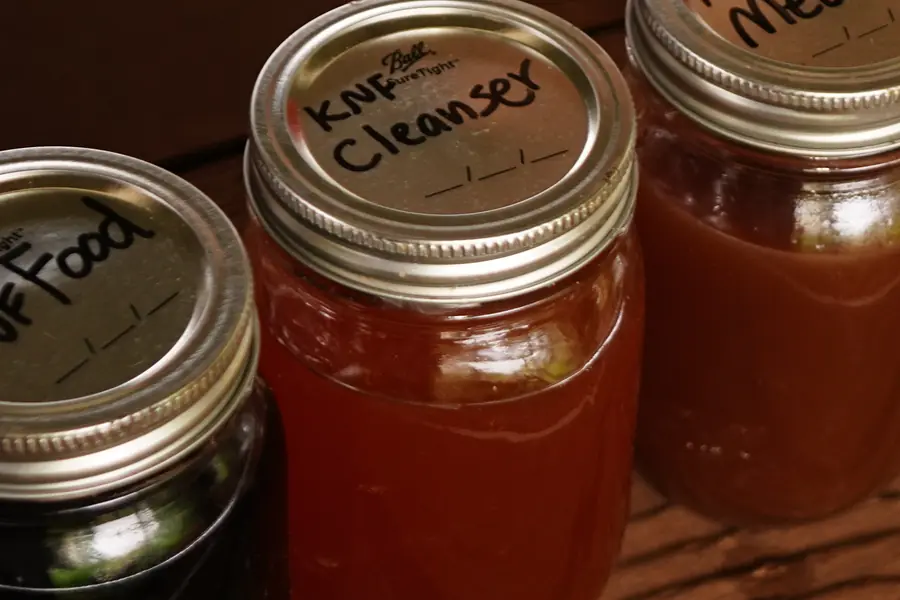
Cleanser — Living Vinegar
What is Cleanser?
Cleanser is a living vinegar. There are many ways to make vinegar, and we teach two: my method from your own Food, water, air and time, which works nearly every time, and Master Cho's, which starts from starch such as makgeolli or brown rice, with no sugar added. Unlike commercial vinegar, it retains living organisms and organic compounds from the fermentation process. It is both a cleaning agent and a biological activator.
What does it do?
Cleanser is acidic in the bottle, but on the plant it works the other way. Master Cho said it turns alkaline the moment it touches the leaf, bringing a leaf that too much nitrogen has turned acid back toward neutral. That neutralizing is why it goes in the tank. It goes in the same tank as Food and Medicine and helps the plant take them in.
On diseased plants, Cleanser can interrupt fungal and bacterial infections without synthetic fungicides.
How is it made?
My method. Fill a jar one-third with finished Food and add twice that much water (rainwater is best). A splash of living vinegar or a piece of mother speeds it up, but it's optional. Cover with cloth or a paper towel and a rubber band — without air you'll make alcohol, not vinegar. Keep it out of direct sun at a steady temperature and wait 3–6 months.
A rubbery skin (a scoby) forming on top means it's working, and vinegar gnats are normal. It's done when it tastes sharp and sour with no sweetness left. Kim Chang, Master Cho's interpreter, asked for strong vinegar, at least 4–5% acidity. The result is a living vinegar, full of the amino acids and enzymes that store-bought distilled vinegar lacks.
Master Cho's method. Let makgeolli (Korean rice wine) or another starch ferment, such as cooked brown rice or green banana, sit covered with paper until it turns to vinegar. He added no sugar. He said liquor turns to vinegar in 3 to 5 days, depending on the temperature.
When to use it
Use when you want to bring a leaf back toward neutral, as a pre-treatment before applying other preparations, or to address fungal problems. Dilute 1:500. Master Cho used it stronger, about 1:300, to pull down a plant that had been overfed. Leave it out of the last 10 days before harvest: it lowers the sugar in fruit and the heat in peppers. Do not apply in direct sunlight; acidity can burn sensitive leaves.