
Komohana Research and Extension Center, Hilo, Hawaiʻi · October 1–3, 2015

Natural Farming Symposium 2015

A day of talks and hands-on skill shares in Hilo, a day of panels, then farm tours and a film. 25 recordings: nine talks including Drake Weinert's keynote, six demonstrations on the lawn, eight panels, a short ceremony and hallway interviews. Every one is checked line by line and boiled down to what was made, what was measured and what was only told.

Read what it all adds up to →

Also on the record: Konkuk 2016

Topics microbes soil economics policy health taro culture food pigs scale protectors research biochar fermentation minerals school gardens Clear

5 talks on “research”

Ashley Lukens ·USA (Hawaiʻi) ·60 min

Hawaiʻi Hosted 1,141 GE Field Tests to California's 172

At the Thursday lunch, Dr. Ashley Lukens, director of the Hawaiʻi Center for Food Safety, walked through her group's report "Pesticides in Paradise" on the seed companies' genetic-engineering field tests and restricted-use pesticide spraying in Hawaiʻi. She drew on industry figures, USDA field-test permits, Kauaʻi spray records and about 150 medical studies, then argued for mandatory disclosure and buffer zones around schools. Short Q&A at the end.
Found Seed crop acreage grew 10x since 1982

economics health pesticides policy research scale

Ted Radovich, James Rushing, Josiah Hunt, Jana Bogs ·USA (Hawaiʻi) ·67 min

Four Scientists on Natural Farming: Proof, Biochar, Minerals

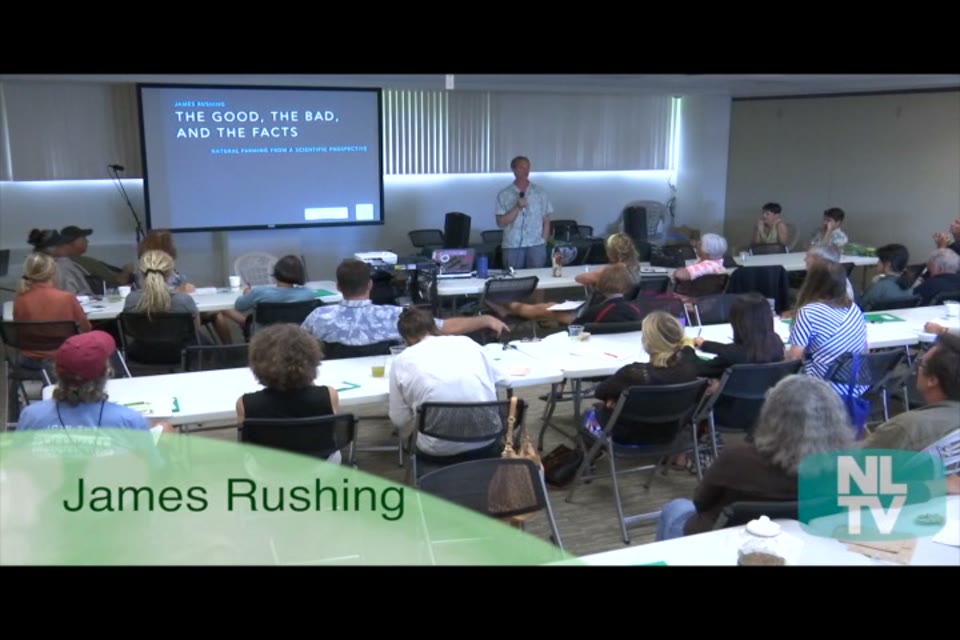
Four short research talks that followed Drake Weinert's keynote. Ted Radovich (UH Mānoa CTAHR) showed his lab's work on Hawaiʻi soils, cover crops, compost and compost tea; James Rushing (UH Hilo) listed what science does and does not yet know about natural farming, and said no top-tier peer-reviewed paper showed it working; Josiah Hunt (Pacific Biochar) explained biochar and read results from published studies; Jana Bogs, a nutritionist and soil consultant, argued for testing soil minerals and microbes, and warned about the sodium in seawater. Each talk got a few questions from the floor.

Found Weathered soil vs fertile soil: P 0.9 vs 480 ppm, Ca 38 vs 4,524, Al 142 vs 15

biochar compost cover crops microbes minerals research

Jeff Melrose ·USA (Hawaiʻi) ·74 min

Hawaiʻi Cropland Shrank From 350,000 to 153,000 Acres

Jeff Melrose, a land-use planner, previews the 2015 statewide map of Hawaiʻi's farms, made with UH Hilo's SDAV lab for the state Department of Agriculture. He stands in for HDOA chair Scott Enright, who was ill. He compares the 1937 and 1980 maps with 2015: about 153,000 acres in crops and 763,000 in pasture, down from 350,000 and 1.1 million in 1980. Then he goes island by island, adds pig and bee maps, and takes questions. HFUU president Vincent Mina introduces him and closes with a pitch for HFUU chapters and membership.

Found 2015: about 153,000 acres in crops and 765,000 acres in pasture

bees coffee economics pigs policy research

Danielle Downey, Jen Rasmussen, Jenny Bach ·USA (Hawaiʻi) ·73 min

Wild Bees Gone, Hawaiʻi Farms Now Need Beekeepers

Three Hawaiʻi Island beekeepers answer a moderator's questions and the room's: the state apiarist Danielle Downey, treatment-free beekeeper Jen Rasmussen of Paradise Nectar Apiary, and Jenny Bach, who does hive removals and works in school gardens. They cover how the varroa mite (2008 on the Big Island) and small hive beetle (2010) wiped out most wild colonies, what that means for farmers who used to get free pollination, pesticide residues in hives, fire-ant baits, and what natural farming might do for bees. Nobody on the panel had data on natural farming and bees; one beekeeper had tried a lactic-acid brew of dead beetles as a repellent.

Found Varroa reached Oʻahu in 2007 and the Big Island in 2008

bees pesticides policy pollination protectors research

Dr. Koon-Hui Wang ·USA (Hawaiʻi) ·34 min

Microbes Need Mulch That Rots: CTAHR's Field Trials

Dr. Koon-Hui Wang, a UH plant pathologist and nematologist, reports on her natural farming field trials in Hawaiʻi since 2010, using soil nematodes as her measure of soil health. Microbes (IMO-4) helped soil tilth and the soil food web on most farms, but yields matched or beat fertilizer only where there was crop residue or a mulch that rots easily; on a long-fallow Maui field with bamboo-leaf mulch and no seedling treatment, the natural farming plots yielded far less. Her conclusion: the Microbes need something to recycle, and they don't replace pest management.

Found Farm 1 soybean: KNF plots darker green, more biomass, higher chlorophyll and leaf nitrogen

cover crops microbes mulch nematodes pests research