Feed 5–7 Days Early: Ripening, Flower Buds, Leaf Shape
Master Cho Han-kyu, interpreted by Kim Chang, Founder of Korean Natural Farming (Janong)
Spoken in Korean. Translated to English and checked line by line.
Video of this visit will be added to the members' archive. The transcript times below match that recording.
With the prescription handout projected, Cho goes through the stage columns and the ripening spray: seawater 1:30, then 1:25, then 1:20 a week apart, sugar up 2–3%, plus purslane Food at 1:1000 for shine. Then the rule: give each stage's prescription 5 days, or a week, before the stage. Questions follow: flowers are made the summer before, the moon calendar, rice by leaf count, reading the stage from leaf shape, and alternate bearing. It ends at lunch.
What they found
When should each stage's prescription go on, and how do you read from the plant which stage it is in?
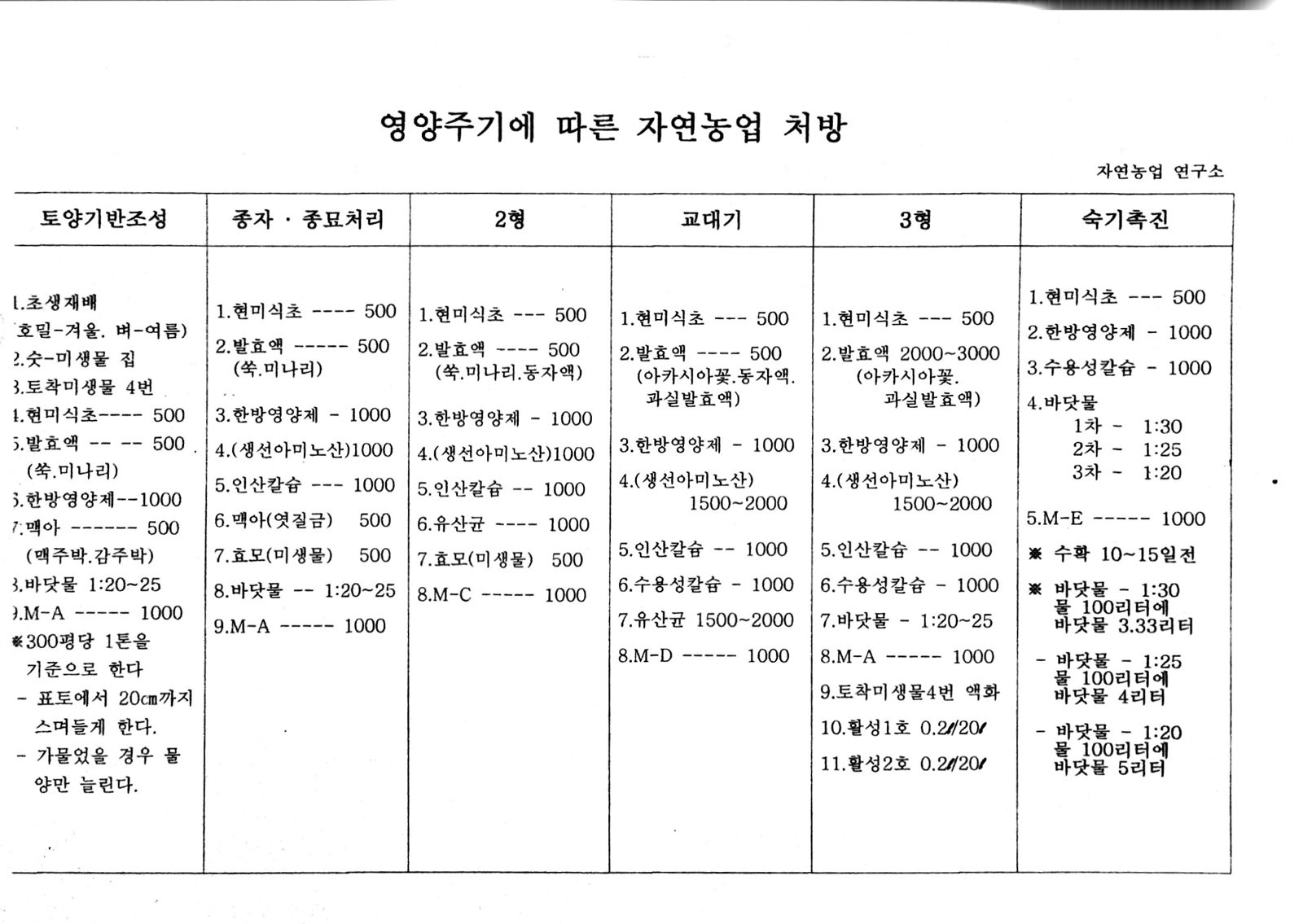
The Korean prescription handout (XFLH5606) is projected until about 2:02:40, then the rice chart (DJSS5255) again. Audience members ask about missed timing, coffee and papaya, the moon calendar, and avocado and lychee years, mostly relayed in Korean by the interpreter. From about 2:18:00 Cho draws leaf shapes on the flip chart: a long leaf, a triangle and a round leaf, then a branch carrying all three.
- Changeover (교대기): flower buds — Handout (shown, not read item by item): BRV 1:500; fermented juice 1:500 (acacia flower, 동자액, fruit ferment); OHN 1:1000; (FAA) 1:1500–2000; WCP 1:1000; WCA 1:1000; LAB 1:1500–2000; Mineral D 1:1000. Spoken: give it one week before the flower-bud date (June 24 for June 30). Cho stresses calcium phosphate (Structure, WCP) here, and says trees that flower and fruit at once, like coffee, need the changeover feeding for longer. No spoken rates.
- Type 3 (3형): sizing the fruit — Handout (shown, not read item by item): BRV 1:500; fermented juice 1:2000–3000 (acacia flower, fruit ferment); OHN 1:1000; (FAA) 1:1500–2000; WCP 1:1000; WCA 1:1000; seawater 1:20–25; Mineral A 1:1000; IMO No. 4 liquefied; 활성 1호 0.2 L / 20 L; 활성 2호 0.2 L / 20 L (the last two not explained). Spoken: give it a week before Type 3 begins (June 30 example). No spoken rates.
- Ripening promotion (숙기촉진): the brix shot — Handout: BRV 1:500; OHN 1:1000; water-soluble calcium (WCA) 1:1000; seawater 1st spray 1:30 (3.33 L per 100 L water), 2nd 1:25 (4 L), 3rd 1:20 (5 L); Mineral E 1:1000; '※ harvest 10–15 days before'. Spoken: Cho starts it 'a week before harvest' for mango, banana or papaya, sprays a week apart, and says sugar rises 2–3% (the interpreter later says 3%). The start differs: one week spoken, 10–15 days printed. Cho adds purslane (쇠비름) Food (FPJ) at about 1:1000 for color and shine; it is not on the Korean handout. Green-plant FPJ is left out because its nitrogen delays ripening.
- Rainy-year correction — Cho: in a rainy, cloudy year, give about double the calcium phosphate you'd give in a dry year. Interpreter: give calcium and water-soluble calcium phosphate together, extra. No base rate given here.
-
The prescriptions go by stage: seed and seedling, Type 2 for the trunk, changeover, Type 3 for the fruit, then ripening
Cho points at each column of the projected handout.
-
Ripening spray a week before harvest of mango, banana or papaya raises sugar 2–3%
Cho says a week before harvest; the handout says 10–15 days before. Seawater gets stronger each time: 1:30, then 1:25, then 1:20, a week apart (3.33, 4 and 5 L per 100 L on the handout).
▶ 1:55:57 As spoken
-
Green-plant Food (FPJ) is left out at ripening: its nitrogen delays ripening
Cho's answer to an audience member who noticed no FPJ in the column. Never put into English.
▶ 1:57:57 As spoken
-
The exception: purslane Food (FPJ) at about 1:1000 in the ripening spray, for color and gloss
Mango and papaya get good color and a shiny skin; 'it makes very high-grade fruit.' Cho: a purslane leaf is brilliant against the sun. Coffee gets its color too.
▶ 2:01:06 As spoken
-
Seawater, calcium and Medicine (OHN) at ripening raise the sugar; coffee tastes much better
Cho's sentence breaks off at 'the sugar…'; the interpreter gives 'like 3% higher'.
▶ 2:01:28 As spoken
-
Give each stage's prescription 5 days to a week before the stage begins
'If you give it then it won't line up, because there's time needed to absorb it. So give it five days ahead, it fits exactly, and you hit a home run.' He read the whole type sequence off the rice chart while saying it. Here (2:03:07) he says five days; at 2:10:00 and 2:17:16 he says a week, as he did for June 24 on Friday morning.
▶ 2:03:07 As spoken
-
Missed the window? Still give it
Answer to an audience question about missing the 5 days from inexperience.
▶ 2:06:03 As spoken
-
The flower is made during the changeover (보전생장), long before it opens; give calcium phosphate then
An open flower means 'the baby is already born'. A living thing that isn't the mother grows in her body, so prepare: give calcium phosphate. On trees that flower and fruit together, like coffee, the changeover feeding runs longer.
▶ 2:06:52 As spoken
-
Flowers that open this spring were made last year, between the end of June and July 5
Heard as '6월 31일' (June 31, no such date). The interpreter said only 'June to July'.
▶ 2:07:47 As spoken
-
If flower buds form June 30, give the changeover prescription June 24, a week before, and many buds are made
Here Cho says a week ahead; at 2:03:07 he said 5 days. Both are kept.
▶ 2:10:00 As spoken
-
Repeated changeover sprays on papaya, eggplant and tomato worked because one of them hit the timing
A farmer said giving it more often worked better. Cho: it isn't that more often is better; early, middle or late, one application hit the right moment, because these plants flower and fruit at once.
▶ 2:11:04 As spoken
-
The date matters, but watching the growth stage matters more
Answer to a question about moon phases. 'When you get married, do you fix the number of days until you have a baby?'
▶ 2:12:28 As spoken
-
Rice: one leaf at planting, two after about a week, transplant at 5–6 leaves, pregnant at 10–11; late pregnancy June 27 to July 2
Matches the chart (말기 6/27–7/2). If by those dates the plant hasn't reached 10–11 leaves, compare date and leaves and take the middle.
▶ 2:13:10 As spoken
-
Read the stage from the leaf: long = Type 2 (spring), triangle = Type 3 (summer), round = Type 4 (fall)
Drawn on the flip chart. On one fruit-tree branch the lowest leaves are round, the middle triangular, the tip leaves long. New leaves look like Type 2.
-
Many long leaves at harvest mean too much nitrogen, and lower-sugar fruit
Phosphate and calcium are short; nitrogen-loving bugs and disease come.
▶ 2:21:29 As spoken
-
Alternate bearing (해거리) follows last year's weather
After a dry year, many flowers and heavy fruit; if the year before was rainy, the tree doesn't bear. Asked about avocado and lychee years in Hawaiʻi.
▶ 2:24:49 As spoken
-
In a rainy, cloudy year, give about double the calcium phosphate
Clouds cut photosynthesis, so fewer stored nutrients are made and fewer flowers form; heavy rain also brings nitrogen down.
▶ 2:25:57 As spoken
-
Bring a rice plant or a cut branch to the next seminar; Cho can read it at a glance
Two courses a year for five or six years and natural farming will be settled in Hawaiʻi. Japanese farmers bring their crops.
▶ 2:27:55 As spoken
- Ripening start: Cho says one week before harvest; the handout says 10–15 days. Three sprays a week apart can't all fit in one week, so the printed window fits the series better.
- The 2–3% sugar rise (3% from the interpreter) is Cho's claim; no measurement was shown.
- Purslane FPJ is not on the Korean handout; the 1:1000 rate is spoken only.
- Cho says '5 days ahead' at 2:03:07 and 'a week ahead' at 2:10:00 and 2:17:16. Both are kept.
- The changeover and Type 3 columns were shown, not read item by item; 활성 1호 and 2호 are not explained.
- The June dates are Cho's examples, probably from Korea; 'June 31' is as heard.
- An audience member said the leaf shapes don't fit papaya leaves; that wasn't resolved before lunch.
- Cho also mentions purslane juice as a face toner and in lipstick; that's off-topic and not tested.
- Give each stage's prescription 5 to 7 days before the stage, so the plant has time to absorb it.
- If you missed the window, give it anyway.
- Next year's flowers are made in this year's changeover; feed WCP then, about a week before buds form.
- For the brix shot, step the seawater up 1:30, 1:25, 1:20 a week apart before harvest, and leave out green FPJ.
- Read the leaves: long leaves late in the season mean too much nitrogen.
- After a rainy year, expect a light crop and give more calcium phosphate.
Next to Master Cho's teaching
-
Differs
Ripening spray: one week before harvest, seawater 1:30, 1:25, 1:20 a week apart The dilutions match the prescription table, but the table says start 10–15 days before harvest, and his recipe book says seawater with water-soluble calcium 15–20 days before. Spoken here: one week.
Cho nutrient cycle prescription table (Oct 2017, transcribed) — Maturity Promotion (숙기촉진)
-
Agrees
Give each stage's solution 5 days early, for absorption He repeats the 5-day shift at the 2017 advanced fruit class: move each treatment forward so there's time to absorb it.
2017/Advanced Cho/advanced fruit/IMG_3202 @ 0:35:35 (translated)
-
Agrees
Changeover spray about a week before flower buds form His book treats the changeover as the plant's 'morning sickness' around floral differentiation and calls for phosphate then.
Cho, IMO and Vital Power of Crops and Livestock, p. 39–40
-
Agrees
Rainy, cloudy year: more calcium phosphate, fewer flower buds next year His 2005 text: low temperature and heavy rain weaken branches and hurt next year's flower-bud differentiation. 'Double' is a new number here.
CGNF Advanced (2005.05) (English translation), p. 21
“So give it five days ahead, it fits exactly, and you hit a home run.”
▶ 2:03:56
“You still have to give it.”
▶ 2:06:03
“If you say you farm by the calendar: when you get married, do you fix the number of days until you have a baby, and then have it?”
▶ 2:11:58
“One look and I can tell right away: ah, this one got too much of some fertilizer.”
▶ 2:28:06
In this talk
- 1:54:45The prescriptions by stage, projected
- 1:55:52Ripening: seawater 1:30, 1:25, 1:20; sugar up 2–3%
- 1:56:55Purslane Food for shine; why no green FPJ
- 2:02:18Give it five days early
- 2:05:12Questions: missed timing, coffee and papaya
- 2:06:24Flowers are made the summer before: June 24
- 2:11:34The moon calendar vs the growth stage
- 2:12:50Rice by leaf count
- 2:17:42Reading leaf shape: long, triangle, round
- 2:21:18Long leaves at harvest: too much nitrogen
- 2:24:04Alternate bearing and rainy years
- 2:26:52Come twice a year, bring your crops; lunch
Transcript
English translation, checked against the Korean as spoken.
1:54:46 The other one. The other one? Here, here, I got it. Oh. So here... Yeah. Oh. You saw the chart as a type 2 and type 3. Number 2 and 3 you saw, yeah? And then there's a changeover. At changeover time you use this prescription. So, changeover stage, the flowering stage, you give this nutrient. At Type 2, when you're building the trunk, you use this prescription. And here is the seed and seedling treatment.
그래서 여기... 교대기 때는 이런 처방으로 [하는 거죠]. 이형 때는, 몸통을 만들 때는 이걸 가지고 처방을 하고 그리고 여기는 종자, 종묘.
1:55:33 That's when you're treating the seed and the seedling. You give that nutrient. And here, it's sam-hyeong (Type 3). That's the type 3. The maturing stage of the fruit is getting big. That's the stage you give this nutrient. This is the ripening treatment. For example, for mango, banana or papaya, a week before harvest, If you give this prescription a week before harvest, the sugar goes up 2 to 3 percent. So when harvesting stage, you give this, about one week before harvest, you give this nutrient, this part, then sweetness
이건 숙기 처리인데, 예를 들어서 망고나 바나나, 파파야나, 수확기를 일주일 앞두고 수확기를 일주일 앞두고 이 처방을 하면은 당도가 2~3% 올라가.
1:56:25 goes up two to three percent. And even the water, sea water, the ratio is starting to change to much stronger. The first you give a 1 to 30, second one use 1 to 25 ratio, third one is 1 to 20 ratio, A week apart each time? Yes. Wait a week each time. each time you wait one week, each time. And you'll see purslane growing around here. 쇠비름 is purslane. So you make Food (FPJ) from that purslane, put it in with this ripening spray and spray it,
일주일마다 [간격이] 있겠죠? 네. 1주일에 한 번씩 기다리세요. 그리고 쇠비름을 보고 나오는데, 쇠비름이 퍼슬레인. 그래서 이제 그 쇠비름을 가지고 천혜녹즙을 만들어서 이 숙기 촉진 때 같이 넣어서 뿌려주면은
1:57:11 and the mango gets a really good color, and here it turns glossy. Make a fermented plant juice with purslane, then your mango, in case of a mango, it has a beautiful color like a citrus skin, it shines. So grow your purslane and make a fermented plant juice for this stage. I don't see FPJ in that stage. Oh! Why isn't fermented plant juice used here?
망고는 색깔이 아주 좋아지고, 여기가 빤딱빤딱해져. 왜 여기는 천혜녹즙을 안 쓰네요?
1:57:57 If you use green juice at this time, the nitrogen instead [unclear] ... ...so ripening gets delayed. So, if you want to make your fruit a beautiful color and shiny skin, Ah, then that purslane, when do you use it? The purslane fermented plant juice, the one that makes it shine? I'm explaining that right now. When you do this, the ripening promotion, you mix it in here. (Interpreter: Ah, ripening promotion.) use that purslane fermented plant juice just here, in this stage. So, um... what is it? What do you call 쇠비름 (purslane)?
이때 초록초록한 거 쓰면 질소만 오히려 [...] 때문에 숙기가 늦어진다고. 아, 그때 그러면은 그... 퍼슬레인 그거는 언제 써요? 천혜녹즙 퍼슬레인, 반짝반짝하게 그러는 거? 아, 그거 지금 내가 설명하잖아. 요거 할 때, 숙기촉진 줄 때 여기다 타는 거예요. (아, 숙기촉진.) 그래서 그... 뭐야? 쇠비름을 뭐라고?
1:58:49 Purslane. Purslane. Take that, make the ferment, mix it in water and wash your face with it: it's a fantastic toner. There is another tip for you, for yourself. Make a purslane fermented plant juice. You mix with water, you wash your face. It's a beauty product. Ladies, what's the thing you put on here? Lipstick. So, in the lipstick, do you know what they put in there to make it shine? It's purslane.
그거를 갖다가 그 발효액을 만들어가지고 그걸 물에 타가지고 세수를 하면 화장수가 기가 막힌 화장수죠. 여러분들, 여자들 여기다 바르는 거 뭐지? 립스틱.
1:59:45 Hold a purslane leaf up to the sunlight and the color is brilliant, isn't it. When you look at a purslane leaf under the sunlight, it is very transparent. When that gets onto the skin of a mango or papaya, it shines. The leaf is so clean, and that... Because the leaf is so transparent, that makes the fruit skin shine. And lipstick shines too, and coffee gets its color. And the lipstick shine.
그 쇠비름 이파리 햇빛에 비춰도 아주 색깔이 영롱하지. 그것이 망고나 파파야 껍데기에 묻으니까 빛나는 거예요. 그 잎이 너무 깨끗하고 그리고 그것이 그리고 립스틱도 빛나고, 커피는 색이 나는 거고.
2:00:30 And then it helps the coffee's color too. So here, at this ripening-promotion stage, if you put purslane fermented plant juice in with it, it makes very high-grade fruit. So when in this stage, if you add purslane fermented plant juice, it becomes a high quality fruit. How much concentration do you give? What? The... at most... Ah, the concentration. For purslane, about one part in a thousand. One to one thousand.
그래서 여기 이 숙기촉진 때 여기다 쇠비름 천혜녹즙을 같이 넣어주게 되면 아주 고급 과실로 만들어져요. 농도는 얼마큼 줘요? 뭐고? 그... 최고로... 아, 농도. 쇠비름 농도는 한 천분지 일.
2:01:19 Even just that gives a real shine. Even using a one to one thousand ratio, it gives you lots of shine. And at this time, if you give seawater, calcium and OHN, the sugar... So because if we use the OHN and the calcium and the ocean water and all that, the sweetness goes like 3% higher. So coffee too: if you do the ripening promotion then, the coffee will taste much better. So even the coffee, if you use this nutrient, the coffee tastes really good.
그렇게만 해도 아주 광이 난다. 그리고 이때 바닷물에다가 칼슘에다가 한방영양제, 이걸 주게 되면 당도가 그래서 커피도 그때 숙기촉진을 해주면 커피 맛이 훨씬 좋을 거예요.
2:02:08 So you saw the nutrient cycle and this recipe together, you're going to grow the best crops If you apply the nutritive cycle and the prescriptions together, in the whole world. So from taking the seed, [unclear], raising the sprout, and marrying it off, through to finishing the harvest, this process goes type 4, 3, 2, 2... 2, 3, 3, 3, 2, 3, as it's laid out here.
영양주기하고 처방하고 이걸 같이 응용을 하게 되면은 그래서 씨를 갖다가 [...] 키워가지고 시집 보내서 수확까지 끝낼 때 이 과정이 4형, 3형, 2형, 2형... 2형, 3형, 3형, 3형, 2형, 3형이 되어 있잖아.
2:03:06 What's prescribed here, for each period, you give it five days ahead. So actually, he says there's a ... to the harvesting, there is a date. But all these nutrients, you give these nutrients 5 days before this date. Do you understand? Yeah. That's very interesting. So, you need to give them before they need these nutrients, five days before.
이것대로 처방되어 있는 걸 이 시기에 5일 앞서 주는 거야.
2:03:56 When this period is that period, if you give it then it won't line up, because there's time needed to absorb it. So give it five days ahead, it fits exactly, and you hit a home run. So what he's saying, if you give on this day, it's already a little bit too late. So before this day comes, five days before, then they have time to absorb those nutrients to begin this stage. So you are hitting the home run. Can you understand? Do you understand? Yes. If you tried to learn this at a university or somewhere, it would take months. But you live it, and came together, so you understood quickly.
요 시기가 고 시기다 할 때 그때 주면 흡수하는 기간이 있기 때문에 안 맞잖아. 그래서 5일 앞서서 주면 딱 맞아서 마지막으로 홈런 치는 거야. 이해가 되세요? 이걸 여러분들이 대학교나 이런 데 가르치고 배우려고 하면은 몇 개월 배워야 배울 거라고. 그런데 여러분들은 생활하고 같이 와서 같이 이해를 하기가 빨리 된 거라고.
2:04:41 If you study this chart at the university, it will take a few months, because you practice and you live this natural farming life that's how you can understand so much better faster When is lunch? What time is lunch time? We have about 20 minutes. So you can have a question about this It's [lunch at] 12, so they say there are 20 minutes left. Do you want to rest?
점심시간이 언제야? 12시니까 20분 남았대요. 쉬실래요?
2:05:38 or if you cannot understand anything, for 20 minutes. Okay. If you miss five days before from inexperience, you do it when you see it? Or it's just, I mean, you have to do something, right? [Relaying] If someone, from lack of experience, didn't give it ahead of time and the period has arrived, what do they do? You still have to give it. Still you have to give. So coffee has fruit and flowers at the same time. [Relaying] And flowers at the same time. Papaya. [Relaying] Especially coffee or papaya: flowers and fruit form together.
자기가 경험이 없어서 오래 전에 못 주고 그 시기가 왔으면 어떻게 하는가. 그래도 줘야지. 그리고 꽃들도 동시에. 특히 커피나 파파야 그러면 꽃하고 열매가 같이 생겨요.
2:06:24 That means the flowers are blooming at the same time. For the flower to bloom, isn't there a pregnancy period? Saying the flower has bloomed is talking about now: it's given birth, the baby is out and growing; that's what it means. The flower itself was made before that; it got pregnant earlier. That is the supplementary growth period (보전생장기). It's supplementary growth (보전생장). What is that? For fruit to set, the flower has to be made first. Only then does the flower open and the fruit set.
꽃이 피는 거가 같이 핀다는 얘기고, 그 꽃이 피기 위해서 임신 [장무] 기간이 있지 않나. 꽃이 피었다는 얘기는 지금 얘기인데, 분만해가지고 애기도 나왔고 자라고 있다, 그런 얘기가 되는 거고. 그 꽃이 만들어진 건 그 전에 임신했잖아요. 그것이 보전생장기야. 보전생장인데, 이건 뭐냐 그러면, 열매가 맺기 위해서 꽃이 먼저 만들어져야 되거든요. 그래야 꽃이 펴서 열매가 맺어지고.
2:07:10 So that period is the supplementary period, and this... The mother's body is growing, right? But the baby isn't the mother's body. A living thing that isn't the mother is growing inside the mother's body. You have to prepare for that. So you give calcium phosphate, so for trees like that, the changeover feeding runs a bit longer. It runs long, and coffee too. The flowers that bloom this spring were made last year, between June 31 [sic; end of June] and July 5. So, in that case, even before the flowering,
그러면 그 기간이 보전 기간인데, 이것은... 엄마 몸이 자라고 있지? 그런데 아기는 엄마 몸이 아니잖아요. 엄마 몸에 엄마가 아닌 생명체가 자라고 있는 거지. 그런 거에 대한 준비를 해야 되거든요. 그래서 인산칼슘을 주고 그러니까 그런 나무는 교대기는 조금 더 오래 주는 게 되는 거죠. 그게 오래 되는 건데, 커피도. 금년 봄에 꽃필 것이 지난해에 6월 31일부터 7월 5일 사이에 만들어지는 거라고.
2:07:58 they are already pregnant. When it flowers, it has already given up the baby, and then the baby is growing because the food is already in there. So he told us, the previous year between June to July we need to give that nutrient already. So if you miss those nutrients at that time, you're going to have a less successful, I think. So if you give those nutrients one year ahead, on that June to between the July, you have very good crops. So he said actually that
2:08:48 flower and fruit, that nutrient length is a little bit longer. Because before flower, we still have to feed them, right? Yeah? No, no? Okay. So look here, there's the changeover period, the changeover. This period [unclear] ... until next spring ... is this period. So this is like they are preparing their pregnancy from the year ahead already, this plant, these crops.
그래서 여기 보면 교대기가 있잖아, 교대기. 요 시기 [...] 다음 봄에 [...] 까지 기간이 이 기간이라고.
2:09:45 So that's why you need to give these nutrients in June and July. So that's why we call it the changeover. [unclear] So you have to always feed them one week ago. It's June 30, so a week before that is June 24. If you give this prescription on June 24, lots of flower buds get made. It's starting, actual flowering starts June 30th, so you need to give June 24th, one week before. And if I already missed it, I just...
그래서 그것을 교대기라고 얘기해서 [...] 6월 30일이니까 거기서 일주일 전이니까 6월 24일, 6월 24일에 이 처방을 내려주면 꽃눈이 많이 만들어지는 거예요.
2:10:32 But I noticed when I give papaya plants and the flowering and fruiting plants, I give this changeover more often. It works better. I noticed that. [Relaying] What he said was: when he grew papaya, eggplant and tomato, he found he should give this changeover more often, and then it did better. He told us his experience. It's not that giving it often made it work; it means he did the timing many times over. So that's fine. You don't know whether the early one hit, the late one, or the middle one, but one of them hit, didn't it?
내가 뭐라 그랬냐면요. 내가 그 파파야나 가지나 토마토 그거를 길러볼 때 이 교대기를 더 자주 줘야 되겠더라고. 그러니까 더 잘 되더라고. 경험을 이야기해줬는데, 자주 줘서 잘 되는 게 아니라 그 시기를 맞추는 걸 여러 번 해줬다는 얘기예요. 그러니까 괜찮은 거예요. 어느 게 앞에 께 맞았는지 뒤에 께 맞았는지 가운데 께 맞았는지 모르지만 [그중에] 맞은 거 아니에요.
2:11:18 Because on those plants the flowers and fruit always come together. So because it is flower and fruit, you need to give more often on a changeover. How relevant are the moon phases to all this? [Relaying] That man says he farms by the calendar. How does that relate? If you say you farm by the calendar: when you get married, do you fix the number of days until you have a baby, and then have it?
왜냐면 그 놈이 꽃과 열매가 항상 같이 피어요. 저 사람은 달력을 보고 농사를 한대요. 그거하고는 어떻게 관계가 됩니까? 달력 보고 농사짓는다고 한다고 그러면, 결혼해가지고 며칠 만에 아기 갖는다고 정해가지고 결혼해서 아기 낳나?
2:12:08 If you are farming according to the moon, I want to ask you, do you have baby according to the moon? A lot of people breed and things do, yeah. So when raising crops the date matters too, but watching the growth process is what matters. Plant that way. So when you are farming with each crop, it's very important to look at the date also, but the nutrient cycle is more important. Now, look here. When you plant rice, right away one comes up.
그래서 작물을 기를 때 날짜도 중요하지만 그 생육 과정을 보는 것이 중요합니다. 자, 여기 보세요. 벼를 심으면 말이지, 바로 뭐냐, 하나가 올라오지.
2:13:00 When you plant the rice plant, only one leaf comes up. Then in about a week, two [leaves] come up. Then when it gets to about ten days [heard '20컵'/'이식후'], how many leaves? Five or six come out. When it has five or six leaves, you transplant it. When the leaves reach ten, eleven, it becomes pregnant.
그러면서 그것이 한 일주일쯤 되면은 두 [잎이] 올라오지. 그래가지고 그것이 [...] 한 열흘 정도 되게 되면, 열흘 정도 되면 이파리가 몇 개냐면 다섯 내지 여섯 개가 나온다고. 그런데 그것이 다섯 내지 여섯 개 이파리일 때 이식을 하지. 이파리가 열 개, 열한 개가 되게 되면 임신이 되는 거예요.
2:13:47 Okay, so when they have five to six leaves, they move to the field and plant. And then from there, their leaves 10 to 11, actually at that time they're already pregnant. So in this stage, after we are pregnant, this is the end of the pregnancy right now. So now it's late pregnancy. Late pregnancy is June 27 to July 2. But sometimes even on June 27 to July 2 the leaves haven't reached [eleven], right? Sometimes, even at the end of the pregnancy, if you observe the crop, they don't have 10 leaves or 11 leaves, it has fewer leaves sometimes.
그래서 이제 임신 말기예요. 임신 말기 하면 6월 27일, 7월 2일이 임신 말기야. 그런데 6월 27일 내지 7월 2일 되는데도 이파리가 [열한 개가] 안 됐다고 할 때도 있잖아.
2:14:43 So you have to Then you compare the date and the leaves and take the middle. combine together your leaf and the date. Leaf number and the date. You have to combine together so it's kind of in the middle stage. Do you understand what I mean? Do you understand what I'm saying? Got it? (Interpreter:) They say they don't understand. (Cho:) They don't know. So I need to compare with a human being again. Then I have to bring it back to people again.
그럴 때는 날짜하고 이파리하고 비교해서 중간치를 잡아야지. 무슨 말인지 아시겠어요? 알았어요? 모르겠대요. 몰라. 그러고 그걸 다시 또 사람으로 돌려줘야 돼.
2:15:28 So when you get married, and then when the egg comes out, and then the seed has to When you marry and [unclear] ovulation comes, when ovulation comes, that's when the sperm has to go in for a pregnancy. come meet the egg right? So that's how a baby is made. So when the baby is made, it grows in the belly. It has to grow in the womb, right? And that growing isn't something you count by the calendar; inside the mother's belly, this one...
결혼해가지고 [...] 배란이, 이런 배란이 될 때 그때 정자가 들어가야 임신이 되며 그래서 애기가 생긴 거예요. 그래서 애기가 생겼을 때 애기가 배 안에서 커요. 자궁 안에서 커야 될 거 아니에요. 그래, 그 크는 것이 날짜대로 따질 게 아니라 엄마가 뱃속에서 말이지 얘가
2:16:19 ...kicks [heard 밝히기도] and so on. There are times like that, right? So the baby is starting to grow. They need to grow, but then sometimes they kick mom's stomach. So just like the human will kick mom's stomach, all these crops have those kind of stage. Just like that, rice, mango and papaya have periods like that too. At that time you have to see whether this is type 2 time or type 3 time. You have to observe and you have to recognize that.
그냥 밝히기도 하고 말이야. 그럴 때가 있지 않아. 그런 거 있는 것과 마찬가지로 벼도 망고도 파파야도 그런 시기가 있다 이거야. 그때가 이것이 2형 때냐 3형 때냐 이걸 봐야 되거든요.
2:17:06 So if you think, ah, this will be type 3 time [heard 사명], take the remedy for type 3, and say it's June 30. Then you have to give it a week ahead of that to hit a home run on June 30. Okay, so you recognize that, oh, this is going to be type three, and if you recognize that, before it goes into this stage, you need to give the nutrient one week before. So how do you tell whether this is type 2 or type 3? The leaves.
그래서 아, 이때가 3형 때가 되겠다 생각하면은 3형에 대한 치유 방안을 갖다가 만약에 6월 30일이다. 그러면 그거보다 일주일을 앞서서 줘야 6월 30일에 홈런을 치는 거지. 그런데 이것이 2형이냐 3형이냐 알 땐 뭐냐 그러면, 이파리가.
2:17:53 To recognize that the crop is type 2 stage or 3 stage, To recognize. The leaf shape... spring leaves are narrow and long like this. Summer leaves are triangular. Fall leaves are round. So if your leaf is long, that's the spring season, You look at this: this is a type 2 leaf, this is a type 3 leaf, this is a type 4 leaf. That's how you read it.
이파리 모양이... 봄 이파리는 이렇게 좁고 길어. 여름 이파리는 삼각형이야. 가을 이파리는 동그래. 이걸 보고 이거는 2형 이파리, 이건 3형 이파리, 이건 4형 이파리 그렇게 보는 거라.
2:18:51 and then when the leaf is a triangle shape, that's the summer season. When you have a leaf that has a round shape, that's a fall season. So when you have this type, that means type 2, and this is a type 3, and this is Fall. I mean, type 4. this is a type four. So can you understand? Not with the papaya leaf. I don't understand the papaya leaf. Okay, again, we're gonna explain differently.
가을, 아니 그러니까 4형.
2:19:47 Look at the stem of a fruit tree; it's like this, right? The lowest leaf is round, the middle leaf is triangular, and the leaf up here is long. That's how it is, right? So this one here is a type 2 leaf, this one is a type 3 leaf, and this leaf [type 4]... that's how it goes. On the same stem, this part is type 2 growth, this part type 3 growth, and this part type 4 growth.
그 나무 줄거리, 과실나무 줄거리를 보면 이렇게 되어 있잖아. 제일 아래 이파리는 동그랗고 중간 이파리는 삼각형이고 여기 이파리는 길고 그렇게 되어 있잖아요. 그럼 여기 이것이 2형 이파리고, 여기 이것이 3형 이파리고, 여기 이파리가 [...] 그렇게 된다고 말이에요. 여기는 같은 줄기라도 여기는 2형 생장이고, 여기는 3형 생장이고, 여기는 4형 생장이라는 말이에요.
2:20:32 So if you look at the fruit trees' branches, there are three different shapes of the leaves. So if you look at the bottom of the leaf, then it's round. So that means type 4. And then when you go up, you will see a little bit like a triangle shape leaf. That's a type 3. And then towards the end, their leaf is kind of long. That's a type 2. New leaf looks like a type 2. So, it's supposed to be harvest time, we need to harvest the fruit, and they observe the leaves.
2:21:18 But say the fruit on the tree is now ripening and should be harvested, and there are still lots of leaves like this. Then, looking at that, there's a lot of nitrogen. Too much nitrogen. So even when you harvest, the fruit is lower in sugar. If leaves are this long like this, that means that tree has too much nitrogen. There should be phosphate and calcium [unclear]...
그런데 지금 나무 열매가 익을 때, 익어야 되는데 그때도 이런 이파리가 많다고 되는 거예요. 그러면 그걸 보니까 질소가 많은 거죠. 질소가 많은 거예요. 많으니까 수확해도 당도가 떨어지는 과일로 되는 거죠. 인산하고 칼슘이 있어야 될 텐데 [...]
2:22:06 Nitrogen has built up, so it's the time when nitrogen-loving bugs come. And rather than a [proper] nutritive state, it's in menopause [unclear]. So if you see lots of these things, these long leaves in your harvesting time, there is a lack of the, what is it, water-soluble calcium phosphate, and too much nitrogen. So when you have too much nitrogen, bugs and disease attack. That's how you recognize. Drake. Draw the pictures and make one guide out of it.
질소가 많아졌으니까 질소를 좋아하는 벌레가 오는 때라고. 그리고 영양상태보다는 갱년기거든요. 그림을 그려가지고 하나의 설명서를 만들어.
2:22:52 So Drake, can you draw a picture and then make a chart? Yeah. Yeah, please. Take a picture. Not right now, yeah. Drake has to draw it for you, so it can be explained. Great, Drake's gonna make a chart and then he will explain one day. This time in Korea, at the specialist training for fruit trees and crops, this will be almost all nutritive cycle. So when he has the next advanced class in Korea, that's what he is going to teach in more detail, on this part,
저, 드레이크가 여러분들 그림을 그려야 설명을 할 수 있을 테니까. 이번에 한국에서 과수, 작물 전문연수 할 때 이게 거의 다 영양주기예요.
2:23:41 the nutrient cycle. So if you know this properly, a mother can manage her daughters' and sons' nutrition. If you learn this one, if you totally understand, even you can You can raise your daughter and the son very well. Hawaii has a natural cycle of things. Some years it's avocado season. Some years it's lychee season. And so if I have an avocado tree and it's a lychee year, with a nutrient cycle, can I still have a lot of avocado?
그래서 이걸 제대로 알면 딸 아들들의 영양관리를 엄마가 할 수가 있는 거예요.
2:24:27 [Relaying] In Hawaiʻi, oddly, some years there are lots of avocados and some years lots of lychee. If you do this in the year a tree isn't bearing, will it bear well? Of course. It's called haegeori (alternate bearing). One year it bears a lot and one year it doesn't; that's what's called haegeori. In a rainy year, it's because last year was dry that there were many flowers and lots of fruit set, but in a dry year, if it rained a lot the year before, it won't bear. Oh, it's like this, because we have, they say, that's like yearly, they have a year, yeah, and they give you crops.
하와이에는 이상하게 어떤 해에는 아보카도가 되게 많이 나오고 어떤 해에는 라이치가 되게 많이 나오고 그런데 열매가 잘 안 나오는 나무 해에 이거를 하면 열매가 잘 나오나? 물론. 해거리라고 하는 건데, 한 해는 많이 나오고 한 해는 안 나오고, 그걸 해거리라고 하는 건데. 비가 많이 오는 해는 지난해에 가물었기 때문에 꽃이 많이 있어가지고 열매가 많이 열리는데, 가문 해, 지난해에 비가 많이 왔다 그러면 안 열리는 거예요.
2:25:20 So when it's dry and then that year, it will give you lots of flower and fruit. But then this one year it has lots of rain, then they wouldn't give you fruit. That's how, that's why they're alternating. And in a rainy year you have to give more calcium phosphate. With clouds, if it's overcast, the plant can't do much carbon assimilation (photosynthesis), right? With less photosynthesis, the stored nutrients don't get made, and when the stored nutrients aren't made, fewer flowers are formed. So that year, if you give about double the calcium phosphate compared with a year without rain,
그리고 비가 많이 오는 해는 인산칼슘을 더 많이 줘야 구름이 끼어서, 만약에 구름이 끼어 있다면 탄소동화를 많이 못 하잖아요. 탄소동화를 덜 하면 축적양분이 지어지지 않고, 축적양분이 지어지지 않으면 꽃은 덜 만들어지지. 그냥 그 해에는 인산칼슘을 비가 오지 않는 해보다 배 정도 주면은
2:26:07 So to correct that, if it's rain or not, you need to give a double amount of water-soluble calcium phosphate. Then you will have a, that tree will give you fruits. When it rains a lot, a lot of nitrogen comes down with it. So also when it rains, lots of nitrogen is coming down. So when you have lots of nitrogen, they don't like the flower and the fruit. So that's why you need to give calcium and water-soluble calcium phosphate together. Yeah, extra. So you guys come to have a seminar two times a year, this natural farming seminar.
그래서 비가 많이 오면 질소가 많이 따라 내려오잖아요.
2:26:51 Then if you take a course like this about twice a year, comparing it with your own farming, you'll understand what's said here right away. After five or six years of that, natural farming would be firmly settled in Hawaiʻi. seminar. If you do that about five years, you guys are going to be really, really good farmers, and then we can spread this natural farming very fast, and you're going to be very excellent farmers. At that time bring [your fruit / crops] [unclear]. So when we have this seminar, from next time, bring your crops when you come.
그러면 1년에 두 번 정도 이렇게 강습을 하면은 자기가 농사짓는 것과 비교해서 여기서 얘기하는 말이 금방 알아들을 거야. 그렇게 5-6년 지나가면 하와이에 자연농업이 정착이 딱 될 거라고. 그럴 때 이 [...]를 가져오라고요.
2:27:45 That's what Japan does. All the Japanese natural farming people, when Master Cho gives a seminar, they bring all their crops, abundance. Then pull up a seedling and bring it, or cut a tree branch and bring it. When I look at the branch [unclear]... one look and I can tell right away: ah, this one got too much of some fertilizer. So that time also bring, if you grow rice, bring one plant. If you grow fruit trees, cut their branches and bring them in. Then we can look at this growth and the shape of their leaves. We can tell you what is going on.
그러면 그때 묘를 뽑아와 주든지, 나무 가지를 잘라서 [오든지]. 나무 가지를 봤을 때 [...] 딱 보고는 아, 이건 무슨 거름이 지나쳤구나 금방 알 수 있어요.
2:28:31 Oh, it's time. It's lunch time. We are going to have lunch. Come on, have a little bit more food.