Send a Dowry at Transplant, Then Read the 180-Day Chart
Master Cho Han-kyu, interpreted by Kim Chang, Founder of Korean Natural Farming (Janong)
Spoken in Korean. Translated to English and checked line by line.
Video of this visit will be added to the members' archive. The transcript times below match that recording.
Rice goes to the field on May 5. Cho's dowry story: like a father sending a daughter off with money, give extra at the end of Type 2 so the transplant roots in and fruits. He says Natural Farming is a work in progress that Hawaiʻi must build for its own weather, then walks the rice chart by date and leaf count, calls rice a 180-day crop, warns against overfeeding, and reads the nitrogen, phosphorus, potassium and calcium needs of each stage.
What they found
When does the crop need its extra feeding, and how do you read a stage chart to know what to give?
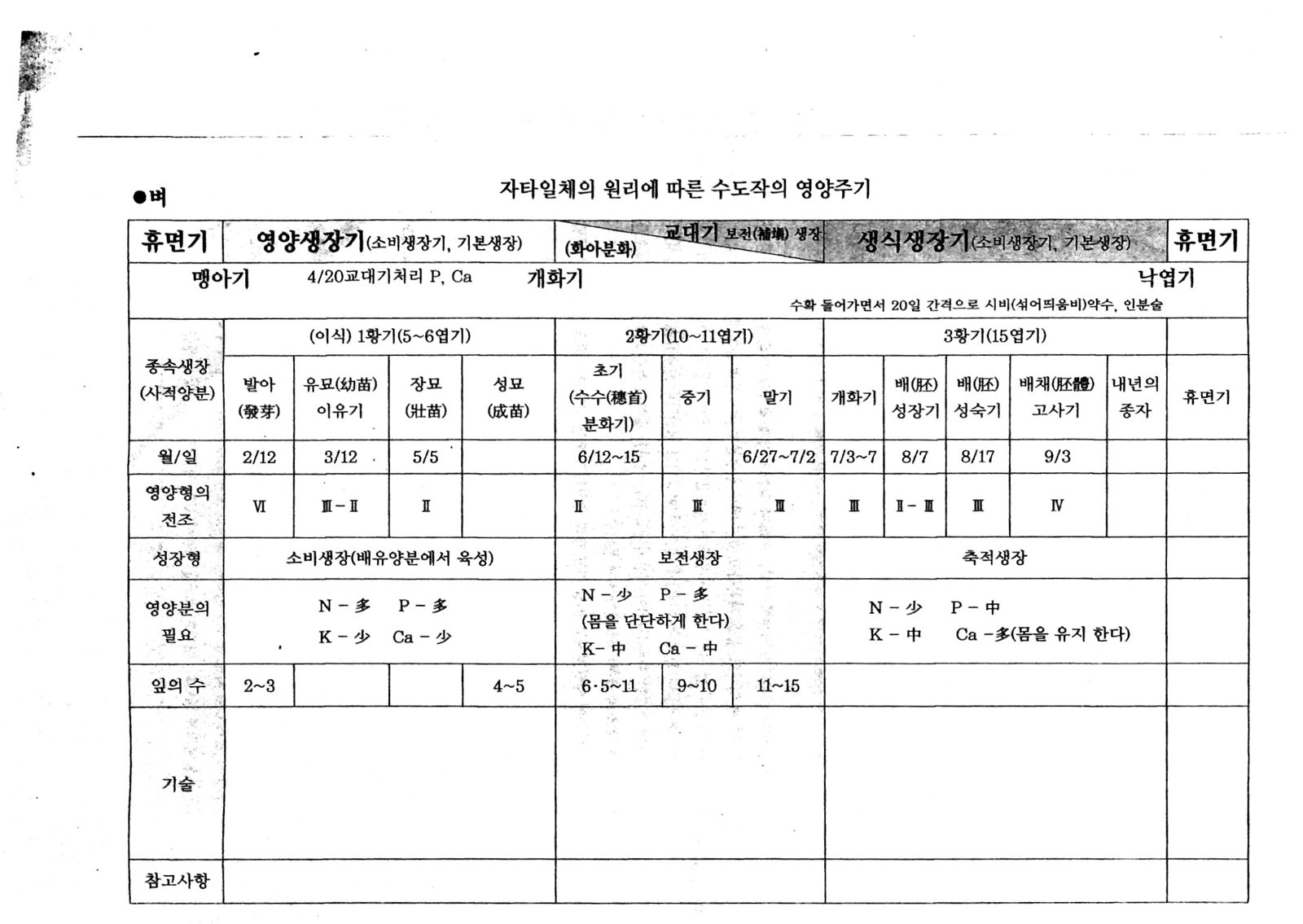
The rice chart (DJSS5255) is projected for the whole page; Cho points with a long pointer, partly seated after about 1:40. Dates and leaf counts here were read off the chart and checked against the photo. Drake made an English version of the chart overnight that marks levels H, M and L.
- The dowry: extra feeding at the end of Type 2 (transplanting) — No recipe or rate given on this page. Cho: give it at the end of Type 2, when the seedling 'marries' into the field (rice, May 5); she keeps the money and spends it when she's pregnant. The interpreter: 'That's why we're using Type 2 right before getting married.' The handout has no separate dowry column; its Type 2 column is on page 4.
- Nutrient needs by stage (rice chart, DJSS5255) — Vegetative, consumptive growth (Type 2): N high, P high, K low, Ca low. Changeover, conservation growth: N low, P high, K medium, Ca medium ('makes the body firm'). Reproductive, accumulating growth: N low, P medium, K medium, Ca high ('maintains the body'). Cho's Korean matches the chart throughout; the interpreter said 'lots of calcium phosphate' for the reproductive stage, where the chart and Cho have phosphorus medium.
-
Rice is transplanted at the strong-seedling stage, May 5, and gets Type 2 again in the main field
Chart: 장묘 5/5, type II. The second half is the interpreter's.
▶ 1:24:37 From the slides
-
Give the extra feeding at the end of Type 2, at transplanting, like a dowry
Type 2 builds the trunk, like a daughter at home until about 22. Given at the end of Type 2, the crop roots in (착근) well in the field and fruits well.
▶ 1:29:23 As spoken
-
Make your solutions ahead of time so the right one is ready at the right stage
Without it, the crop gets 'inner sickness': disease and bug attack, and fruit that doesn't form and falls (interpreter).
▶ 1:31:09 As spoken
-
Natural Farming is a work in progress; Hawaiʻi has to build its own cycle for its own weather
Taiwan, Hong Kong, China and Korea all differ. CGNF should gather each region's results into a global Natural Farming standard. Cho's new book, combining his roughly ten Korean books with about 300 photos, was due by the end of November 2017.
▶ 1:34:00 As spoken
-
Rice chart dates: sprouting 2/12, young seedling 3/12, strong seedling 5/5, second stage 6/12–15 to 6/27–7/2
Then flowering 7/3–7, embryo growth 8/7, embryo ripening 8/17, 9/3. The interpreter misread 6/27–7/2 as 'June 12th to July 22nd'.
▶ 1:39:25 From the slides
-
Rice by leaf count: transplant (first stage) at 5–6 leaves, second stage 10–11 leaves, third stage 15 leaves
Look at the date, the type the plant should be in and the leaf count, and at a glance you know which stage it is and what to give.
▶ 1:39:35 From the slides
-
Rice is a 180-day crop: seed in February 12, harvest September 2
Chart's last date is 9/3. Cho: papaya or banana in Hawaiʻi, from flower to harvest, works out to 180 days 'just the same'.
▶ 1:42:53 As spoken
-
Divide a 180-day chart for your crop and it tells you what to give on which days, and what the plant should look like
Hold the chart up against the crop and you can tell whether you are late or early, then adjust with the nutrients, instead of wandering the field.
▶ 1:44:10 As spoken
-
The same kind of chart works for chickens, pigs and cattle
Feed and nutrients matched to each period; they don't get sick and they develop well.
▶ 1:45:27 As spoken
-
Plants and animals get sick more from eating too much than from hunger: fertilize a little short of enough
Given a little less than enough, it's taken up well and the plant grows sturdy. 'Less is more' (interpreter).
▶ 1:47:49 As spoken
-
Coffee given too much fertilizer drops more fruit
Cho's example for overfeeding.
▶ 1:48:26 As spoken
-
Vegetative growth (Type 2): nitrogen high, phosphorus high, potassium low, calcium low
Chart 소비생장 (raised on the endosperm, 'the mother's milk'): N多 P多 K少 Ca少. 'This is the fertilizer that builds up the body.'
▶ 1:48:50 From the slides
-
The VI printed under sprouting is a mistake for IV; IV is the seed stage, at harvest and at planting
Raised by the interpreter and Drake; Cho: 'Number 4.'
▶ 1:50:36 From the slides
-
Changeover (conservation growth): nitrogen low, phosphorus high, potassium medium, calcium medium
Chart 보전생장: N少 P多 K中 Ca中, 'makes the body firm'. Leaf counts 6.5–11, 9–10, 11–15 (Cho read them like dates).
▶ 1:51:26 From the slides
-
Reproductive (accumulating) growth: nitrogen low, phosphorus medium, potassium medium, calcium high
Chart 축적생장: N少 P中 K中 Ca多, 'maintains the body'. For fruit trees this is also when next spring's flowers are prepared. Then it goes to seed.
▶ 1:53:36 From the slides
- The dowry is a picture, not a recipe: no rate or formula is given on this page, and the handout has no dowry column.
- All dates are for rice in Korea. Cho asks Hawaiʻi to build its own chart.
- The chart prints VI under sprouting; Cho says it should be IV.
- '180 days' for papaya and banana is Cho's rough figure, not worked out on tape.
- Several dates and leaf counts were misheard by the interpreter and the machine passes; the chart photo was used to settle them.
- Cho's dowry story includes a bride whose stress ends in miscarriage, and he says going hungry heals people's sickness. Those are claims about people, not tested, and we don't repeat them as advice.
- Make your solutions ahead, so each is ready when its stage arrives.
- Give the extra feeding at the end of the vegetative stage, at transplanting, to assist the crop in rooting in.
- Feed a little short of enough; overfeeding brings sickness and fruit drop.
- Early growth wants nitrogen and phosphorus; the changeover wants phosphorus; fruiting wants calcium.
- Keep a dated, leaf-counted chart for your own crop, and use it to tell whether you're early or late.
Next to Master Cho's teaching
-
Agrees
Rice chart: dates, leaf counts and N/P/K/Ca by stage The projected chart is the same table printed in the Plant Textbook: same dates, leaf counts and N/P/K/Ca levels, including the VI under germination that Cho corrects to IV here.
CGNF Plant Textbook, p. 78–79
-
Agrees
Overfeeding causes disease; feed a little short of enough The textbook compares fertilizing rice to meals and says eating to about 80% full keeps the stomach healthy; overfed early, the crop can't take food when it matters.
CGNF Plant Textbook, p. 39–40
“Natural Farming is a work in progress.”
▶ 1:34:00
“So with crops too, when you fertilize, give a little short of enough; then it's taken up well and the plant grows sturdy.”
▶ 1:47:49
“Less is more.”
▶ 1:48:13
In this talk
- 1:24:33Transplant May 5, and the dowry
- 1:28:52Give the dowry at the end of Type 2
- 1:31:05Get ready ahead, or the crop gets sick
- 1:33:51Natural Farming is a work in progress
- 1:36:04Cho's new book
- 1:38:39Reading the rice chart by date and leaf count
- 1:42:53180-day crops: make your own chart
- 1:45:59Overfeeding makes them sick; less is more
- 1:48:44N, P, K and calcium by stage (and VI should be IV)
Transcript
English translation, checked against the Korean as spoken.
1:24:36 So here is [weaning]. And this is the strong-seedling stage, May 5, when you transplant the seedlings. So there is a, after baby became a seedling, we moved to the field. So we moved to the field. So that's the main field. We use a type 2 again. So you have to transplant the seedlings then. Everyone, in Hawaii, when you marry off a daughter, do you send her with a dowry, or just send her? When your daughter is getting married, do you have a dowry? No.
그래서 여기가 [이유기]야. 그리고 이것이 장묘기, 5월 5일날에 모를 낼 때. 그래서 [이때] 모를 내야 되는데, 여러분들, 하와이에서 딸 시집 보낼 때 지참금 줘서 보내나, 그냥 보내나?
1:25:23 Dowry. Do we have those? What do you think? Huh? Cash? Cash? ... They say there's no such thing. There's none of that. In that case, his father is doing rice farming. I don't think that's the translation in [English], but they, I don't know, in English, I don't know, they don't have that word.
어때요? 어? 그게 캐시? 캐시? ... 그런 게 없대요. 그런 거 없어요.
1:26:12 Then think of it this way. The daughter has married into her husband's family and isn't used to it yet, and she needs pocket money. Can she ask her husband for it? Can she ask her mother-in-law? She needs some money. Can she ask money to her husband or her mother-in-law? [She can't ask, can she?] They say she can't. Right, she can't. She'd have to suffer it inwardly, wouldn't she? But still she needs some money. So the father should think ahead and send her off with some money; then her married life goes well.
그러면 이렇게 생각해 봐. 딸이 시집가가지고 시집에 아직 익숙해지지 않았는데 용돈이 필요해. 그러면 남편 보고 달랠 수 있고, 시어머니 보고 달랠 수 있고? [못 달래죠?] 그럴 수가 없대요. 예, 그럴 수가 없지. 속으로 [앓아야] 될 거 아니야. 그러면 아빠가 [미리] 생각을 해서 그 돈을 좀 줘서 보내야 시집살이가 잘 되거든요.
1:27:02 So if her father is more wise, he should think of those things. spending money and then send her away. Then there would be no problem. Is it easier to send her with money, or easier to send her with nothing? So for your parents' situation, do you feel more better with some money, or send her away without anything? Yes, I think the parents would feel easier sending her with a little money.
주고서 보내는 게 편해? 그냥 보내는 게 편해? 예, 부모가 돈을 조금 줘서 보내면 더 마음이 편할 것 같아요.
1:27:50 That's right. That's how we get it. Yes, and the daughter with a little bit of money. So in that stage, think of it that way, that your daughter is getting married to other family. So this side is living with her parents. This side is her parents' home, This is after she got married and lived with in-laws. So when she marries she has to take a little dowry with her, right? So when you send your daughter to in-laws, send with some money.
이쪽은 친정집이고 그래서 시집갈 때 지참금을 조금 가져가야 되잖아
1:28:51 Here, Type 2 builds up the trunk. This is her life at her parents' home, up to about twenty-two. So she marries. And once she marries, what happens? She gets pregnant. Once she's pregnant, she has things to spend money on. So she has to have that money in hand ahead of time. So when should you give her this money? At the end of Type 2: if you give her money when she marries, she holds on to it and spends it when the time comes. Then the crop roots in well in the field it was transplanted to, and it fruits well. That's the point.
여기에서 이형이 몸통을 길러서 이것이 친정에서 스무 두 살 정도까지 친정을 다하는 거예요. 그래서 시집을 가잖아요. 시집을 가게 되면 뭐예요. 임신이 되잖아요. 임신 되고 난 다음에 용돈 쓸 게 생기잖아요. 그럼 이때 돈을 갖다가 미리 가지고 있어야 될 거잖아요. 그럼 이 돈을 언제 줘야 되느냐. 이형 말기에, 시집갈 때 돈을 주면 가지고 있다가 그때 돈을 쓰게 되거든. 그러면 작물이 정식한 밭에서 착근이 잘 되고 열매가 잘 열린다 이거죠.
1:29:36 So this is like still the, what do you call it, right before she getting married. yeah so we have to give right before she getting married she need to have some money that's the money and then she got pregnant and then started to have a baby this is a fruiting stage to have a fruiting stage she needs some money, that she needs to spend it, that means absorbing some nutrient. That's why we have to give this nutrient at that time. That's why we're using Type 2 right
1:30:25 before getting married. Can you understand it? Yeah, okay. They say they understand. So, even if you don't know much about crops... It's not mine. Before I get slapped. So you're people who farm, aren't you? Farmers have to know this and get ready well in advance.
알겠대요. 그래서 이걸 갖다 작물에 대해서 잘 모르겠지만 그래서 농사짓는 사람들 아닙니까? 농민들은 그걸 알고서 미리 미리 준비를 해놔야 된다
1:31:12 That's what I'm telling you. So if you are farming, you need to prepare all of these so you can give the right nutrient at the right time. So you need to make all of these inputs. If she has no money to spend at this time, she just worries, doesn't she? She just gets sick. So in this stage, if you didn't give that nutrient, they start to get sick. they start having a disease and bug attack and all that. And what kind of sickness comes at this time? An inner sickness, a sickness of the heart.
그런 말을 하는 것이기 때문에 이때 쓰는 돈이 없으면 그냥 걱정이 되잖아요. 그냥 병 걸리는 거예요. 이때 병이 대개 무슨 병이냐면 속병이 걸리는 거예요. 마음의 병이.
1:31:58 In human beings, at this time, because she didn't have money to spend, she has stress inside. That's why they get sick. So that stress is really high, you could lose baby. So that sickness [unclear] ends in a miscarriage [unclear]. That's why all this fruit is not forming and keep falling down. If you have a little bit more money, actually that nutrient, then you will have a calm life and have beautiful babies. If the parents know this ahead of time and send her off with a little dowry, her mind is at ease, so she doesn't get sick and the baby grows well.
그래서 그 병이 [불명확] 유산으로 [불명확] 그걸 갖다가 미리 부모들이 알아가지고 조금 지참금을 주고서 보내면 마음이 편하니까 병이 안 걸리고 애기도 잘 자라는 거죠.
1:32:44 Do you think that's true or not? Got it? Do you think that happens, or not? Yes. They say it's true. They say it happens. I can't find this out by asking the crop, but can't I know it from what I've lived through myself? So I'm asking you to get ready in advance. You are not a plant, so you don't know, but you look at your life, you probably understand. That means always be ready with all these nutrients. That example is always think about your fellow, your other people. Got it?
알았습니까? 그런 일이 있을 것 같아요, 없을 것 같아요? 사실이래요. 그런 일이 있대요. 그래서 내가 작물에게 물어봐서는 모르겠지만, 내가 살아온 과정을 겪어봐도 그걸 알 수 있지 않느냐는 거지. 미리 미리 준비를 해달라고. 알았습니까?
1:33:31 So what is this, really? It's being considerate of the other person. Always considerate. So Natural Farming is not a finished product. He said, natural farming is not done yet. Natural Farming is a work in progress. The natural farming is moving forward to the future. So Hawaii's Natural Farming has to be made to fit Hawaii's weather. So Hawaii nutrient cycle should be according to Hawaii weather.
그러니까 그것이 바로 뭐냐 그러면 상대방을 배려하는 거예요. 그래서 자연농업은 완성품이 아닙니다. 자연농업은 진행형이야. 그래서 하와이의 자연농업은 하와이의 기상 조건에 맞춰서 만들어져야 돼.
1:34:31 So to make a Natural Farming that fits a region, you have to build it up in that region, one piece at a time. So in Hawaii, we need to use indigenous. So every single one, according to Hawaii environment, we develop it. So develop right Hawaiian nutrient cycle. recipe. Taiwan its own way, Hong Kong its own way, China its own way, Korea its own way: they're all different.
그래서 이 자연농업은 그 지역에 맞는 자연농업을 만들어내기 위해서 그 지역에서 하나씩 하나씩 쌓아올려야 돼요. 대만은 대만대로, 홍콩은 홍콩대로, 중국은 중국대로, 한국은 한국대로 그것이 다 다르다고 말이에요.
1:35:17 So all these nutrient cycles according to your country, if you're living in China or Korea or Taiwan, you need to develop this according to your environment. So we gather all of it in one place, CGNF puts it together, and we have to make a global Natural Farming standard. So we collect all, if we... it's his wish. So let's say they all develop that formula. So we collect all the formula. So CGNF Hawaii will develop those with the information as a CGNF International research center.
그래서 그걸 가서 다 한 데다 모아가지고서 CGNF가 그걸 종합을 해서 지구촌 자연농업 스탠다드를 만들어야 합니다.
1:36:03 So right now I'm writing a book, and it will be published by the end of November. He is writing a book right now. It will probably finish by this November and then print out. I'm putting in about 300 photos, so it reads almost like a comic book; you'll get it just by reading. So he's going to put about 300 pictures. Also the book itself is like a cartoon setting. So while you are reading you could understand really easily. So I'm editing all of this, fully unpacked, so each region can adapt it to its own use.
그래서 이번에 제가 책을 지금 쓰고 있는데 11월 말에는 출판이 될 거예요. 사진도 300장 정도 넣고 아주 만화책 비슷하게 읽어보면 알게. 그래서 여기 이것도 완전히 풀어서 지역 지역에서 맞춰 쓸 수 있도록 전부 다 편집을 합니다.
1:36:41 So even this cycle, he's going to make it more easy, so put it in that book, so everyone can understand much easier. So I use Korean language, so we need to translate with each country's language. Since I write in Korean, if it's translated into each country's language, it becomes a reference book. I've written about ten books in Korean. If all of them were translated and published, it would help a great deal, for people to read. He has about ten books about the natural farming.
[내가 한글로 쓰니까] 그 나라 말대로 또 책을 번역을 해서 만들어내면은 참고서적이 되지. 지금 내가 한글로 써 놓은 책이 한 10권 정도 되는데 그걸 전부 다 번역을 해서 출판이 되어지면 상당히 도움이 될 거예요. 읽으면.
1:37:33 If we could translate with a different language, it will help lots of our country. The one that I'm writing right now, I'm trying to get all ten book contents into this book. So the book I'm writing now pulls together all the books I've written, bound into one. So if you all bring out every result of the Natural Farming you've made in Hawaii, and we make it one for the whole world, the world's agriculture will change. So whatever you're farming, all those information, if I gather it and put it in our data, the
그래서 내가 쓴 책을 종합해서 그 묶어가지고서 [합본으로?] 요번에 쓰는 책이야. 그래서 여러분들이 하와이에서 만들어낸 자연농업의 결과를 전부 다 내놓아가지고 지구촌적으로 하나를 만들면은 지구촌의 농업이 바뀔 거예요.
1:38:23 the CGNF International, they were really helpful. Okay. So at [three months?] you send her off to marry: that is, you transplant. Once you transplant, the next word is pregnancy, in human terms. At this point the rice gets pregnant too: it puts out tillers. So when this seedling became an adult, she's getting married, got married.
오케이. 그래서 3개월에서 시집을 보내잖아. 정식을 하잖아. 정식을 하게 되면 그 다음은 임신이란 말이지. 사람으로 말하면은. 이때 이 벼도 임신하게. 가지를 쳐 가지.
1:39:11 She's going to have a baby. That means, uh... they're starting to have more branches coming out from this rice plant. So by date this is February 12, March 12, May 5, June [12 to 15] ... [dates unclear]: it's all laid out. And here it's transplanting, the first stage, with five to six leaves. The second stage is when [10 to] 11 leaves are out, and the third stage at 15 leaves. This is when the ear is forming inside. Look at this: ah, today is such-and-such a date,
그래서 이건 날짜로 2월 12일, 3월 12일, 5월 5일 6월 10일 내에 25일 쭉 나와있잖아 [6/12~15?] 그런데 여기에서는 이식, 1황기고, 그 이파리가 5 내지 6개고. 2황기는 [10~]11엽기 날 때고, 3황기가 15엽기[…] 이때가 이제 배가 밸 때거든. 이걸 보면은 아 지금 몇 월 며칠이니까
1:39:57 so the type should be this: Type 2, or Type 2 to 3, whatever type it should be, and this many leaves should be out. You look at all that, and at a glance you know: ah, it's the second stage now, so this is the nutrient to give. So this chart is like this. So this is the rice, case of the rice. So when this is the il-hwanggi, that means that's the transfer from the baby to the seedling stage. The isik means transfer to the field. That's the meaning.
형은 무슨 형이 되어야 되고, 2형이나 2형 3형이 되는 어떤 형이 되어야 되고, 이파리는 몇 개가 나와야 되고. 이런 걸 다 보고서 딱 보면 아 지금 2황기로구나. 그러면 어떤 영양물을 줘야 되겠구나 하는 걸.
1:40:39 So if you look at this, the transporting stage, if you look at the plant, they have about five to six leaves. And then this is the nutrient you are giving at that time. And then in the field, in this stage, you see that this date, June 12th to July 22nd, this is the beginning and then the middle and then towards the end. on this stage, if you look at it, the leaves number is 10 to 11. And then with that, in the beginning you give this nutrient,
1:41:27 and the middle you give this nutrient, and towards the end you give this nutrient. So if you see they are getting old, yeah? So in the beginning we use lots of nitrogen, there's a type 2 is a vegetative growth. So towards the maturing stage, you need to start giving type 3, which is maturing stage or fruiting stage, has a calcium in it. So after this, July 3rd to September 3rd, in these days, you are starting the harvesting stage.
1:42:13 So if you look at the leaf, there's 15 leaves. So every plant has a different number of leaves probably. But they, so according, so towards to the harvest stage, we use more of type 3, which has a water-soluble calcium. Yeah? So that's how you're looking at this chart. So you can use this chart with any crops. That's how you use this chart. Can you understand now? Or? Yes. Yes. Yes. So just look at this table: the seed goes in on February 12, and you harvest on September 2.
그래서 여기 표만 보면 이게 2월 12일 날 씨를 넣어가지고서 9월 2일 날 수확을 하잖아요.
1:43:04 So that's six months. So in this case, we are growing rice in Korea. You plant the seed from February. We harvest in September. So it takes about six months. So rice is a 180-day crop. So rice crop harvesting is, we call it, 180 days crop. So here in Hawaii: when does papaya or banana flower, and when do you harvest? And when does that banana flower appear, when does it get pregnant? Work it out and it's 180 days, just the same.
그러니까 이것이 6개월. 그래서 6개월 정도 걸려요. 그래서 벼농사는 180일 농사예요. 그래서 하와이에서 파파야나 바나나가 언제 꽃이 피어가지고 언제 수확을 한다. 그리고 그 바나나 꽃이 언제 생기느냐, 임신이 언제 되냐. 그걸 계산해서 보면 180일, 아주 마찬가지예요.
1:43:51 He looked at our papaya. After we put seedling, and then seed, and then it became a seedling, and then flowering, and then maturing, That length is same as rice. It takes about six months. So because it's six months, if you take this chart, a 180-day chart, and divide it up, it all comes out: on which days you have to give what, and on which days the plant should look like what. So, when you make a chart, you make 180 days and you observe from this day to this day what is happening and from this date to this date, what is happening, you recall,
그래서 6개월이기 때문에 이 도표를, 180일 도표를 쭉 나누면은 며칠 며칠에 뭘 해줘야 되고, 며칠 며칠에 모양은 어떤 모양이라는 게 다 나와.
1:44:35 and from this date to this date, what is happening, you record, That's how you work it out. Instead of wandering around the paddies and fields for nothing, you hold up a table like this and compare, and when you look at the crop you can tell: ah, we're late now, or we're early. Then you can adjust with the nutrients. So we don't have to carry our tool, you know, walk around the field, they don't know what to look for. If you have this chart, you know, look at the plant, oh, this time we need to give this nutrient. So you know very specifically, detail-oriented nutrient system.
이렇게 계산을 하는 겁니다. 논밭에 괜히 [나가서] 어슬렁거리려고 돌아다니는 게 아니라 이런 표로 딱 가지고 대조해 보면 작물을 봤을 때 아 지금은 늦었구나, 일렀구나. 그걸 알 수가 있잖아요. 그러면 영양분을 가지고 조절할 수가 있는 거죠.
1:45:26 So even the livestock, you can make this chart and use it. So chickens, pigs, cattle: you can make the same thing for all of them. So you give feed and nutrients to match each period, and they don't get sick and they develop [well]. So according to, if you create this right chart, your plant and livestock is not going to get sick and they grow very healthy. You all: do people get sick more from eating too much, or from going hungry? I'm asking you, when you get sick, when you eat too much food, you get sick, or when you're so hungry and...
그래서 닭이고 돼지고 소고 다 똑같은 걸 만들 수가 있어요. 그래서 그 시기에 맞춰서 [사료를] 주게 되고 영양분을 주게 되고 병 걸리지 않고 [건강하게] 발육한다고. 여러분들 많이 먹어서 병나는 게 많아? 굶어서 병나는 게 많아?
1:46:17 They say either one can make you sick. Which one do you get sick of more? From eating too much. Just as people get sick from eating too much, plants and animals too mostly get sick from eating too much. So, you say, when you have too much food, you get sick more often. It's the same thing. Crop and livestock, if you feed them too much, they get sick more often. So how do we cure this sickness? How do you fix it?
둘 다 병이 날 수가 있대요. 많이 먹어서. 사람이 많이 먹어서 병나는 거 마찬가지고 식물도 동물도 많이 먹어서 병나는 게 많아. 그래서 이 병을 어떻게 고칠까요? 어떻게 고치냐?
1:47:05 How can you fix this disease? Feed them before they need it, before they're hungry. Ah, they say: feed them before they get sick. No. You have to go hungry; that's what heals the sickness. No, you have to make them starve. Then their disease gets well. Because they eat too much. Because you have to rest your stomach. Can you understand this theory? So with crops too, when you fertilize, give a little short of enough; then it's taken up well and the plant grows sturdy.
아, 아프기 전에 음식을 먹이래요. [아니,] 굶어야 병이 낫는 거야. 그래서 작물도 거름을 줄 때 조금 부족한 듯이 줘야 흡수가 잘 되고 [몸]이 튼튼해지는 거예요
1:48:03 So even when you give this nutrient, eat less, they will absorb the food better and they are much healthier. So less is better. Less is more. Yeah, less is more. Giving less gets you more, they say. That's right. Coffee too: give it a lot of fertilizer and more of the fruit drops. Even the coffee plant, if you give too much nutrient, coffee fruit is falling down. Yeah. So what this table is: it matches the nutrients needed to that: when the body is growing big.
적게 [주는 게] 더 많은 것을 얻는다고. 맞아요. 커피도 거름을 많이 주면 낙과가 많아져. 그래서 여기 이 표가 뭐냐 그러면 그거에 맞춰서 영양분이 필요. 몸이 클 때.
1:48:50 When the body is growing, nitrogen is high, phosphorus is high, potassium is low, calcium is low. This is the fertilizer that builds up the body. First, when they were young, from the seed, you need to make them grow. Nitrogen is a lot and then phosphorus a lot and then potassium just little, calcium is small. That's the type 2.
몸이 클 땐 질소가 많고, 인산이 많고, 가리가 조금이고, 칼슘이 적다. 이게 몸집을 키우는 거름이야.
1:49:39 So I used H for high, L for low, and M for medium. This number four is when there's a seed stage. We were wondering, me and Drake, we were wondering, what is this? That's the seed stage. So when they are harvesting, they're turning into seed stage. And when we plant, there's a seed stage. Seed. Seed. So done that way, when the nutrient cycle goes well, inside the body [unclear]...
그렇게 해가지고 영양주기 [불명확] 잘할 때는 몸속에 [불명확]
1:50:27 But, this is number 6 and this is number 4. But, they are the same picture. Number 4. Number 4. Yes, he made a mistake. It's all 4. This one is number 4. Correct, correct, this one. Number 4. Those are number four. Those and... are number four. Yes, number 4. So looking at this by growth stage: consumptive growth. This is the basic growth, consumptive growth. Isn't that what consumptive growth is? It's the process of growing by feeding on the mother's milk.
4번이요. 4번. 이곳이 4[번]입니다. 네, 4번. 그래서 이걸 갖다가 생장으로 봤을 때 소비생장에다가 소비생장의 기본 생장이거든 이게. 소비생장의 기본 생장 아니야? 소비생장은. 엄마 젖, 젖샘을 먹고 자라는 과정이란 말이지.
1:51:17 And here, isn't something growing? Because something is growing, you have to make the body bigger, right? So nitrogen... no: when you make the body firm, nitrogen is low, phosphorus is high, and it makes the body firm. Potassium is medium and calcium is medium. Look at these numbers: from 6.5 it's 11, then 9 to 10, then 11 to 15. [Heard as June dates; on the chart these are the leaf counts.] This is from what was done in the past. So it was made by putting all of those [records] in. So in this stage, they need to grow.
여기가 뭐가 자라지 않나? 뭐가 자라기 때문에 몸집을 크게 해줘야 할 거 아니야. 그래서 질소가, 아니 몸을 단단하게 만들 때 질소는 적고 인산이 많고 몸을 단단하게 한다. 가리는 중이고 칼슘은 중이란 말이지. 이 날짜로 보면 6월 5일에서부터는 11일이고, 6월 9일서부터 10일이고, 6월 11일에서 15일이 이것이 옛날에 한 것이지. 그래서 [그런] 것들을 다 넣어서 만들어진 것이다.
1:52:05 So their body is getting big, so they're spending growth. Because they're eating that, so it's actually spending that. And then this part, you have to grow strong in this stage. So you have to give them type 3. So nitrogen is small, and if you look at it, the calcium is medium. But in this stage, you are growing your body, more bone structure. So your body became hard? Rigid. Not hard.
1:52:50 Rigid. Rigid, yeah. that's what is going on Here is accumulating growth: reproductive growth. This is the stage of the flowering stage, the pregnant stage. This is the pregnancy period, and since this is reproductive growth, it's the time of raising the baby in the womb. In crop terms, the flower forms and develops, so the flowers can bloom well next spring. It's the preparation period. So this is the reproductive growth period.
여기가 축적생장, 생식생장이거든. 요거는 임신기고, 요거는 생식생장이기 때문에 배 안에서 애기를 키울 때라고. 작물로 말하면 꽃이 생겨서 그것이 발효[발육?]해서 내년 봄에 꽃이 잘 필 수 있도록 준비기간이지. 그래서 이게 생식생장기야.
1:53:35 At that time nitrogen is low, phosphorus medium, potassium medium, calcium high. At that time you have to maintain the body. The mother's body. That carries it through to harvest, and you harvest. And then it goes on to seed. So in this stage, it's a fruiting stage. So you need to, your mom is giving birth to the seed. So you need to take care of your body with lots of nutrients. So at that time, in this stage, you give less nitrogen,
그때는 질소가 적고, 인산이 중이고, 칼리가 중이고, 칼슘이 많은데, 그때는 몸을 유지해야 된다 이거 말이야. 엄마의 몸을. 그렇게 해서 이제 수확이 연결돼 가지고 수확하는 거지. 그래서 다음에 종자로 들어가는 거죠.
1:54:21 lots of calcium phosphate. What was this called? Potassium. Potassium, medium, And then you need lots of calcium to hold your body. And because you are giving your, actually... Huh? Oh, here's...
이게 뭐라고 했죠?