Five Kinds of Stone and a Drop: Gokseong's Mineral Water
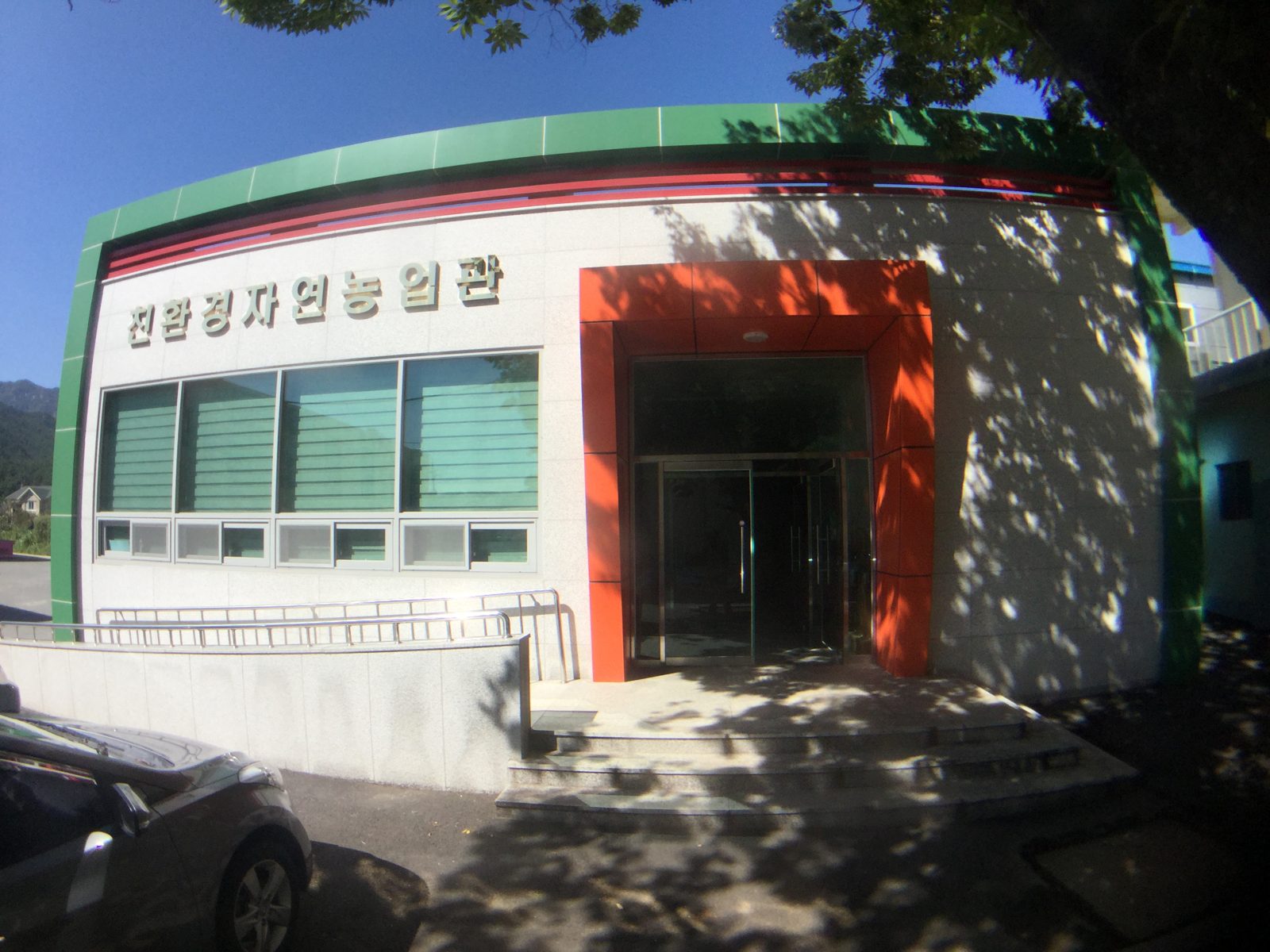
Gokseong County center staff, interpreted into English by Dr. Hoon Park, Gokseong County Agricultural Technology Center, Gokseong, South Jeolla: Eco-Friendly Natural Farming Hall (친환경자연농업관) and natural farming materials greenhouse (자연농업자재창고) · South Korea
Video of this visit will be added to the members' archive. The transcript times below match that recording.
The group's first stop in Gokseong was the county's own natural farming center. Staff showed a mineral-water system: water is pumped up and dropped onto five kinds of stone in a tank, which the guide says adds minerals and oxygen, and a small bag of Microbes (IMO4) adds microbes too. Outside, the county's return-to-farm support center and the start date of its natural farming teaching, 2009, were explained.
What they found
What does a county government's natural farming center look like, and how does its mineral-water system work?
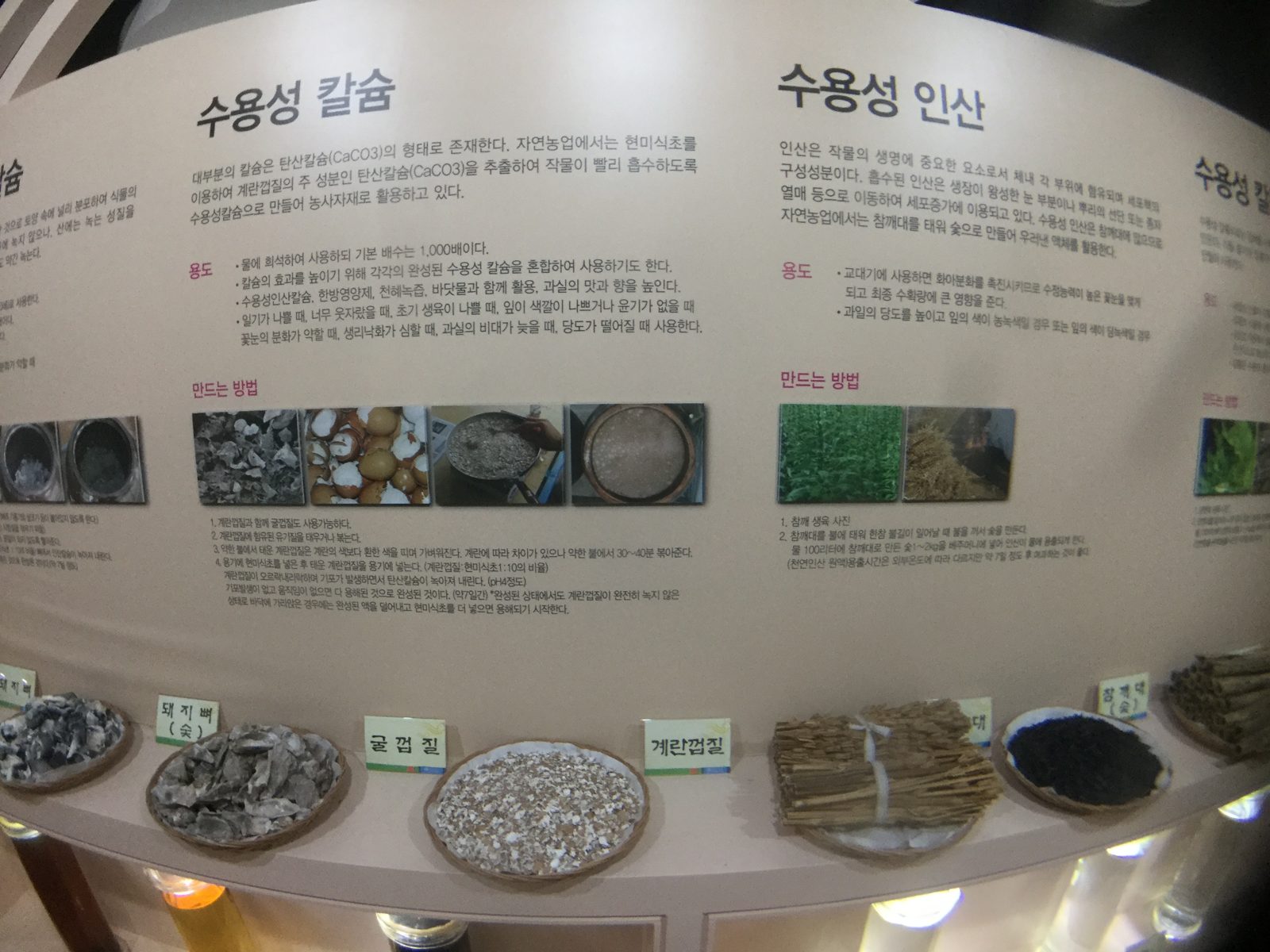
Gokseong County Agricultural Technology Center campus, Gokseong, South Jeolla, early afternoon of October 6, 2016 (stop photos 13:08–14:03). Three parts were seen: the Eco-Friendly Natural Farming Hall, with displays of raw materials and recipe panels and a lecture room; a greenhouse signed 'natural farming materials warehouse' (자연농업자재창고) holding the mineral-water tank, baskets of stone and input-making gear; and, outside, the county's Return-to-Farm and Rural Settlement Support Center (귀농귀촌지원센터) and the county's sprayer trucks (photos only). The county began teaching natural farming in 2009; the building named in the answer dates from 2014. Tank size, drop height, flow, stone names and how the water is used on crops: not stated.
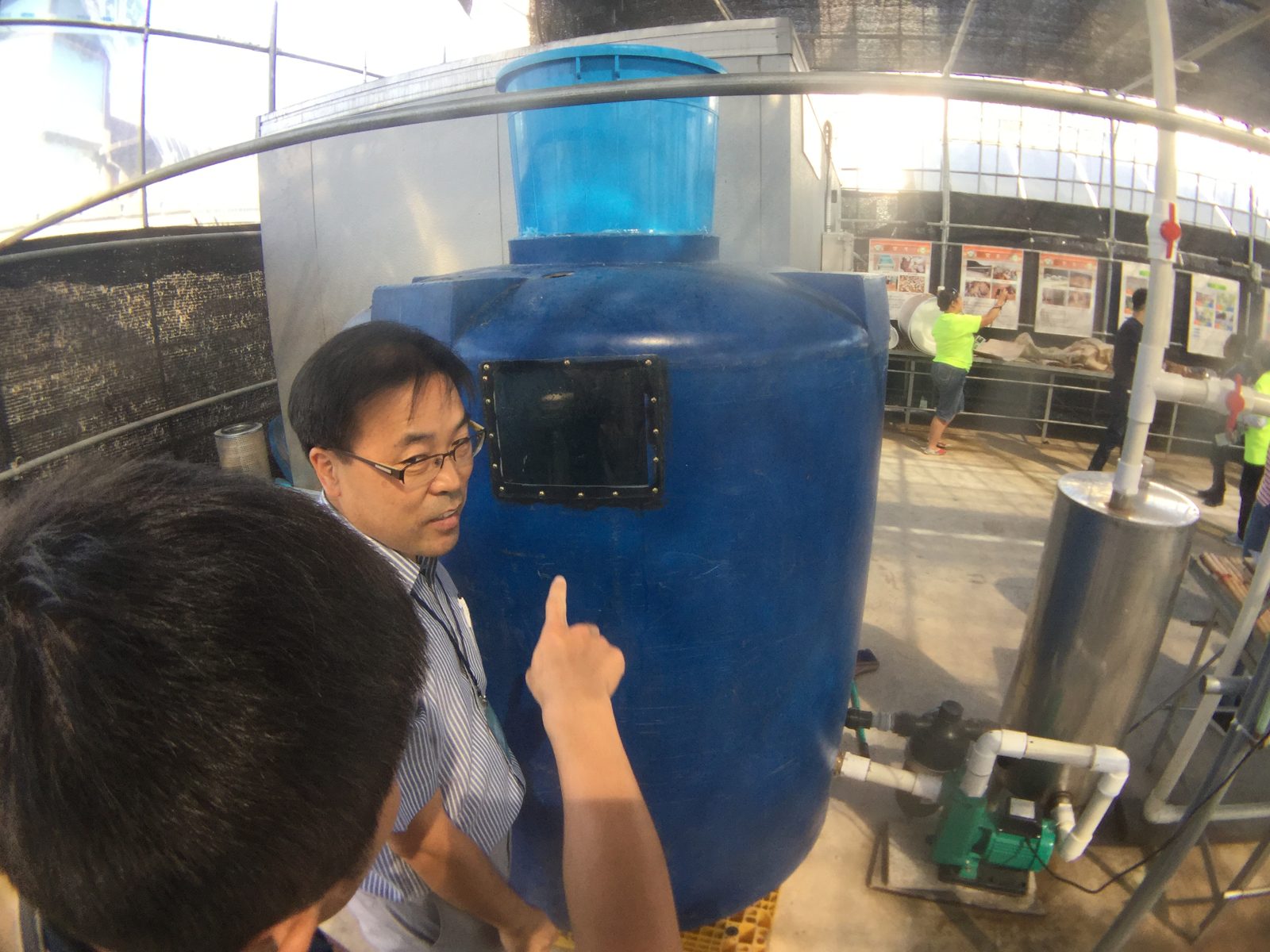
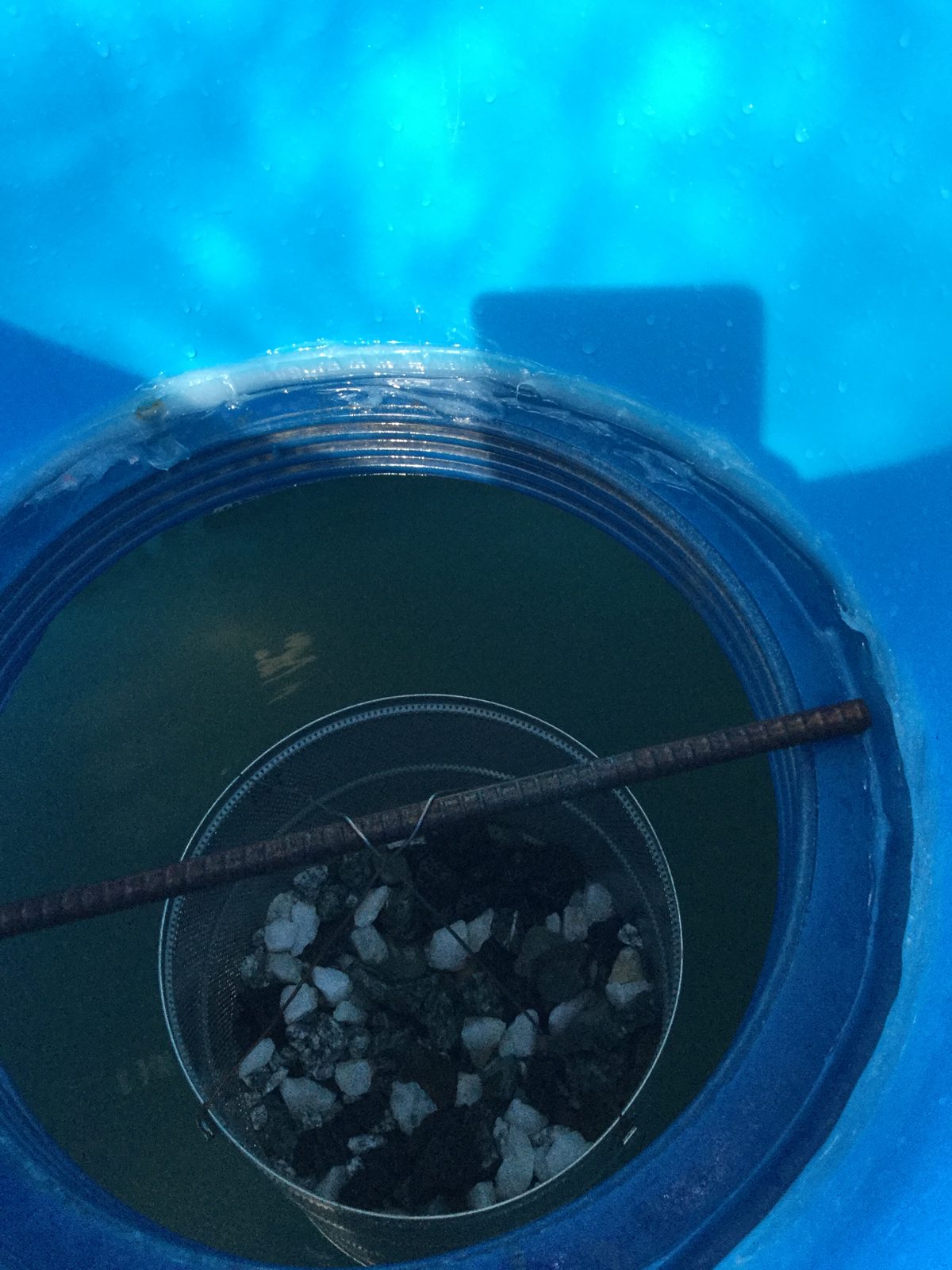
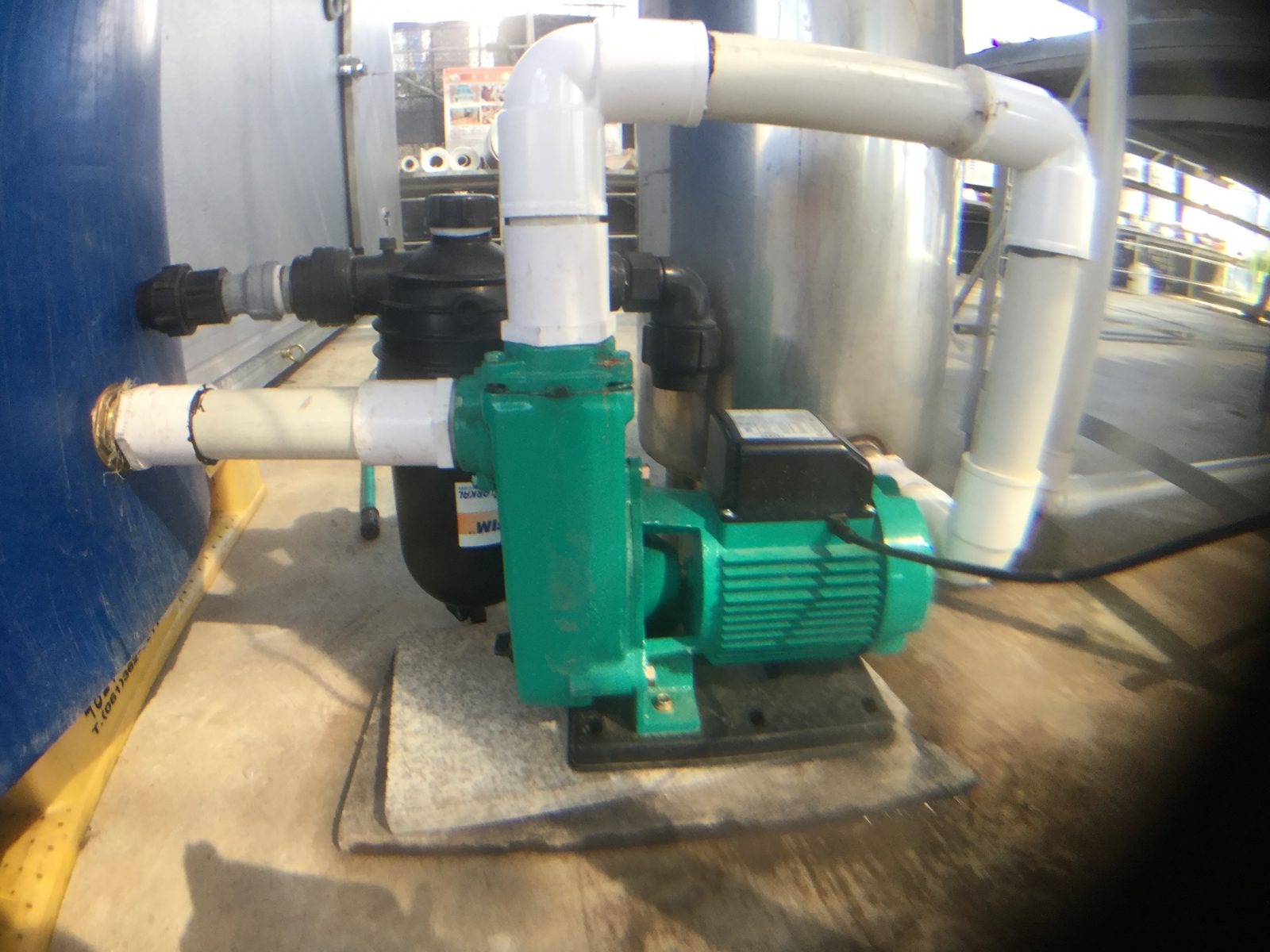
- Mineral water (the uploader calls it BMW) — Ordinary water ('rainwater is the best', per one transcript) is pumped up and dropped onto stones inside a blue tank; the guide says the impact frees minerals from the stone and mixes in oxygen. Water recirculates through the stones until it is needed, then a valve opens a pipe to the farmers. Photos show an electric pump, a timer switch and a mesh basket of stones under the water.
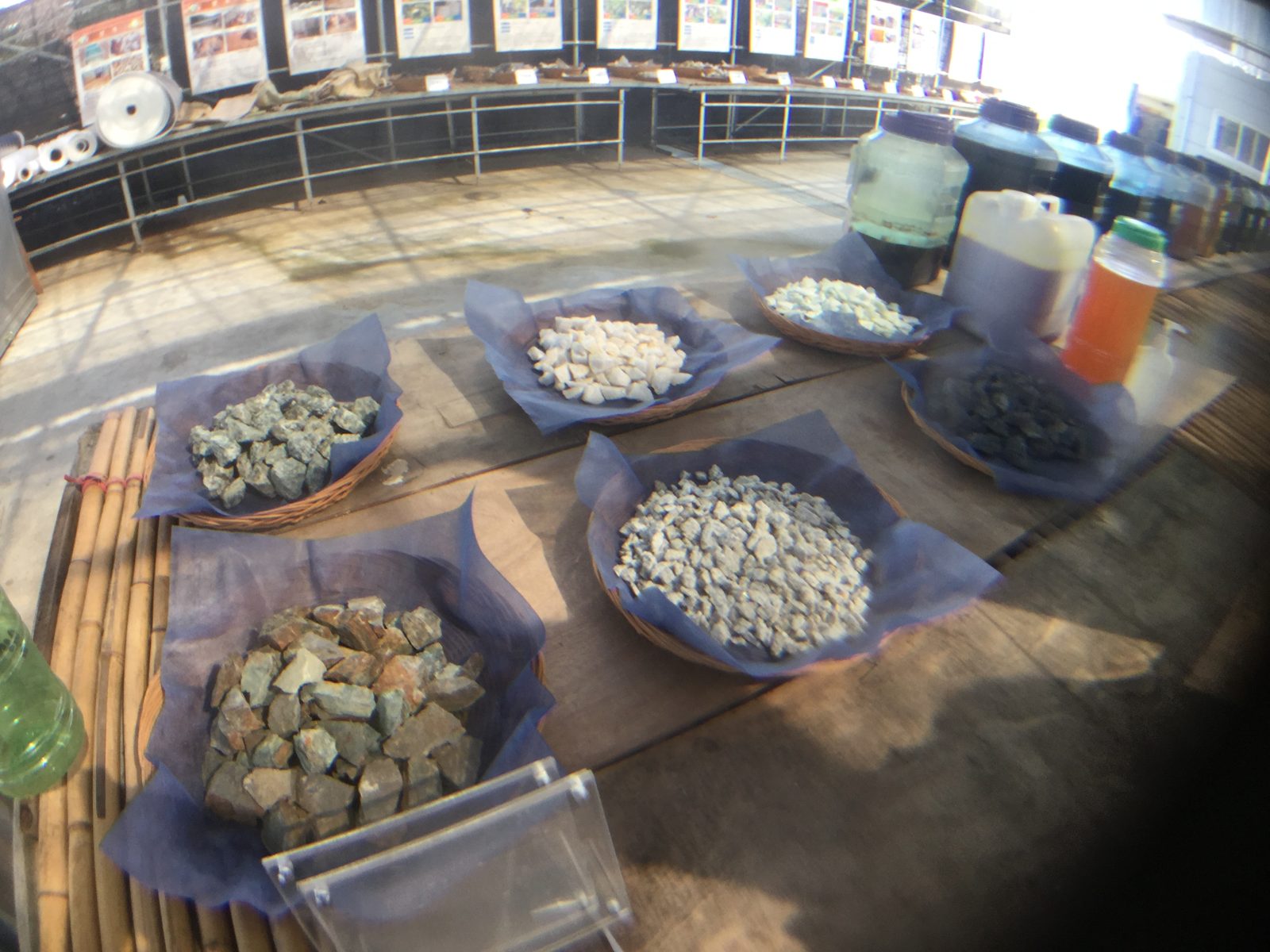
- Stones — Five kinds of stone 'with different minerals' (spoken); granite is named once. Six baskets of broken stone were on the table. The guide did not remember their names and said any mineral-rich local stone will do.
- Microbes (IMO4) in the water — A small bag of IMO4 placed in the tank adds microorganisms to the water as well as minerals and oxygen.
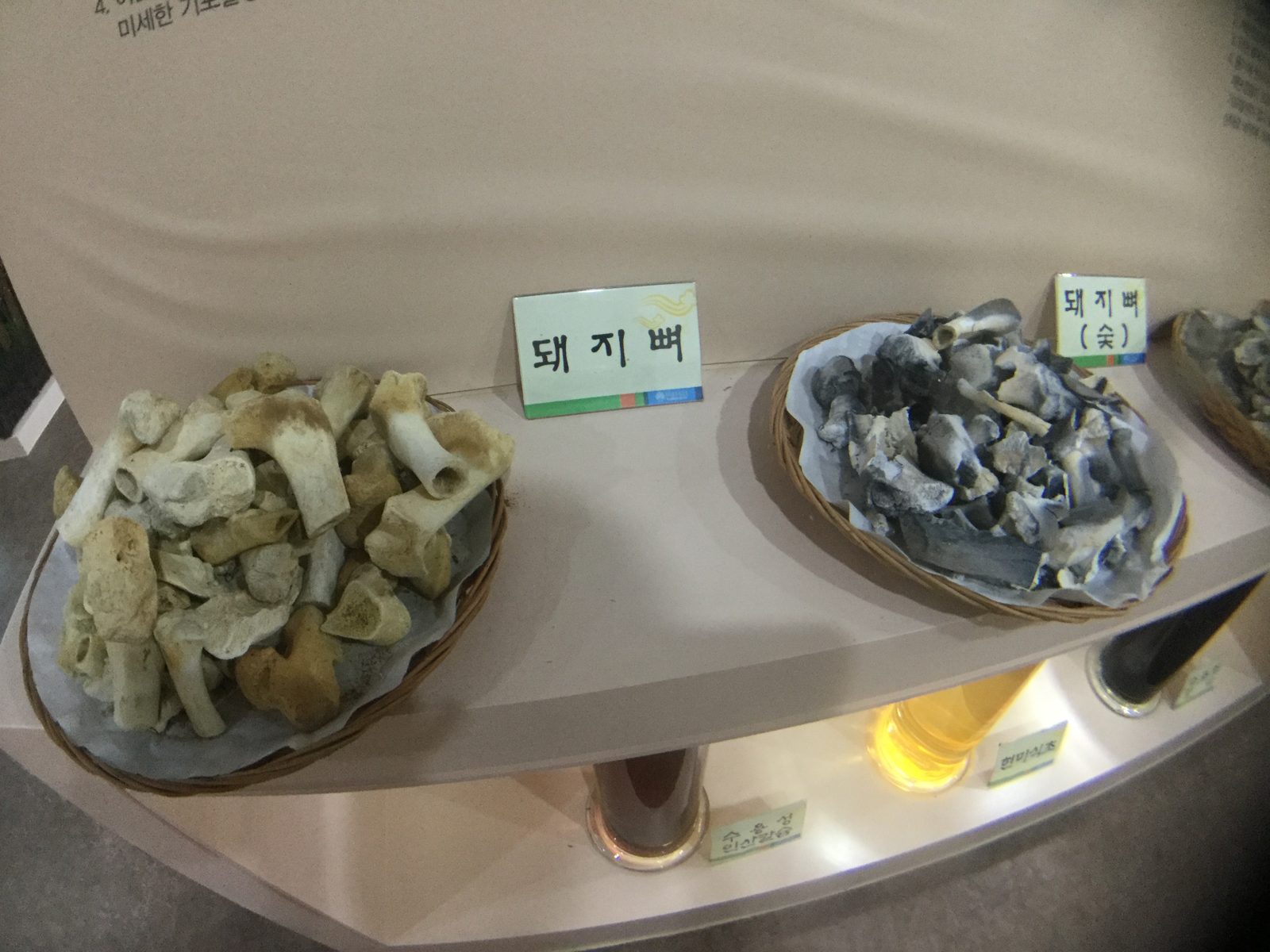
- Hall displays — Recipe panels and raw materials for water-soluble calcium (eggshell, shell), water-soluble phosphate and water-soluble calcium phosphate (raw and charred pig bone), and tall jars of plant material. A spoken line calls one display 'a natural pesticide, not a chemical' and a poster 'the nutritional cycle'.
- Sulfur preparation board (sign only) — A board in the greenhouse shows a sulfur preparation (labels: 유황 sulfur, 가성소다 caustic soda, 황토+천매암+소금 red clay + phyllite + salt). Legible amounts include phyllite powder 500 g, sea salt 1.5 kg, caustic soda 20 kg and water 50 L; the rest is cut off. It was not discussed in the audio.
-
Water dropped onto stone picks up minerals and oxygen
Claimed by the guide while pointing at the tank; no water tests were shown.
▶ 2:29 As spoken
-
Five kinds of stone, each with different minerals
Spoken; six baskets of stone were on the table beside the tank.
▶ 2:58 Said and shown on the slides
-
A bag of IMO4 in the tank adds microbes
'If you put the IMO4 in the small package, then they get the microorganisms too.' The guide calls the result 'medicinal water for the agriculture.'
▶ 3:48 As spoken
-
The water keeps recycling until farmers draw it off by pipe
Spoken; the pipe and valve are visible in the frames.
▶ 4:00 Said and shown on the slides
-
No special Korean stone is needed
'Whenever you go to your own country, you have certain kinds of stone that have lots of minerals.' Use your own area's stones.
▶ 5:36 As spoken
-
The county helps city people start farming
A Return-to-Farm and Rural Settlement Support Center (sign on the building) teaches newcomers and helps with start-up money, per the interpreter.
▶ 6:22 Said and shown on the slides
-
Gokseong began teaching natural farming in 2009; this building is from 2014
Answer given in Korean and interpreted. Talk 17, by Gokseong's Cho Kyung-hoon, also dates the start to 2009.
▶ 7:10 As spoken
- A short walk-through: nothing was measured, and no data on the water (minerals, oxygen, microbes) or on crop results was shown.
- The stones were not named, the drop height and tank volume were not given, and how the water is diluted or applied in the field was not said.
- Most of the audio is the English interpreter; the county staff's own Korean explanations were mostly not captured clearly.
- The hall's lecture-room presentation (photos 13:21–13:27) is not in this edit.
- A mineral-water setup needs only a tank, a pump, broken stone and a drop: water falls onto the stone, picks up air, and recirculates until used.
- Use stones from your own area; break them so the water strikes fresh surfaces.
- Hanging a small bag of Microbes (IMO4) in the water adds a living part to the mix.
- A county office can make and hand out inputs and teach newcomers, which is how Gokseong spread natural farming.
Next to Master Cho's teaching
-
Agrees
Drop water onto broken rock, with IMO4 in a sack Cho's own recipe: a waterfall onto sharp-edged rocks in a mesh sack, with IMO4 in a cloth sack where the water swirls. Gokseong's tank is the same idea in a closed, pumped loop.
Cho, Janong Natural Farming (2010 draft), p. 49
-
Agrees
IMO4 hung in the water adds the 'bacteria' to minerals and water Cho explains BMW as bacteria, minerals from rock, and water, with an IMO4 stack hung in the tank and shaken by the falling water. He wants a free fall of over 3 m; the drop here was not stated.
2018/Cho - advanced hawaii/cho advanced 2018 2-1 @ 2:20:04 (translated)
-
Goes further
Any local mineral-rich stone will do Cho's recipe calls for 'various rocks such as granite'; his 2010 draft says elvan must be included. The guide's 'use your own area's stones' fits the first and skips the second.
Cho, Natural Farming Agricultural Materials (Recipe), p. 93
“And when the water drops from that high, they hit the stone.”
▶ 2:29
“So this is medicinal water for the agriculture.”
▶ 3:56
“Whenever you go to your own country, you have certain kinds of stone that have lots of minerals.”
▶ 5:36
In this talk
- 0:00Into the county center
- 0:15Natural Farming Hall displays
- 0:45Poster room: the nutritive cycle
- 1:15The mineral-water greenhouse
- 2:00How the tank works
- 2:58Five kinds of stone
- 3:38Adding IMO4
- 4:24Which water, which stones
- 5:36Use your own local stone
- 6:00Return-to-farm support center
- 7:01Teaching since 2009
- 8:11Back to the bus
Transcript
English translation, checked against the English as spoken.
0:50 This is natural pesticide. Natural pesticide. No, it's a plant. It's a plant. It's a natural pesticide, not a chemical. And this is a nutritional cycle. If you use according to the nutritional cycle, you can have a very successful crop.
2:00 Medicinal water. This is a water tank. So we fill the water. There is a special stone inside. And when the water drops from that high, they hit the stone. And when they hit it, some minerals from the stone will come out into the water. And also, at the same time, air, oxygen, will go into the water.
2:47 So this water, when they drop, they get oxygenized and mineralized. And they come out through here. And there is another stone. Such a stone, five different kinds. Five different stones. They have different minerals. Okay. So this one is just keep on recycling here. Every time they drop down, they get more oxygen, more minerals from here, because they have a stone inside the...
3:38 If you put the IMO4, then you get not only mineralized plus oxygenized. If you put the IMO4 in the small package, then they get the microorganisms too. So this is medicinal water for the agriculture. So when the farmer doesn't use it, then they keep recycling. They put more oxygen, more minerals into the water. When they need to use it, they open this one; this pipe goes to the farmer.
4:24 So what type of water is this? Just regular water. Rainwater is the best. Oh, you're flooding it. Granite and not granite. I'm sorry, I don't remember each individual name, but they have different kinds of mineral resources, which are very important for the different kinds of minerals.
5:36 Now, you don't have to have a specific, particular stone in Korea. Whenever you go to your own country, you have certain kinds of stone that have lots of minerals. So all you have to use is indigenous, your area's stones, to use for the minerals. Okay? Let's go. ...to the countryside to farm. This is helping them to start it up. Wow. The center there. So they ask for land? No, they ask for how to start farming.
6:22 So this seems to be a return-to-farming center. The return-to-farming center? Yes. The Return-to-Farm and Rural Settlement Support Center. Yes. They give guidance there too. So if some people in the city say, I'm tired of living in the city, then they come down here; the government [helps with] the money to start up with new farming, and they teach how to do that. The government is really helping the people. For how long? Since how long have they established this? He's asking how long it has been here, how many years since natural farming started.
그래서, 여기가 귀농센터인 것 같아요. 귀농센터에요? 네. 귀농귀촌지원센터. 네. 저기도 안내하고 여기 얼마나 됐냐고, 자연농업이 된 지 몇 년 됐어요?
7:10 Natural farming started in 2009, and this building dates from 2014. In 2009, they started teaching this natural farming. This particular building was built in 2014. Two years old. They are very, very encouraging the people to farm. That's what the Korean government tries to do. She's a very good expert in making, the hands-on. She has talented fingers.
자연농업을 시작한 지는 2009년도부터 하고, 이 건물은 2014년도에 했습니다.
8:11 Let's go. Let's go to the bus. Thank you.