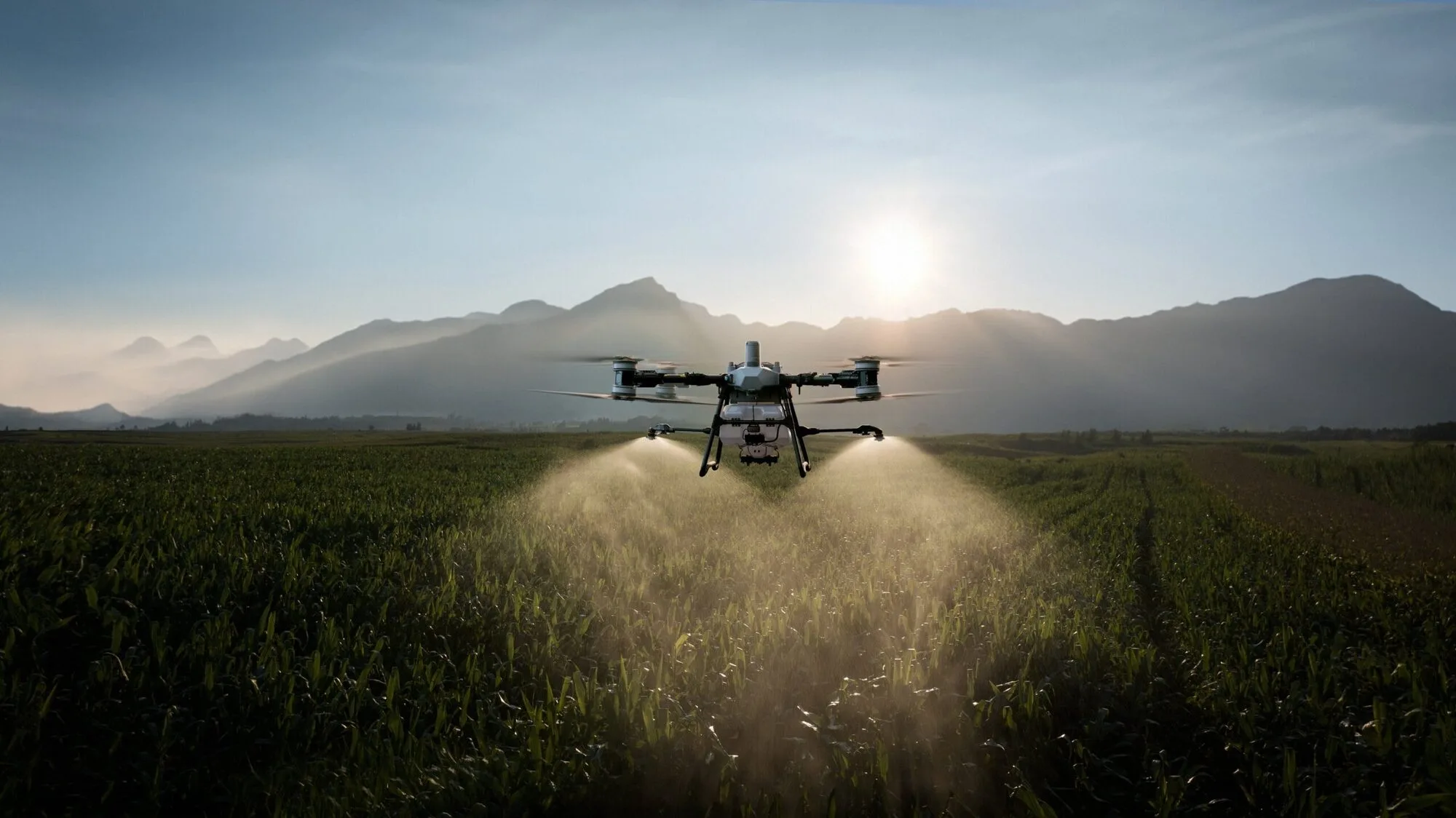
An acre restored every five minutes.
We spent three years proving you can restore land from the sky — 330 flights putting living biology on tired ground around Hilo. It works. The soil comes back. The poison stays off the reef. Now one thing stands between a promising pilot and a working restoration fleet: a faster aircraft. Help us put it in the air.
Founding gifts are being pledged now. The first names on this campaign are the ones that carry it — be one of them.
Become a founding donorThree years in the air
In July 2023 we bought a DJI Agras T40 and asked one question: can you deliver living Korean Natural Farming biology from the air — at full strength, at real-farm scale? That first year we logged 274 flights and sprayed 1,301 gallons across 95 acres: suppressing banana bunchy top virus, restoring pasture on degraded former cane land, and keeping orchard crops fertile on aerial KNF alone.
2024 taught the hard lessons — operator licensing, a repair bill, and what it means to depend on a single aircraft. By late 2025, operations were reliable and flying in service of our research projects. The question is answered. Aerial application of KNF solutions works.
What stopped us: the math of going slow
KNF solutions aren't a chemical mist. They're living biology delivered in volume — our standard is 25 gallons per acre, ten times what a conventional spray drone puts down. At that rate the T40's 40-liter tank is empty in less than half an acre, and to pump it all out we have to crawl along at four feet per second. Land, refill, swap battery, launch, repeat. Measured across our flight logs: an acre every 20 to 25 minutes, all in — about a dozen acres on a strong day.
That's the whole bottleneck. Not the biology — that works. Not the demand — farmers keep asking. Just throughput.
The leap: a four-nozzle T100
The DJI Agras T100 in its four-nozzle high-flow configuration carries two and a half times the liquid (100 liters — a full acre in one sortie) and pumps it out at 40 liters a minute, DJI's published spec — 3.3 times the T40's pump. Its batteries recharge in eight to nine minutes off a field generator, so three batteries in rotation keep it flying all day without a pause.
Run the same equations that match our T40 flight logs and the T100 pencils out at about 8 minutes per acre against our measured 20 to 25 — call it 33 acres a day from one aircraft, with good days past 40. And the trailer, deck, and certification this campaign funds are sized for two aircraft: a pair of T100s with a full deck crew puts an acre down about every five minutes.
| Spray cadence | Our T40 today | One T100 | Two T100s |
|---|---|---|---|
| Acres covered per flying day | ~12 | ~33 | ~65 |
| Acreage served on a weekly cycle | 60 | 165 | 325 |
| Acreage served every other week | 120 | 330 | 650 |
| Acreage served on a monthly cycle | 250 | 690 | 1,370 |
Modeled at 25 gallons per acre, a 6-hour spray window, 75% wheels-turning utilization, 5 flyable days a week — and calibrated against 330 logged T40 flights. This campaign funds the first T100; the ground rig it rides on is built for the second.
Show the math
- Acres per sortie = tank ÷ application rate. At 25 gal/acre (94.6 L): T40 = 40 L ÷ 94.6 = 0.42 acres. T100 = 100 L ÷ 94.6 = 1.06 acres.
- Spray minutes per sortie = tank ÷ pump rate. T40 = 40 ÷ 12 L/min = 3.3 min. T100 = 100 ÷ 40 L/min = 2.5 min.
- Turnaround per sortie (ferry, land, battery swap, refill, launch): our T40 logs average an acre every 20–25 minutes, which backs out to ≈6 minutes of turnaround per sortie. We hold the T100 to that same 6 minutes — moving 2.5× the liquid — because fast refills are exactly what the trailer is designed for.
- Minutes per acre = (spray + turnaround) ÷ acres per sortie. T40 = (3.3 + 6.2) ÷ 0.42 ≈ 22.5 min (matches the logs). T100 = (2.5 + 6.2) ÷ 1.06 ≈ 8.2 min.
- Acres per day = 6 flying hours × 75% utilization ÷ minutes per acre. T40 ≈ 12. T100 ≈ 33.
- The honest range: the pump is 3.3× faster while spraying, but turnaround doesn't shrink with it — so the whole-cycle gain is 2.7×, approaching 3.6× if the deck crew turns the aircraft in under 4 minutes. We plan on 33 acres a day and treat anything more as a good day.
The cost of standing still
Without a faster aircraft, the program idles at three acres an hour on one aging T40 — a single point of failure, one hard landing from grounded. The farmers who keep calling stay on a waiting list. The cane land stays bare. And every acre we don't cover keeps drinking imported chemistry that ends up on the reef. The biology is proven. The demand is standing in line. The only thing missing is throughput.
Bigger than fertilizer
Every gallon we fly replaces synthetic inputs on land that drains, in a few short miles, straight to the reef. On this island there is no away — what goes on the pasture ends up in the ocean. Spraying living microbiology instead of imported chemistry restores the soil, feeds the watershed, and cleans what flows to the sea. This is ecological restoration with wings: reviving degraded cane land, suppressing plant disease without poison, and growing food that's healthy for the farmers who raise it and everyone who eats it.
And it rebuilds an economy while it works. Hawaii farmers pay $400–$800 an acre for imported fertilizer; KNF solutions brewed from local inputs cost 60–70% less. The industries this fleet can carry are the backbone of East Hawaii agriculture:
- Pasture & cattle — restoring grass on thousands of acres of former cane land
- Papaya, sweet potato & banana — staple crops fighting disease and input costs
- Macadamia, coffee & cacao — orchard crops holding fertility on biology alone
- Kava, lychee, longan & rambutan — the tropical crops that make this coast unique
Every acre gets documented. Our research partnership with the University of Hawaii turns each flight into data — peer-reviewable evidence of what biological inputs do for yield, soil, and cost.
From one trailer to the whole island
The trailer this campaign funds is a mobile airbase — a pod of two aircraft, a deck crew, tanks, and pumps that goes wherever a truck can tow it. Parked at our Papaikou base, one pod puts 1,370 acres a month inside a regular spray cycle. Here's what that looks like on the island, and what it takes to grow from one pod to full coverage:
- ● Papaikou home base — solid ring is the day-trip service zone this campaign opens (≈15 mi, roughly matching our free RTK coverage)
- ⎊ Dashed orange ring — the 30-mile reach of a full two-aircraft pod, Laupahoehoe to Volcano to Kapoho
- ○ Future pod bases — Waimea, Kona, and Kaʻū, each serving its own 15-mile zone
Island outline from the US Census Bureau county boundary; rings drawn to scale. Zones are illustrative — the trailer serves any farm a truck can reach.
And the acreage is not a guess. The State of Hawaiʻi maps every farmed acre in its Statewide Agricultural Land Use Baseline (2020 update). Here is Hawaiʻi Island's actual footprint, against what it takes to serve each crop on a monthly spray cycle:
| Crop on Hawaiʻi Island | Acres (2020) | Pods to serve it monthly |
|---|---|---|
| Banana | 599 | this pod, one aircraft |
| Flowers, foliage & landscape | 1,538 | 1 |
| Papaya | 3,207 | 2–3 |
| Tropical fruits | 3,311 | 2–3 |
| Diversified crops | 4,343 | 3 |
| Coffee | 6,028 | 4–5 |
| Macadamia nuts | 21,405 | 16 |
| All cropland outside forestry | ≈41,500 | ≈30 |
| Pasture | 552,091 | the long game |
What would cover the whole island?
That's the question this pilot is built to answer. One crew is a two-drone pod — the exact rig this campaign funds — and it treats 325 acres a week. So covering every farmed acre on Hawaiʻi Island comes down to simple division:
| Treat every acre… | All cropland ≈41,500 ac |
Cropland + pasture ≈594,000 ac |
|---|---|---|
| Once a month | 30 crews | ~420 crews |
| Every other week | 64 crews | ~915 crews |
| Every week | 128 crews | ~1,825 crews |
One crew = one two-drone pod = 325 acres/week. Cropland excludes the 20,921 acres of commercial forestry, which isn't sprayed. Pasture is 90% of the island's farmland — and in practice takes a lighter, seasonal cadence, so the real "treat everything" number sits between the two columns, not at the top of the pasture one.
So the road from here is short and countable:
- This campaign — $314,000. The first T100 and the pod built to carry two: 690 acres a month from the Papaikou base — every banana farm on the island, with room to spare.
- The second aircraft — about $55,000. Completes the pod at 1,370 acres a month: all of the island's papaya and banana inside a quarterly rotation.
- A crew per district — about $350,000 each. Puna, Hāmākua, Kaʻū, Kona. Four crews put every orchard crop on the island inside a quarterly cycle — and each one sustains itself on fee-for-service by its second year.
- Full cropland coverage — 64 crews. Every food and orchard acre on the island under living biology every other week. That's the number this pilot is proving the model for.
- The horizon. Beyond the cropland wait 552,000 acres of pasture — the vast majority of the island's farmland, and the decades-long prize.
Built to pay its own way
Year one, applications are free — participating farms pay only for materials while we gather the data. Year two, the program becomes a fee-for-service operation at a fraction of what farmers spend today, and the fleet sustains itself. We run lean: an all-volunteer committee structure, under budget two years running, backed by the ARIA Foundation and a membership that grew 47% last year. We've been trusted with small budgets and delivered. This is the big one.
What it takes
This is a complete flying restoration operation, not just an aircraft: the drone in its high-flow configuration, batteries and a field generator, a support trailer with tanks and pumps, a truck to pull it, a certified pilot and ground operator, FAA Part 137 certification, insurance, and freight to Hilo. Real numbers, researched July 2026:
| Line item | Cost |
|---|---|
| DJI Agras T100 ready-to-fly kit (3 batteries, charger) | $39,999 |
| Four-nozzle high-flow spray kit | $2,400 |
| 4th flight battery + field generator | $7,000 |
| Drone support trailer — tanks, pumps, flight deck | $45,000 |
| Truck lease, one year | $17,000 |
| Pilot + ground operator, one year | $170,000 |
| FAA Part 137 certification & exemptions | $4,500 |
| Insurance — liability, chemical, hull | $12,000 |
| Ocean freight to Hilo | $12,000 |
| Contingency & spares | $4,101 |
| Year One, all in | $314,000 |
Read the table closely and you'll see it: the aircraft is $40,000. The other $274,000 is what it costs to fly it five days a week for a year — a certified pilot and ground operator, insurance, FAA certification, and the rig that keeps it fed. We'd rather show you the real number than sell you a drone that sits in a shed.
From the founder
In July 2023 we put our first drone in the air not knowing if living biology would even survive the pump. It did. Since then I've watched banana disease knocked back without poison and dead cane land turn green from a tank of brewed microbes. We broke things. We fixed them. We got licensed, got insured, and learned exactly what a real operation costs — that education is itemized in the table above. We've been trusted with small budgets and delivered every time. This is the big one. Help us fly it.
— Drake, Pure KNF Foundation
Put it in the air
Founding Fleet Sponsors
For Hawaii businesses and major donors: gifts of $25,000 and up put your name on the support trailer and your brand behind every acre this fleet restores. Read the funder's brief or write foundation@pureknf.org to start the conversation.